
Current Reports

Small Multifamily Investment Trends Report Q2 2026

Arbor Realty Trust’s latest Small Multifamily Investment Trends Report, developed in partnership with Chandan Economics, evaluates what’s driving this sector’s ongoing stability as macroeconomic conditions remain mixed. Loan originations rose last quarter, and valuations are rebounding, signaling that normalization is taking hold.

Articles

Where Labor Market Momentum Outpaces the National Average

Labor market conditions are a foundational driver of rental housing demand, influencing tenant stability and household growth. While the national pace of hiring has moderated, the economies of many metropolitan areas continue to outperform. Expanding on Arbor’s latest Top Markets for Multifamily Investment Report, our research teams highlight the local dynamics supporting growth in several of the country’s strongest-performing multifamily markets.

Analysis

U.S. Multifamily Market Snapshot — May 2026

The U.S. multifamily sector continued to build momentum at the start of 2026. Rent growth moved into positive territory, and a moderating construction pipeline showed that vacancy may have reached its cycle peak.

Articles

Fannie Mae, Freddie Mac Rank Arbor Among Top Multifamily Lenders for 2025

Arbor’s track record of top finishes across multifamily agency rankings reflects the depth of our financing capabilities, the strength of our industry partnerships, and our disciplined, detail-driven approach to execution. Longstanding relationships with Fannie Mae, Freddie Mac, and the Federal Housing Administration (FHA) — built over many years of close collaboration — enable our team to deliver strong borrower outcomes across market cycles, reinforcing Arbor’s position as one of the top multifamily lenders in 2025.

Articles

Senior Renters Prefer Multifamily Housing and City Living

Senior renters are increasingly choosing multifamily housing, with more than half now living in these rental properties, according to new data from the U.S. Census Bureau’s American Community Survey. Where they live — both by property type and by metropolitan area — provides insight into how housing preferences, local market conditions, and migration patterns shape rental housing demand.

Articles

Arbor’s Tree Planting Program Spans Four Decades and Two Continents

Arbor is proud to have planted thousands of trees in the past 40 years – nearly 22,000 in the past five years alone – and we’re still going strong. Since day one, Arbor’s focus on community-building, which grew from the forward-thinking vision of Chairman, CEO, and President Ivan Kaufman, has defined the company’s direction and driven its philanthropic activities.

General: 800.ARBOR.10

2020 Large Multifamily Investment Report:
Top Opportunities

Overview

The U.S. economy was gliding into 2020 along a path of consistent yet unspectacular growth. After more than a decade of expansion, multifamily asset pricing remained exceptionally tight, with investors searching for yield in secondary and tertiary markets. When the full magnitude of the COVID-19 pandemic hit the U.S. in March, it became readily apparent that the multifamily sector would see a recessionary reshuffling of fundamentals, in a pace unrivaled in recent history.

This report develops an analytical framework to predict where large multifamily investment opportunities will be most abundant in the year ahead. Through the use of an opportunity matrix, the top 50 U.S. metros are ranked based on a composite blend of performance metrics. The analysis pays specific attention to how local economies have fared during the pandemic and how multifamily investment activity performed. The top 50 metros are based on population estimates. All metros are reported at the Metropolitan Statistical Area (MSA) level.

Key Findings

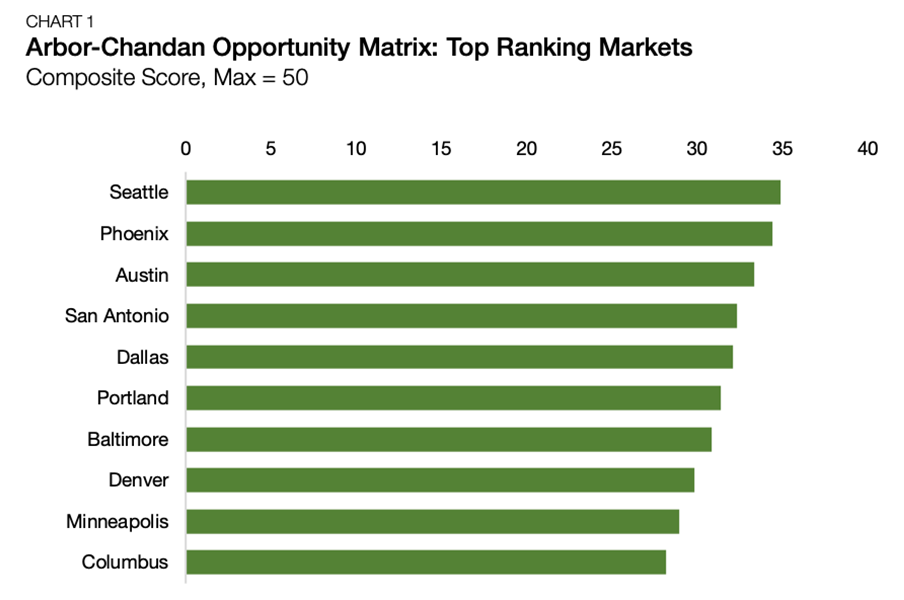
  • Seattle tops the Arbor-Chandan Opportunity Matrix.
  • Phoenix and Austin follow closely behind, benefiting from resilient labor markets.
  • Texas metros, led by Dallas and Houston, continue to capture an outsized share of large multifamily investment activity.

Opportunity Matrix

The 2020 Arbor-Chandan Large Multifamily Opportunity Matrix features eight categorical criteria: levels of large multifamily loan volume, levels of multifamily construction, labor market size, labor market performance during COVID-19, mobility trends, renter performance and sentiment, renter preferences and an assessment of COVID-19 risk. These variables account for many of the considerations that investors would make before deploying capital.


All eight categories receive equal weighting. In categories with more than one data field, each indicator receives equal weight. (For a full breakout of the Opportunity Matrix, see Table 1.)

Top Ranked Markets

Rising to the top of the 2020 rankings is Seattle, Washington (Chart 1). Seattle finds itself at the top of the list for several reasons, though none are more apparent than its all-around consistency. Measured across all 18 indicators that filter into the composite matrix, Seattle never sinks below the 31st rank in any one component. In short, it performs exceedingly well in critical areas, such as wage growth, employment growth and COVID-19 risk assessment, while never performing much worse than average across the board. These results follow a recent Wallet Hub Report, which similarly ranks the Seattle metro as the country’s top real estate market. 

Other cities rising near the top of the matrix rankings include Phoenix and Austin. Both combine better than average COVID-19 risk assessments, robust pipelines of incoming multifamily supply and ample liquidity. According to a 2019 Apartment List Study, of the top 15 U.S. MSAs, Phoenix has the lowest share of millennials on track to transition into homeownership within the next five years – a market feature that should support demand for rental housing even as homeownership rates rise nationally.


Well before the great “work from home experiment” of 2020, household preferences were already rapidly shifting. Maturing millennial households have a growing desire for mixing the amenitization of Class A multifamily while also enjoying the space of the suburbs. Metros that are less space-constrained and can add ample, garden-style multifamily offerings with convenient access to urban job centers are well-positioned to capture transitioning demand. According to a recent report published by CREXi, Phoenix and Austin are two of the country’s best markets for suburban multifamily performance.

COVID-19 Risk Assessment

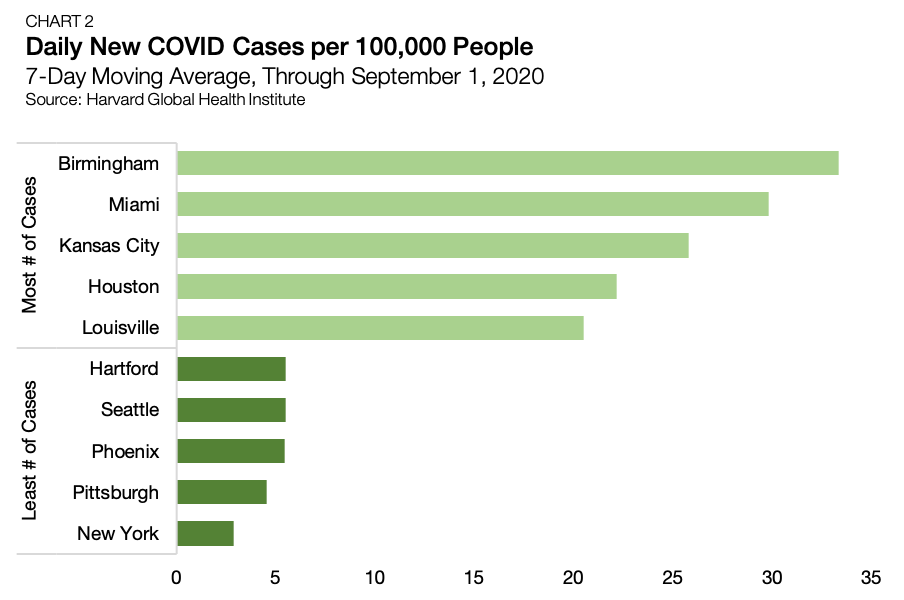
If the year to date has imparted any lasting wisdom, it’s that meaningful economic growth is impossible without first containing the risk of COVID-19’s local spread. Thus, this report leverages the Harvard Global Health Institute’s COVID Risk Assessment Model, which tracks the number of confirmed positive cases in the last seven days per 100,000 people. The metro areas with the lowest COVID-19 risk factors share several commonalities. In this respect, the best performing metros are New York, Pittsburgh, Phoenix, Seattle and Hartford (Chart 2).

Excluding Phoenix, these metros were all among the earliest examples of community spread in the U.S. Nevertheless, all five have their first wave peaks solidly in the rearview and have managed to suppress a second wave to date. Birmingham sits on the other side of the COVID-19 risk spectrum, followed closely by Miami and Kansas City. At 33.3 cases per 100,000 people, Birmingham’s case density is more than 11 times higher than that of New York City.

Renter Performance

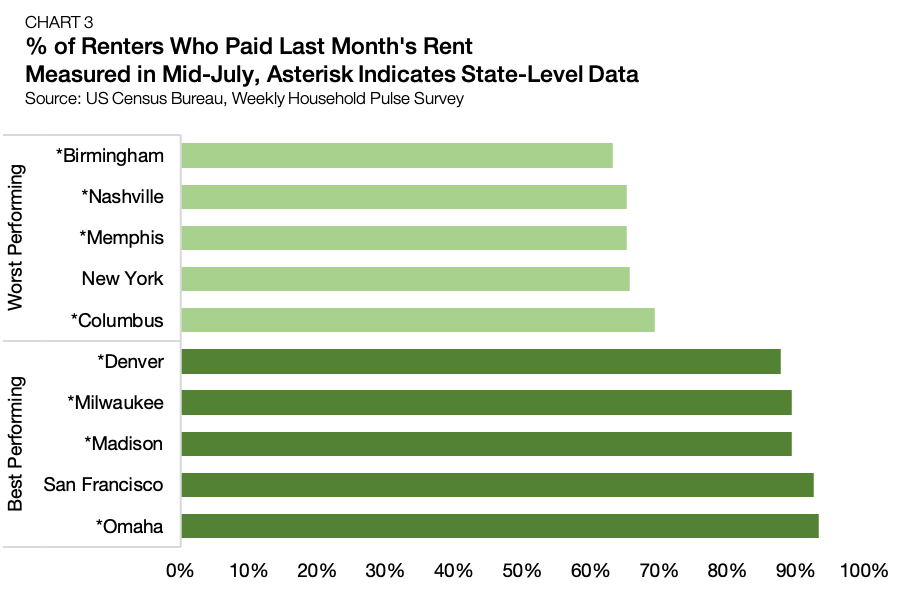
COVID-19 went from a distant news item to an immediate threat to most American household finances at breakneck speed. To capture the pandemic’s effects in real time, the U.S. Census Bureau launched the Weekly Household Pulse Survey. While phase one of the measurement period concluded in mid-July, we use the last week of the survey to capture how well renters in different metro areas were weathering the storm and meeting their monthly rent obligations. The Census Bureau reports data nationally, statewide and for the top 15 metros. In metro areas where there is no data coverage, we substitute state-level data.


Apartment renters in Omaha were outperforming all other tracked metros, with the share of renters who reported making their previous month’s rent payments at 93.3%, well above the national average of 79.2% (Chart 3). The San Francisco Bay Area came in a close second with 92.6%. Birmingham counted the lowest share of renters meeting their payments with just 63.2% reporting in July.

Large Multifamily Investment

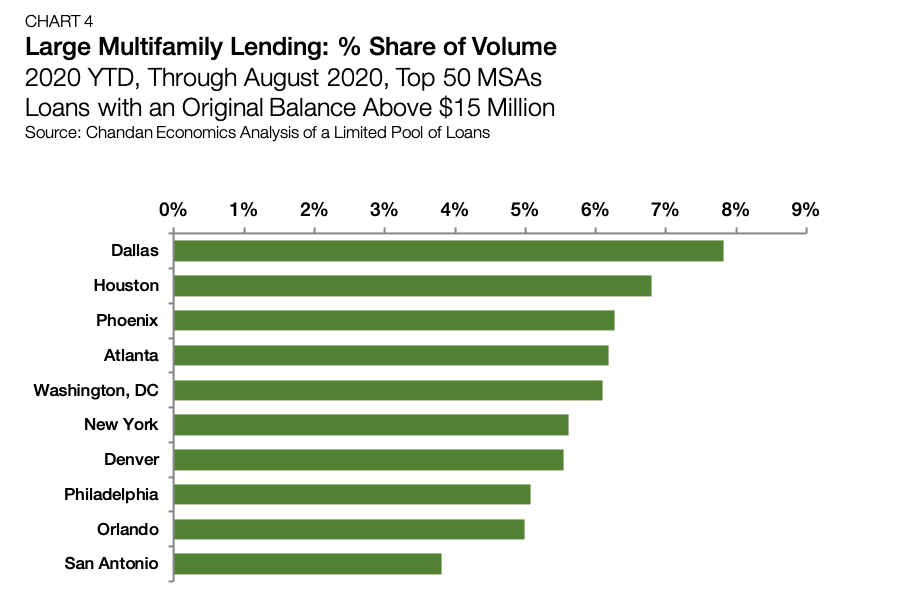
Multifamily investment across U.S. markets is anything but uniform. Differences exist along the lines of urban density, labor composition, geography and economic fundamentals. Moreover, in 2020 there is the added layer of the pandemic risk. Investors are considering where the virus might move, the preparedness of localities, and the “stickiness” of demand in the event of an outbreak. We analyze a limited pool of loans originated year-to-date through August 2020, with original balances above $15 million and across the top 50 metros. Lending volumes include loans originated for both investment sales and refinancings. They are used here as a proxy for where market-level liquidity and total investment activity have held up amid the coronavirus turbulence.


Leading the way and accounting for 7.8% of all tracked lending volume is Dallas, Texas (Chart 4). Reportedly, rental collections in Dallas have held up better than expected, and the local multifamily market is already transitioning out of its “wait and see” mode as deal closings are once again on the uptick. When measuring by loan count instead of dollar volume, Dallas similarly leads our sample, picking up 7.9% of the total (Chart 5).

Measured both ways, Houston and Phoenix follow closely behind in second and third positions. While not unscathed, Houston has continued to enjoy well above average economic success compared to most other metros, with a critical dependence on industrial, logistics and healthcare occupations that have buoyed the city’s resiliency. Texas, led by Dallas, Houston and San Antonio, is the only state to have more than one metro reach the top ten. Taken together, these three Lone Star state metros account for 18.4% of the sample’s large loan lending volume and 19.0% of the loan count. 


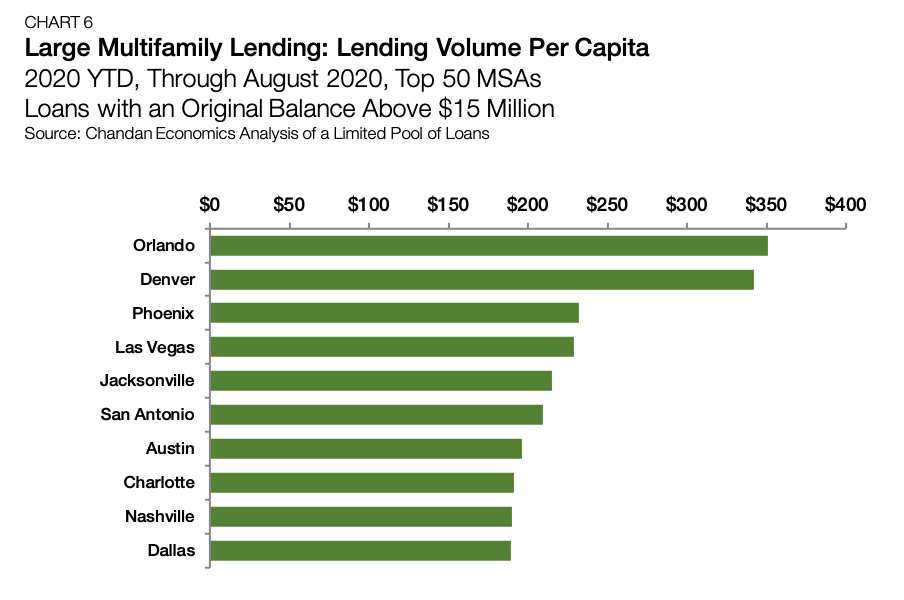
We also track lending volume per capita (or the total number of large multifamily lending dollars per person in each MSA). This measurement normalizes the results and accounts for population differences, allowing for an “apples to apples” comparison. Rising to the top of the rankings are Orlando and Denver. In our sample, these two metros capture $350.97 and $342.05 of lending volume per MSA resident, respectively. This is well above the average set  across the top 50 of $103.36 per resident (Chart 6).

Market Spotlight: Seattle

Seattle rises to the top spot in our 2020 rankings, driven by a diverse set of favorable macroeconomic conditions. As COVID-19 arrived in the U.S. earlier this year, the state of Washington immediately found itself in the spotlight. When a nursing home in Kirkland, an eastside suburb of Seattle, became the nation’s first known case of community spread, Seattle’s economic outlook dimmed. 


Despite its dark spring, the Emerald City is already regaining its glisten. By September 1, Seattle charted as the fourth lowest-risk area in the top 50, according to the Harvard Global Health Institute’s COVID Risk Map. After establishing the most comprehensive statewide database in the country, Washington state bolstered its prowess in testing and tracing cases, helping its economy recover quicker and more sustainably than its fellow compatriots.


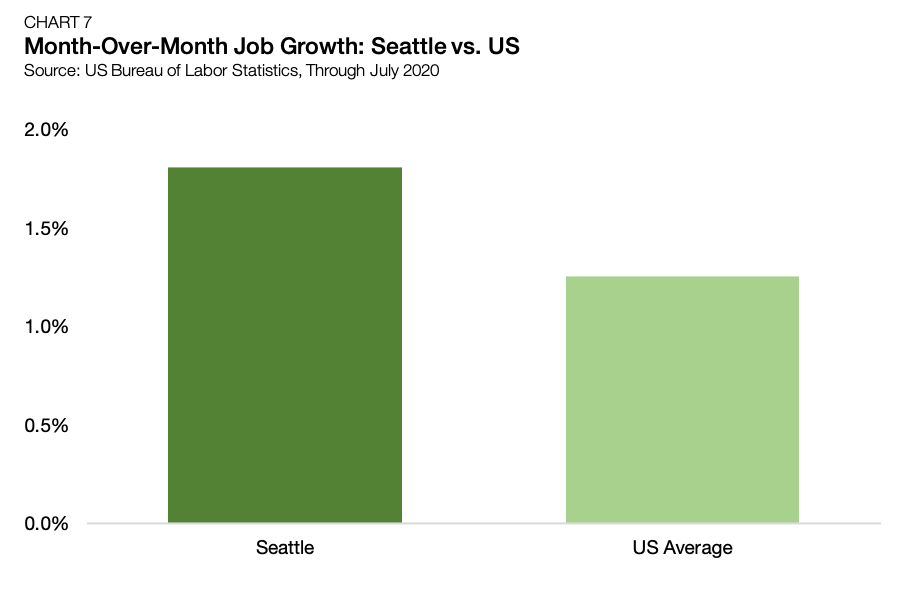
Before the recession, Seattle led all U.S. cities in local wage growth, registering a weighty 7.4% year-over-year increase, sustained in large part by the city’s tech industry. Seattle’s relative dominance in tech and other STEM-area job growth has attracted a wave of higher-earning renters, benefiting its multifamily sector. Through July 2020, the Seattle MSA was back to growth, with employment jumping 1.8% month-over-month, edging out the national average by more than half a percent. This was calculated using seasonally-adjusted metrics measured by the U.S. Bureau of Labor Statistics (Chart 7).


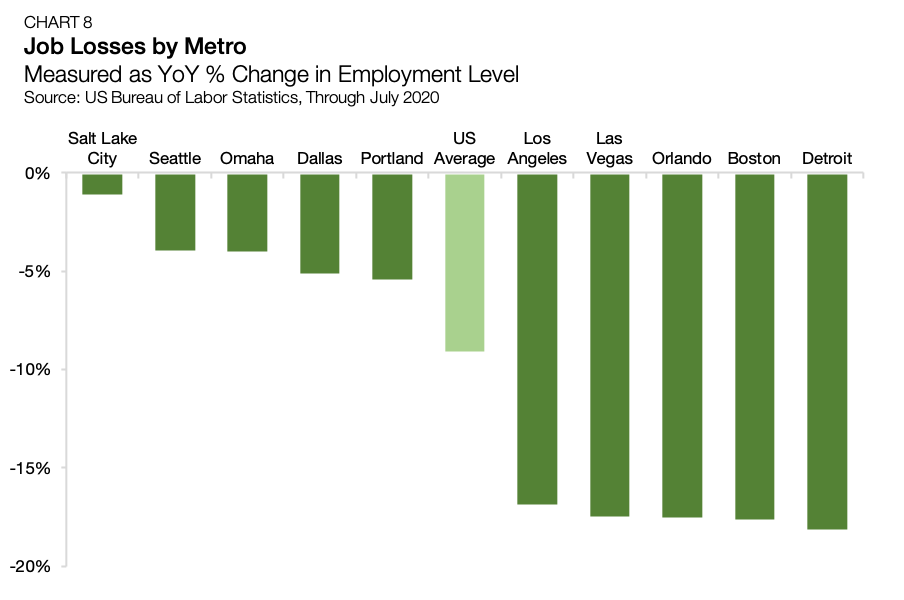
While no metro labor market was spared from the pandemic-provoked crisis, by June, Seattle’s employment base was down only 4.0% from the prior year. Similarly sized cities did not fare nearly as well. Detroit, comparable in size and growth to Seattle before to the recession, suffered the worse job losses nationwide. Its employment base shrank by an incredible -18.2% from a year ago (Chart 8). Meanwhile, Minneapolis and Phoenix, which ranked closely behind Seattle in the final rankings, saw more muted job losses of -5.8% and -6.3%, respectively.


Rental demand remains more resilient in Seattle compared to other cities, supported by a durable labor market in a housing landscape with relatively limited available supply. As cities from coast to coast experienced an uptick in vacancies from large outflows out of city centers, Seattle proper saw apartment inventory fall during the pandemic. According to Zillow research published in August, for-sale inventory in the urban center dropped by an annualized 20.0% from February to May.


While our metro-level analysis covers the impact on both the urban core and its surrounding areas, like other cities across the country, Seattle’s urban core is still facing concerns of an exodus. As pandemic-related fears have some renters eyeing a flee to the suburbs, Seattle residents are staying put in higher numbers compared to other large cities. According to metrics gathered by Apartment List, urban renters searched outside of their home-city at an average of 31.0% nationwide. Meanwhile, Seattle residents searched outside of the city just 20.7% of the time, placing it in the top quartile of inner-city searches among the metros in the study.


The impact of the virus will continue to ebb and flow as the situation evolves in each city. Even as the crisis wanes in certain regions of the country, it will still take some time for growth to return to pre-pandemic levels. Nevertheless, the state of Washington continues to have one of the more methodical approaches to handling the turbulence and the economics of the Seattle area were a supportive tailwind heading into COVID-19. Across the top 50 U.S. metros, Seattle is best positioned to attenuate the downside risks and offer upside.

Outlook

The coronavirus will continue to create a unique set of challenges for multifamily operators and investors for the foreseeable future. Of course, where there are changes and disruption, there is also opportunity. Metropolitan areas with healthy labor markets and the development economics to support horizontal, well-styled apartment communities are strategically positioned to add supply that captures migrating demand. While headlines suggest that urban households are flocking to exurban alternatives, many highly urbanized metros, led by Seattle, are improving fundamentals and outcomes despite macro headwinds.

For more multifamily research and insights, visit arbor.com/blog

Disclaimer All content is provided herein “as is” and neither Arbor Realty Trust, Inc. or Chandan Economics, LLC (“the Companies”) nor their affiliated or related entities, nor any person involved in the creation, production and distribution of the content make any warranties, express or implied. The Companies do not make any representations regarding the reliability, usefulness, completeness, accuracy, currency nor represent that use of any information provided herein would not infringe on other third party rights. The Companies shall not be liable for any direct, indirect or consequential damages to the reader or a third party arising from the use of the information contained herein.