Current Reports

Single-Family Rental Investment Trends Report Q1 2026

Arbor’s Single-Family Rental Investment Trends Report Q1 2026, developed in partnership with Chandan Economics, spotlights how market shifts, including the rising cost of living and historically high build-to-rent activity, have fueled record rental household growth.

Articles

Top Markets for Multifamily Building Permits

Multifamily permitting trends indicate continued national stability amid local recalibration. Across the country, issuances were steady, rising just 2.6% in 2025. At the metropolitan level, trends diverged sharply, with some markets accelerating and others pulling back. Per-capita leaders continued to cluster around high-growth Sun Belt and regional hubs, while year-over-year market-level fluctuations suggest that more pipelines have become increasingly selective and, in some cases, more concentrated in large-scale projects.

Articles

Seven Facts About FHA Multifamily Loans

The Federal Housing Administration (FHA), a part of the U.S. Department of Housing and Urban Development (HUD), is one of the largest mortgage insurers in the world. The agency insures mortgages on affordable housing, multifamily properties, single-family homes, and healthcare facilities. Since 1934,  FHA has financed over 50,000 multifamily mortgages nationwide. Whether you’re interested in acquiring, refinancing, or rehabilitating an affordable housing property, FHA multifamily loans are a financing route you need to know about.

FHA 232/223(f)

FHA® 232/223(f): Healthcare Refinance, Acquisition or Mod Rehab  

Articles

Top States for Population Growth

Despite a national slowdown, population growth remained concentrated in a small group of states in 2025, where strong net domestic migration inflows, economic opportunity, and in some cases elevated birth rates drove the annual increases. Overall, 14 states had an annual population growth rate above 0.75%, while 12 states had less than 0.1%, according to a Chandan Economics analysis of the U.S. Census Bureau’s 2024 American Community Survey.

Articles

Arbor’s Build-to-Rent Financing: 10 Reasons to Choose a Premier Lender

Build-to-rent (BTR), a compelling solution to the U.S. housing market’s evolving needs, is experiencing record growth. BTR accounted for 8% of all single-family rental (SFR) construction starts in the 12 months that ended in the first quarter of 2024, according to Arbor’s Single-Family Rental Investment Trends Report Q2 2024. As the need for quality rental units remains high, borrowers have much to gain from partnering with an experienced lender who specializes in build-to-rent financing.

General: 800.ARBOR.10

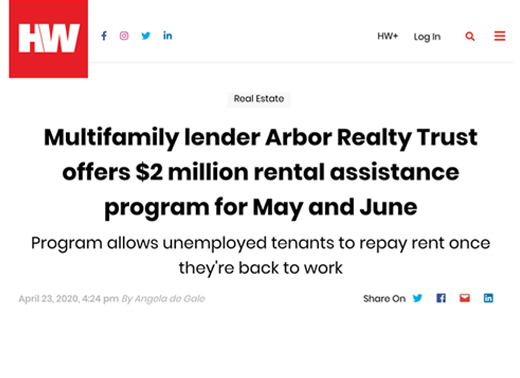
Multifamily lender Arbor Realty Trust offers $2 million rental assistance program for May and June

Arbor Realty Trust offers rental assistance program

Program allows unemployed tenants to repay rent once they’re back to work

One of Fannie Mae’s top 10 multifamily lenders, Arbor Realty Trust, has launched a $2 million rental assistance program to help tenants who’ve lost their jobs due to COVID-19. The program advances May and June rent payments and allows tenants to repay once they’re re-employed.

Focusing on tenants who live in multifamily properties financed through Arbor, the program not only fills the gap of rent for the tenants but also protects the property owners of those buildings, the company said in a statement.

“The next few months will be very difficult for many renters whose incomes have been significantly impacted by COVID-19,” Arbor’s President and CEO Ivan Kaufman said in an email to HousingWire. “We certainly realize that, and in a proactive effort to supplement government relief efforts and leverage private capital to protect the multifamily ecosystem, we created a unique program that will help thousands of the tenants across the nation.”

Here’s how the program works: Arbor is contributing $1 million to the program and participating property owners will match Arbor’s advances, dollar-for-dollar, totaling $2 million. The property owners must invest at least $10,000 and up to $100,000 in the program. Those property owners then work with their tenants to complete the online application, and the funds are on a first-come, first-serve basis.

To qualify, tenants must:
– Live in a property of an Arbor borrower who agrees to participate in the program and match Arbor’s funds
– Currently pay $2,000 or less in monthly rent
– Be in good standing with consistent on-time payments
– Submit proof of 30% income decline via an employer letter
– Provide documentation of unemployment and/or insurance benefits, government assistance and other forms of income sources

With May’s rent due in a week, an Arbor spokesman said its goal is to review the applications within 48 hours and notify the property owners so they can update the tenants. If approved, the advance payment goes to the property owner to cover the tenant’s rental payment. The tenants then have up to three years to pay back the May and June rent payments at zero interest, the spokesman said.

A company spokesman said the rental assistance program could help as many as 2,000 and 3,000 tenants.