

Rental Markets with the Fastest Growth and Tightest Occupancy

- More metropolitan areas saw year-over-year increases in rental occupancy rates, demonstrating continued progress in absorbing post-pandemic supply.
- Hartford, CT, led the nation, with four of the top five tightest markets located in New England.
- Indianapolis, IN, recorded the largest year-over-year increase in rental occupancy, while Greensboro, NC, ranked among both the tightest markets and the fastest-tightening markets.
Out of the 75 largest U.S. metropolitan areas, occupancy rates for all types of rental properties, including multifamily and single-family rentals (SFR), remained exceptionally high in 2025. Occupancy rates were above 95% in nearly 30% of markets, according to an analysis of newly released U.S. Census Bureau data. While rental vacancy at the national level remained higher than pre-pandemic norms, more markets recalibrated to tighter occupancies last year.
The Tightest Rental Markets by Occupancy
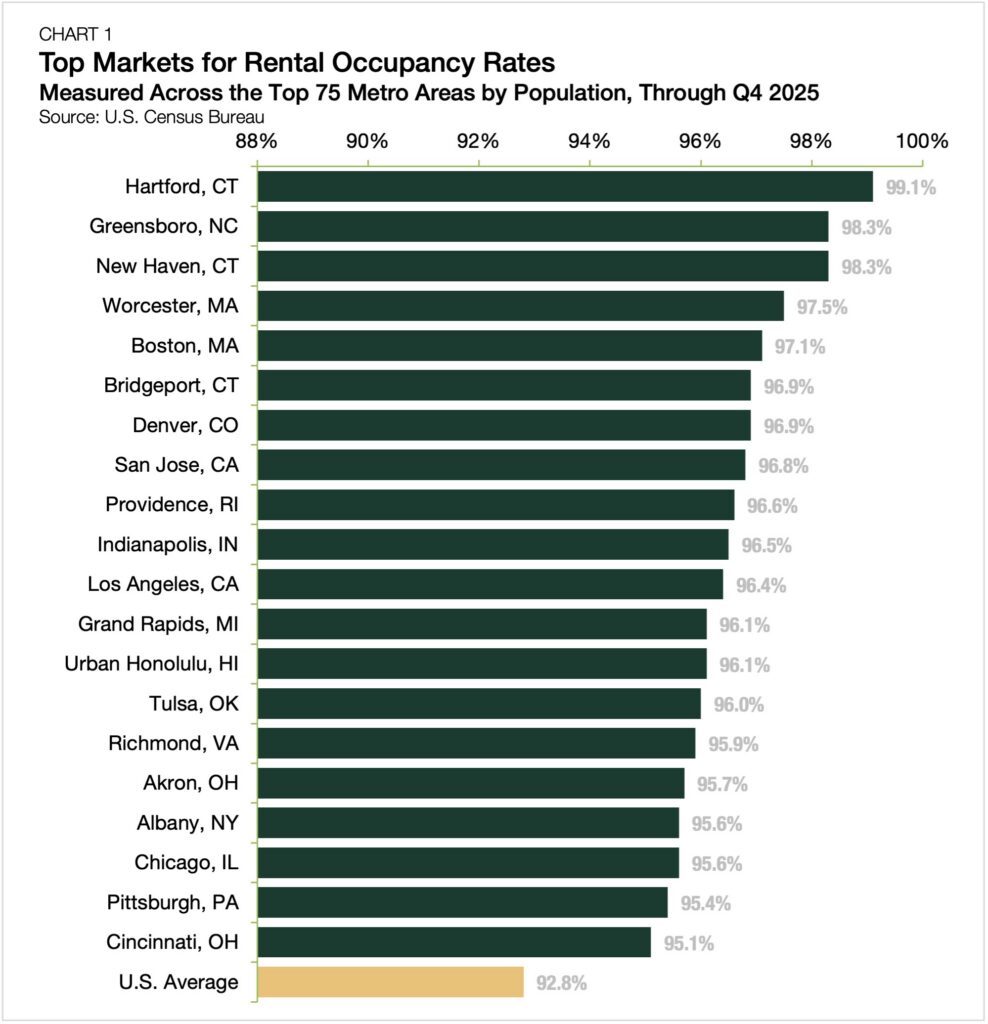
Among the nation’s largest rental markets, several, such as Hartford, CT, are operating at or near full capacity. The Hartford metro area, with a 99.1% occupancy rate, had the nation’s tightest rental market at the end of 2025 (Chart 1).
A recent Zillow analysis identified Hartford as the top housing market for year-ahead home price appreciation in 2026, citing its significant undersupply of available inventory relative to pre-pandemic levels. With rental vacancy rates sitting below 1% through year-end, Connecticut’s capital city is clearly undersupplied.
Tight conditions extend well beyond Hartford. Greensboro, NC, and New Haven, CT, both posted 98.3% occupancy rates, placing them among the most supply-constrained rental markets nationally.
Regionally, New England continued to dominate the rankings. Worcester, MA (97.5%) and Boston, MA (97.1%) rounded out the top five, underscoring the region’s persistent shortage of rental housing. The concentration of high-occupancy markets in New England reflects long-running structural constraints, such as limited land availability, restrictive zoning, and historically low levels of new housing production, which have left many metros with little surplus to buffer against rental demand increases.
Top Markets for Rental Occupancy Growth
Roughly half of the 75 largest metropolitan areas finished 2025 with higher rental occupancy rates than the year prior, up from one-third in 2024. Beyond absolute occupancy levels, year-over-year changes revealed where rental markets tightened most quickly across the country.
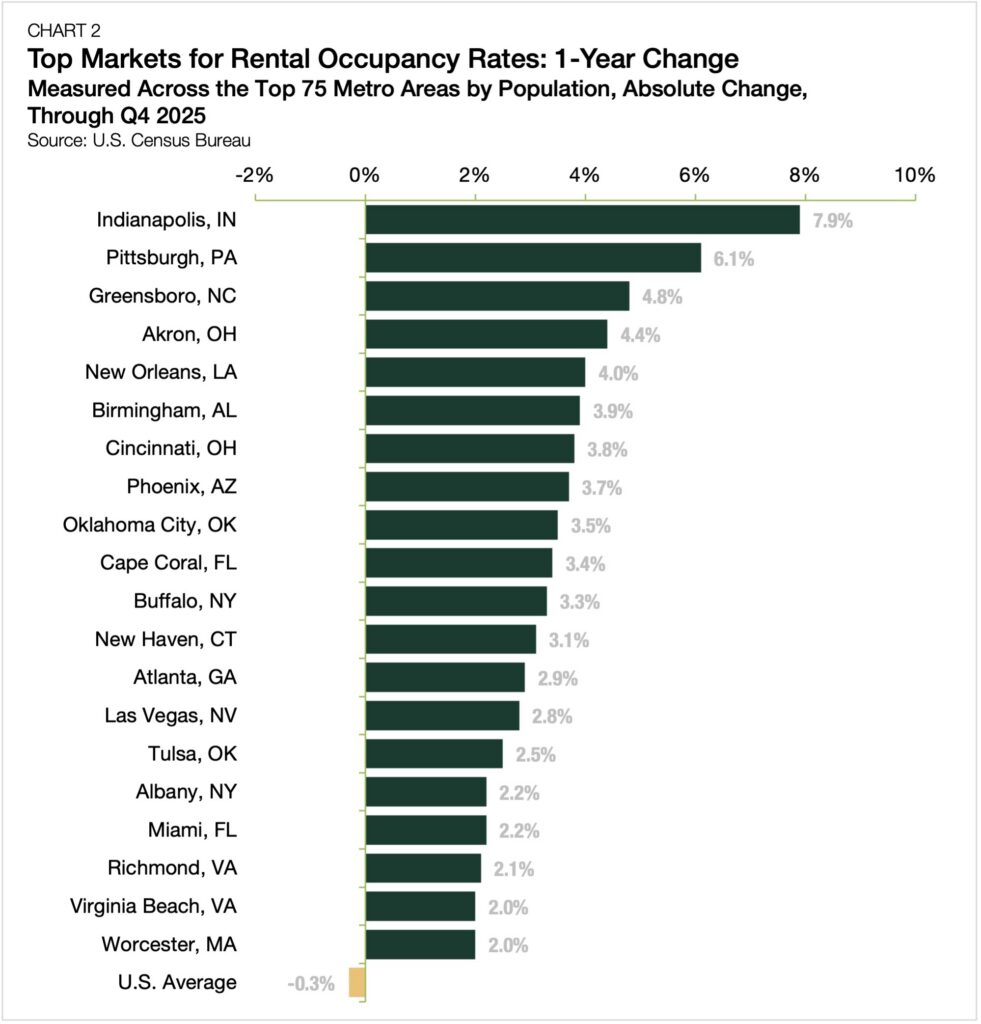
Indianapolis, IN, recorded the largest year-over-year increase in rental occupancy last year (+7.9 percentage points), signaling the rapid absorption of available rental supply (Chart 2). Pittsburgh, PA, followed closely behind, posting a 6.1 percentage point increase in occupancy, reflecting a meaningful tightening in rental conditions.
Both Indianapolis and Pittsburgh have relatively affordable housing costs and diversified employment bases, as well as measured development pipelines that have allowed demand fundamentals to translate into tighter occupancy conditions.
Rounding out the top three markets for rental occupancy growth was Greensboro, which saw a 4.8 percentage point increase over the past year. Notably, Greensboro appeared in both rankings. Rental conditions in Greensboro have quickly tightened as its population has seen sustained growth. North Carolina’s population expanded by 1.3% in 2025, the third-highest growth rate in the country.
The Bottom Line
With both multifamily and SFR, supply and demand are approaching a more balanced state. Over the past two years, national occupancy rates retreated as these sectors absorbed new units developed during the post-pandemic construction boom. However, occupancy rates at the metro level continue to improve for a growing number of markets, demonstrating that stabilization is gaining momentum.
Interested in the multifamily real estate investment market? Contact Arbor today to learn about our array of multifamily, single-family rental, and affordable housing financing options or view our multifamily articles and research reports.