

Single-Family Homes for Rent Reach 7-Year High
- The number of single-family rental (SFR) households increased again in 2025, growing 1.7% to reach a seven-year high, according to preliminary estimates.
- Consistent SFR household growth returned, following a slowdown between 2017 and 2022.
- The recent expansion of the sector has been primarily driven by attached, purpose-built single-family rentals, highlighting the increasing influence of build-to-rent (BTR).
The number of households renting single-family homes rose 1.7% in 2025, reaching a seven-year high, according to a new Arbor Realty Trust and Chandan Economics forecast, based on an analysis of newly released U.S. Census Bureau data. Since the pandemic, the single-family rental (SFR) sector has stabilized, reversing recent household losses and regaining momentum.
SFR Households Establish New Growth Pattern
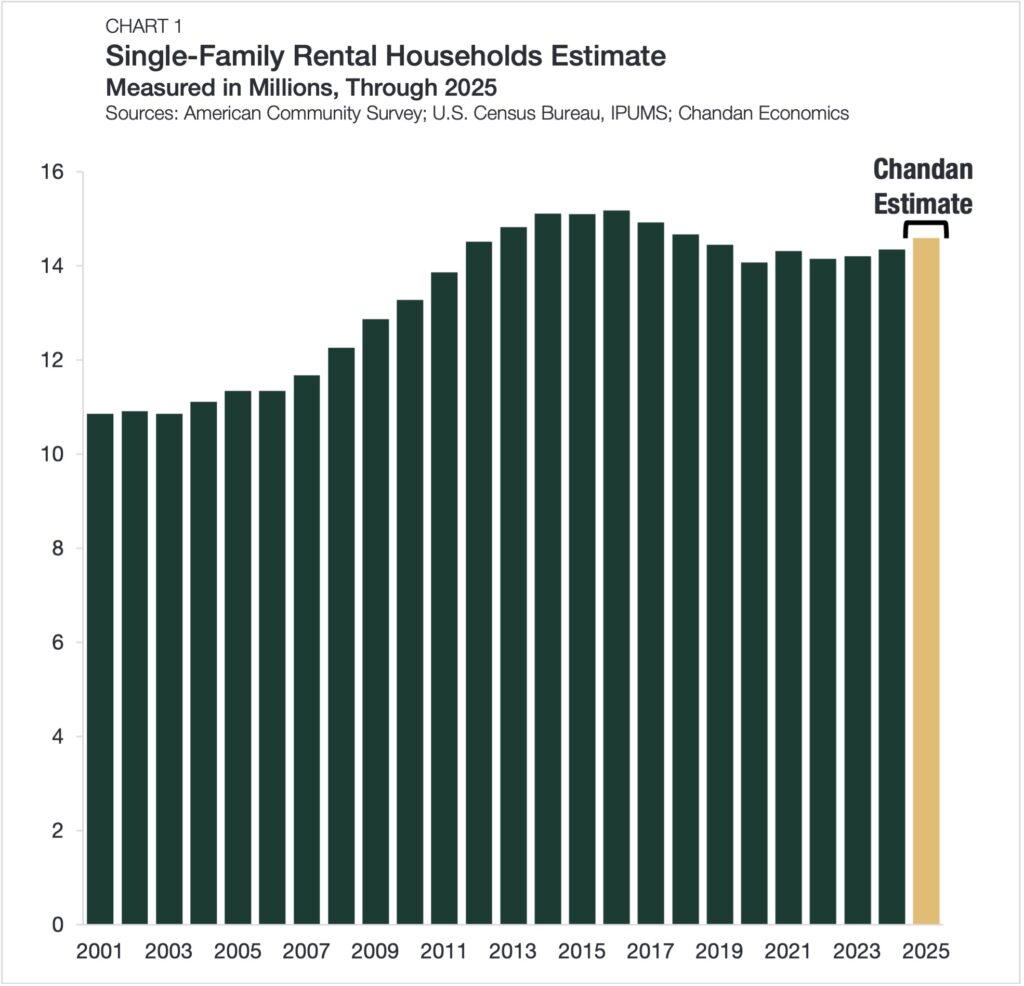
Newly released official estimates from the U.S. Census Bureau’s American Community Survey indicate the number of households in the single-family rental sector rose by nearly 141,000 to hit 14.4 million in 2024 (Chart 1). Taking a preliminary look at 2025, Chandan Economics estimates that the number of SFR households jumped again by about 243,000, reaching 14.6 million.
Following 2023’s expansion (+0.4%), SFR’s trajectory has accelerated over the past two years, with its number of households growing by 1.0% in 2024 and 1.7% in 2025 (Chart 2).
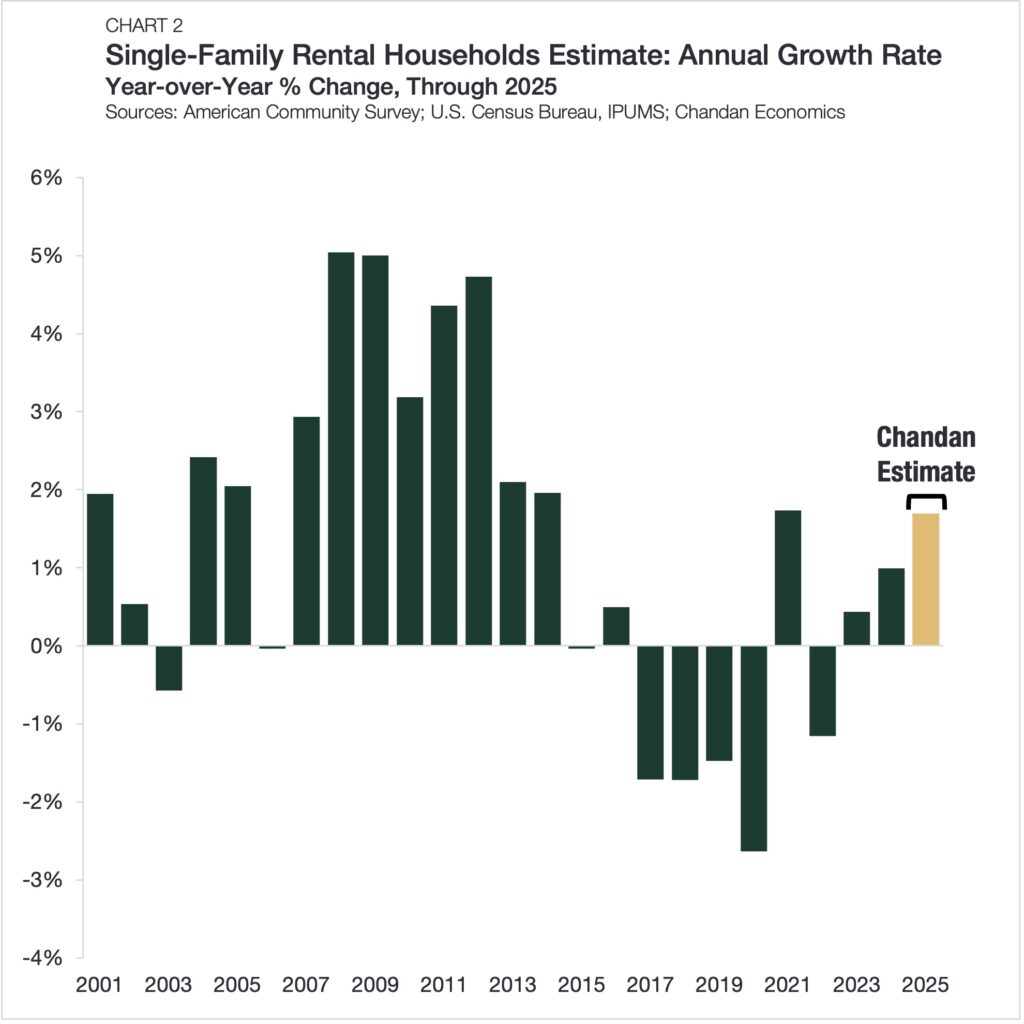
The return to consistent annual gains is especially noteworthy as it follows a sustained period of weakening household growth. After the number of SFR households hit an all-time high of 15.2 million in 2016, growth decelerated in five of the next six years, falling to a cyclical low of 14.1 million households in 2020.
The net decrease of more than a million SFR households reflected the fact that the sector was, and remains, most supported by small landlords operating less than 10 total units. The housing market’s strength alongside generationally low mortgage interest rates opened a substantial window of opportunity for small-portfolio investors to cash out and transition SFR inventory back into owner-occupied units, which increased by about 8.6 million in five years.
While it may take several more years of sustained growth to approach the pre-pandemic peak, SFR has demonstrated a return to growth, adding an estimated nearly half a million households in the past three years alone.
Factors Supporting Growth
Although institutional operators’ market share remains comparatively small, evidence suggests their capital investments — alongside a broader market push to develop purpose-built SFR communities — are a primary factor supporting the sector’s new growth pattern.
Build-to-rent (BTR) construction starts now routinely account for more than 7% of all single-family development. Between 1975 and 2013, BTR’s single-family market share was just 2.3%. The structural increase in BTR supply has enabled the SFR sector to absorb a growing number of household formations.
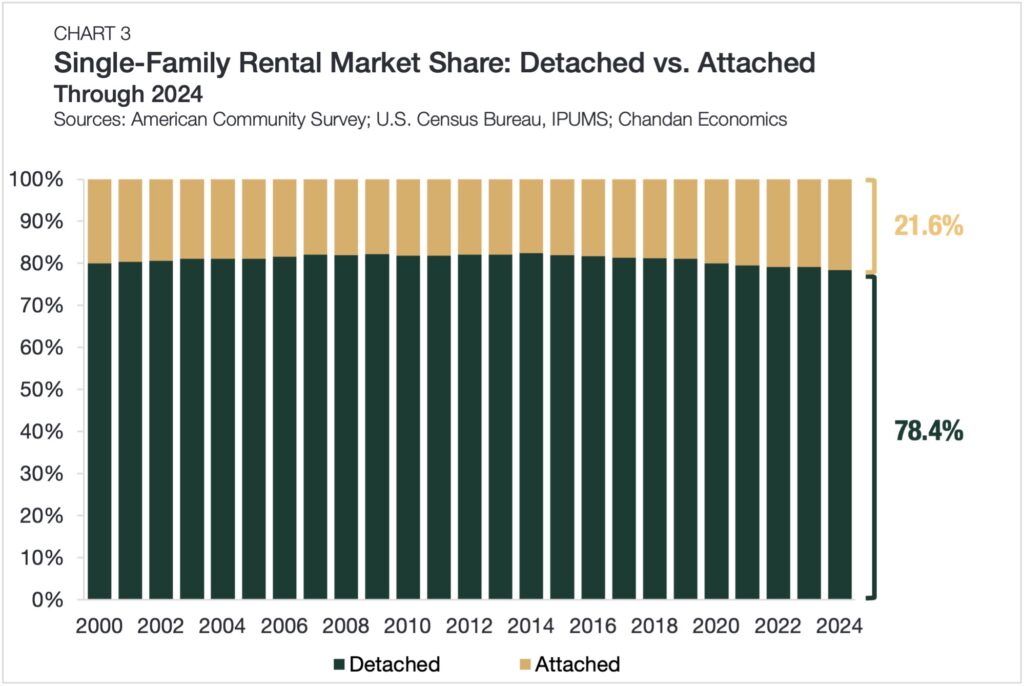
Data from the American Community Survey also support the idea that BTR communities are driving the sector’s expansion. In 2024, the number of SFR households that were properties attached to adjacent properties — a design style favored by BTR communities — jumped 4.3% from a year earlier. Meanwhile, rental households in detached single-family properties increased by just 0.1%. Even with an overwhelming majority of SFR households (78.4%) living in detached properties, attached rental homes accounted for 91.0% of the sector’s total expansion in 2024 (Chart 3).
The Bottom Line
After several years of contraction following a mid-2010s peak, the SFR sector has re-entered a consistent growth phase, driven by expanding BTR supply and sustained affordability pressures in the for-sale housing market. While total SFR households remain below a prior high, renters’ growing preferences for higher-quality homes in amenity-rich communities signal the start of a durable structural shift. Looking ahead, SFR appears positioned for continued, measured expansion as capital investment and housing preferences continue to favor single-family homes for rent.
Interested in the multifamily real estate investment market? Contact Arbor today to learn about our array of multifamily, single-family rental, and affordable housing financing options or view our multifamily articles and research reports.