

Top Multifamily Markets for Eco-Friendly Commutes
- New York, Chicago, San Francisco, and other large metropolitan areas with highly developed public transit systems had the most environmentally friendly commuting patterns.
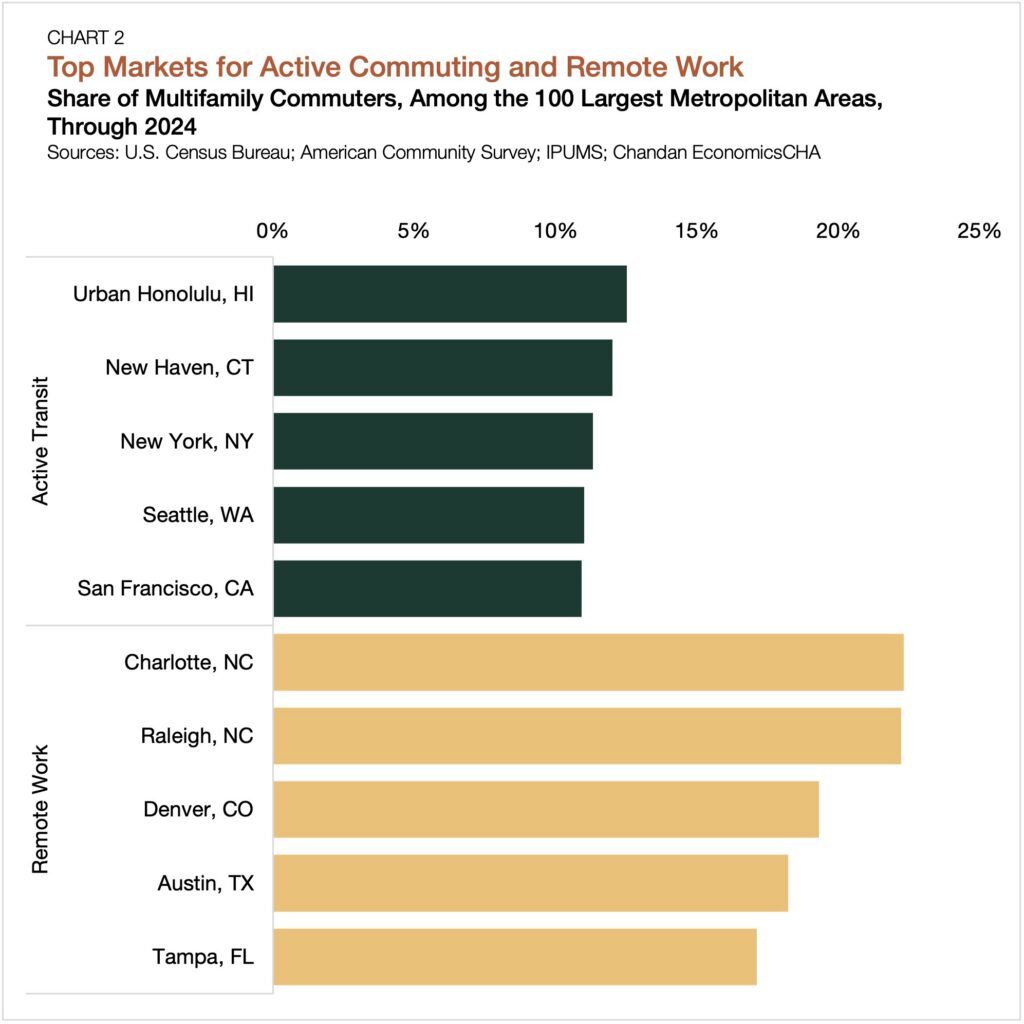
- Urban Honolulu and New Haven had the highest shares of active commutes, such as walking and biking.
- Mid-sized markets, including Charlotte, Raleigh, and Denver, ranked relatively high with the support of elevated shares of remote workers.
In many urban areas, densely concentrated housing, strong transit networks, and walkable neighborhoods offer residents viable environmentally friendly commuting alternatives. Using data from the U.S. Census Bureau’s American Community Survey, Arbor Realty Trust and Chandan Economics examined commuting patterns of workers living in multifamily rental housing in the nation’s largest metropolitan areas to identify where renters rely least on private cars to travel to the office.
Public Transit Anchors the Greenest Commutes
Overwhelmingly, metropolitan areas with robust public transit systems exhibit the most eco-friendly commuting patterns. New York led all other markets by far, where working multifamily renters relied least on automobiles. Only 28.8% opted to drive a private car to and from work each day. Chicago, the second greenest market, lagged considerably behind New York at 55.0% (Chart 1).
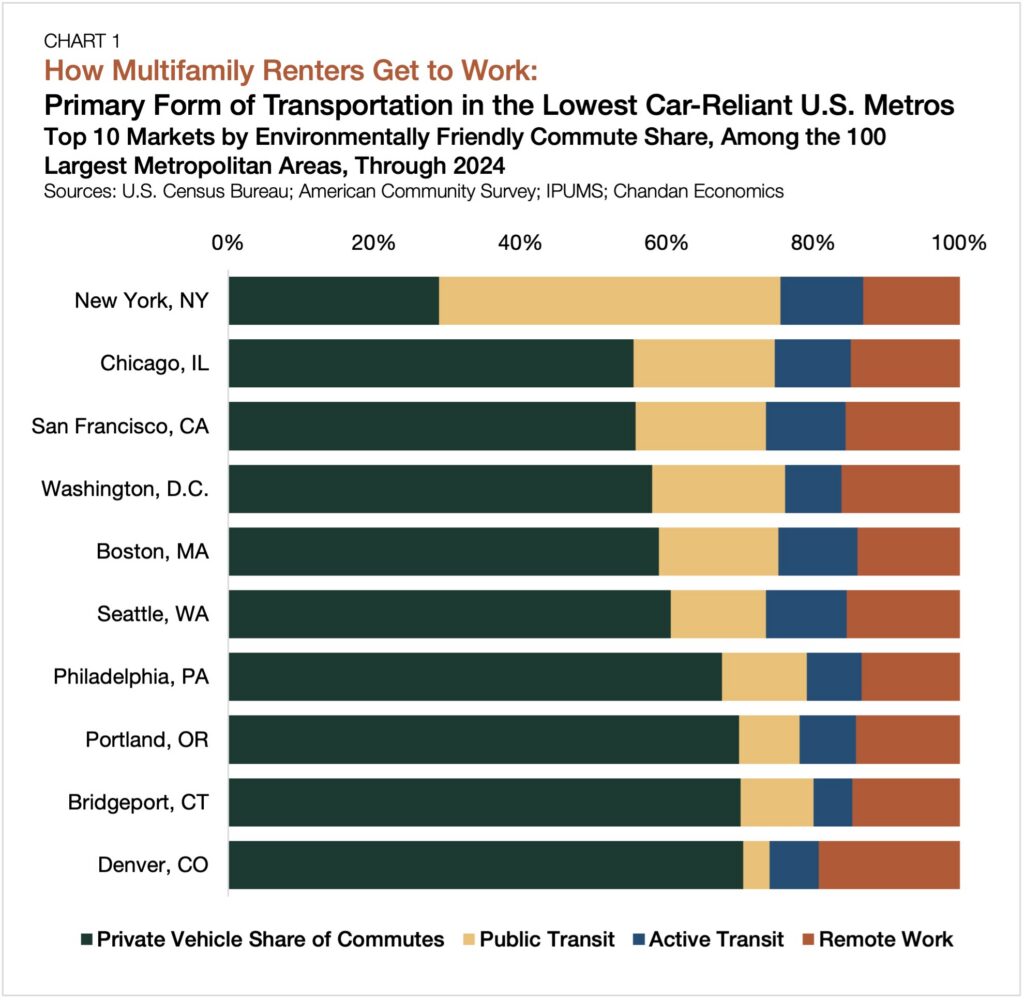
Nearly half of the New York metropolitan area’s multifamily renters rely on public transportation as their primary means of commuting. Anchored by the nation’s largest subway system and supported by extensive rail and bus networks, the region’s transit infrastructure — combined with high residential density and limited parking — makes public transit a practical commuting option in the nation’s largest city.
New York is not alone in demonstrating the link between transit access and environmentally friendly commuting. Chicago, San Francisco, Boston, and Washington, D.C., also rank among the metro areas with the lowest reliance on private vehicles; all of them have extensive rail and bus networks that connect dense residential neighborhoods with employment centers. When taken together, local dynamics reflect a broader cycle in which density supports transportation investment, transit reinforces housing demand, and both contribute to some of the deepest and most liquid multifamily markets in the country.
Active Commuting and Remote Work
Although access to public transit often drives the conversation on eco-friendly commuting, active transportation has become increasingly common. Urban Honolulu, New Haven, and New York had the highest shares of workers who walked or biked to work, indicative of compact urban layouts and short commuting distances (Chart 2).
In markets like these, physical features, including dense neighborhoods and pedestrian-friendly street networks, make walking and biking more viable alternatives to driving. In response to the uptick in active transportation, major metros have made adding or enhancing bike lanes a priority. Additionally, the introduction of bike-sharing networks, such as Biki bikes in Urban Honolulu and Citi Bike in New York, has further expanded cycling access.
The rise of remote work has also reduced commuting emissions. Several fast-growing Sun Belt metros — including Charlotte, Raleigh, Denver, and Austin — rank relatively high on the list due in part to elevated shares of remote workers. Although working at home is not a mode of transportation, it eliminates commuting trips altogether, reducing transportation demand and lowering the environmental footprint associated with daily travel.
The Bottom Line
For multifamily investors, owners, and operators, commuting patterns provide a clear signal of how location and infrastructure shape renter demand. Markets with strong transit access, walkability, and proximity to employment centers tend to support more efficient, lower-emission travel. At the same time, active transportation and remote work are expanding renter flexibility. Together, these dynamics are strengthening demand fundamentals and giving major metros an edge.
Interested in the multifamily real estate investment market? Contact Arbor today to learn about our array of multifamily, single-family rental, and affordable housing financing options or view our multifamily articles and research reports.