Current Reports

Affordable Housing Trends Report 2026

Arbor Realty Trust’s Affordable Housing Trends Report, developed in partnership with Chandan Economics, explores a year marked by one of the most significant policy shifts in decades, with consequential developments in both the marketplace and the political arena. Our annual report finds that although affordability continues to present challenges, this year’s new initiatives are set to rebuild tomorrow’s pipeline.

Articles

HUD Expands FHA Financing Eligibility to Qualifying BTR Projects

The U.S. Department of Housing and Urban Development (HUD) recently announced a significant policy change that expands Federal Housing Administration (FHA) mortgage insurance eligibility to qualifying build-to-rent (BTR) communities. Effective immediately, professionally managed rental developments consisting of detached single-family homes, duplexes, and triplexes are eligible for FHA-insured financing under the same general framework as traditional multifamily properties.

Articles

Financing a Build-to-Rent Community Through Construction, Lease-Up, and Stabilization

Single-family rentals (SFR) now house 41% of the U.S. renter population, according to Rentometer Mid-Year Report 2025: National Trends in Single-Family Rental Markets. Arbor provides investors with short-term and long-term SFR financing to meet this growing demand. Whether a sponsor is developing a build-to-rent (BTR) community, holding an SFR portfolio long-term, or acquiring assets to rehab, Arbor finances build-to-rent (BTR) communities across construction, lease-up, and stabilization under one lender relationship, backed by the strength of an $802 million BTR collateralized loan obligation Arbor closed in May 2025.

Articles

Why Top Multifamily Lenders Practice Disciplined Underwriting

Every multifamily lender says it underwrites conservatively, but few follow a truly disciplined approach. Arbor Realty Trust’s own record is a case in point, with 19 consecutive years in the Top 10 Fannie Mae Multifamily DUS Lenders, a top-three ranking in Freddie Mac’s Conventional Small program, and an upgraded Commercial Special Servicer rating from Fitch Ratings in January 2026.

Investment

Special Report Fall 2026

Arbor Realty Trust’s Special Report Fall 2026, developed in partnership with Chandan Economics, leverages data-driven research to detail the state of the rental housing market. Amid headwinds, multifamily remained resilient in a selective investment environment favoring disciplined underwriting and market selection. Attractive entry points for well-positioned investors continue to populate the road ahead.

Analysis

U.S. Multifamily Market Snapshot — September 2026

The U.S. multifamily market remains on stable footing in a mixed macroeconomic climate. Rent growth continued to trend upward through the second quarter, while apartment fundamentals remained resilient amid slowing employment growth and elevated vacancies.

Current Reports

Single-Family Rental Investment Trends Report Q3 2026

Arbor’s latest Single-Family Rental Investment Trends Report highlights how this commercial real estate sector performed resiliently in the face of adversity last quarter. Even as policy uncertainty created new headwinds, firm operating fundamentals drove SFR forward.


General: 800.ARBOR.10

The State of Rental Housing

Stabilization Advances as Refinancings Accelerate

Key Findings

  • Multifamily fundamentals stabilized, driven by easing supply pressures, despite broader economic uncertainties.

  • Occupancy levels remain strong, with nearly 30% of markets operating above 95% occupancy.

  • Loan originations rose sharply, while selective capital conditions and improving valuations supported an opportunistic investment backdrop.

The Outlook

The rental housing market is beginning to achieve a state of balance after a period of recalibration. The supply surge in 2023 and early 2024 has moderated, asset values have reset, and rent growth is stable. While uncertainties abound across many sectors of the economy, multifamily fundamentals are stabilizing.

The macro environment continued to be characterized by slowing, positive economic growth, but downside risks remain. Year-ahead recession probabilities eased to begin the year, but spiked as the U.S.-Iranian conflict jostled energy markets and hiring momentum turned negative. Financial markets are pricing in continued easing at the short end of the yield curve through year-end 2026, implying a lower policy rate environment ahead. Even if long-term rates prove to be more resistant, a steeper yield curve will improve lenders’ outlook and may incrementally support credit availability as the year progresses.

Capital markets have begun to reflect the shifting macro environment. Multifamily mortgage originations rebounded sharply in 2025, and private-market valuations remain well below their post-pandemic peak despite the return of modest price growth. At the same time, a significant refinancing cycle continues to test leverage and underwriting discipline across portions of the market.

The year ahead is unlikely to resemble the exuberance of the post-pandemic expansion — or the dislocation that followed. Instead, 2026 appears increasingly defined by normalization, selective capital, and widening opportunities for well-positioned investors.

Labor Market Cools, Output Remains Resilient

The macroeconomy started 2026 in a late-cycle deceleration rather than a downturn. Labor market momentum slowed materially, yet broader economic activity held up better than many expected. The U.S. economy added only 116,000 jobs in 2025, the smallest annual gain in a non-recession year since 2003, according to the U.S. Bureau of Labor Statistics.

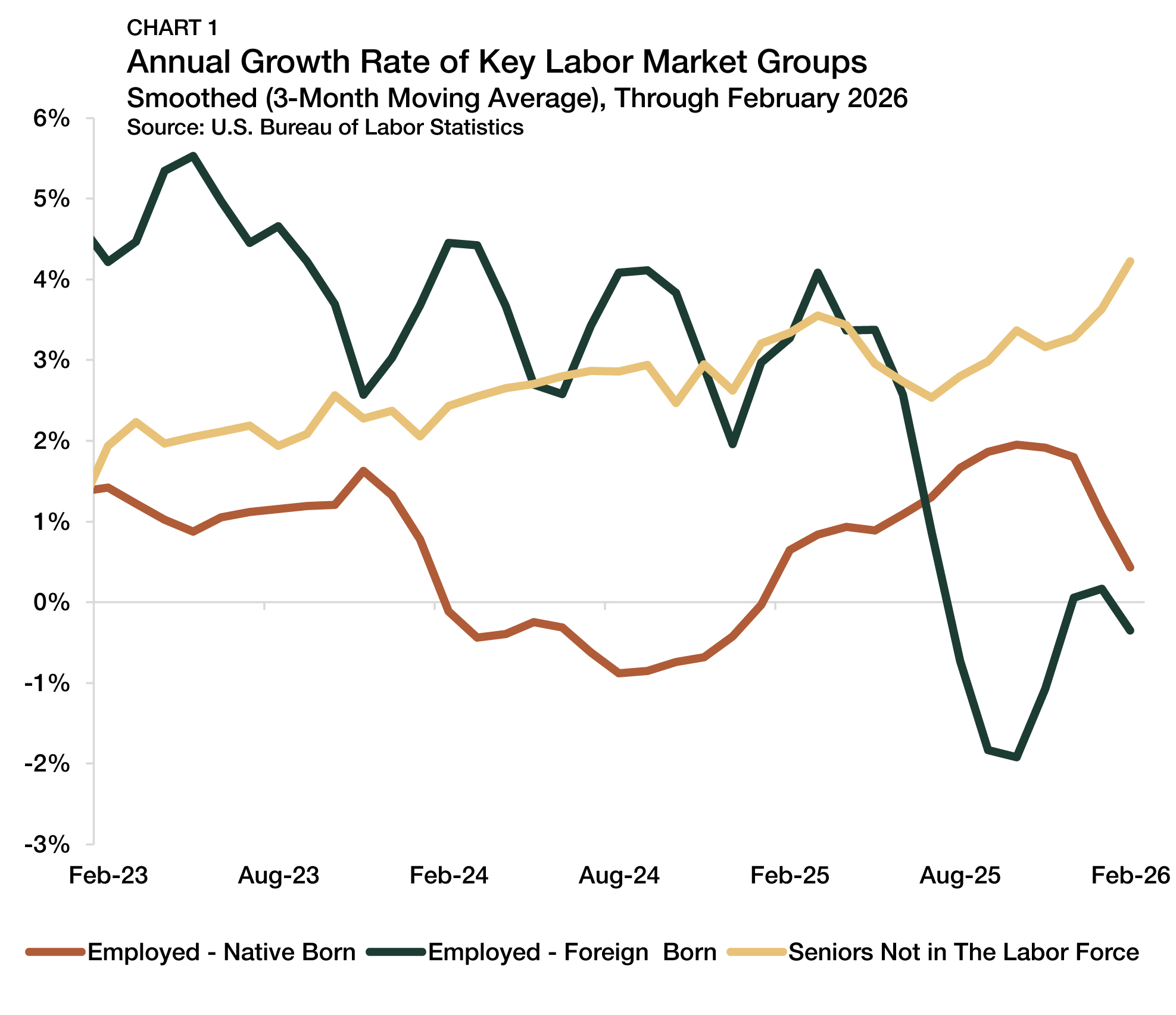
The current cycle, however, is structurally different. There is little cyclical slack remaining in the labor market. Demographic headwinds have intensified as retirements accelerate, and labor force growth slows meaningfully (Chart 1). Earlier in the expansion, robust international migration provided an important source of labor supply growth and supported broader population gains.

But this tailwind for rental housing has diminished as of late. Recent estimates from the U.S. Census Bureau show that net international migration, which peaked in 2024, fell sharply in 2025 and is projected to decline further in 2026 if current trends persist. The combination of lower immigration and rising emigration represents one of the most significant shifts in the demographic momentum of this cycle.

Additionally, today’s slower hiring pace reflects not only cooling demand for workers but also a labor force that is expanding at a more constrained pace than during the immediate post-pandemic rebound.

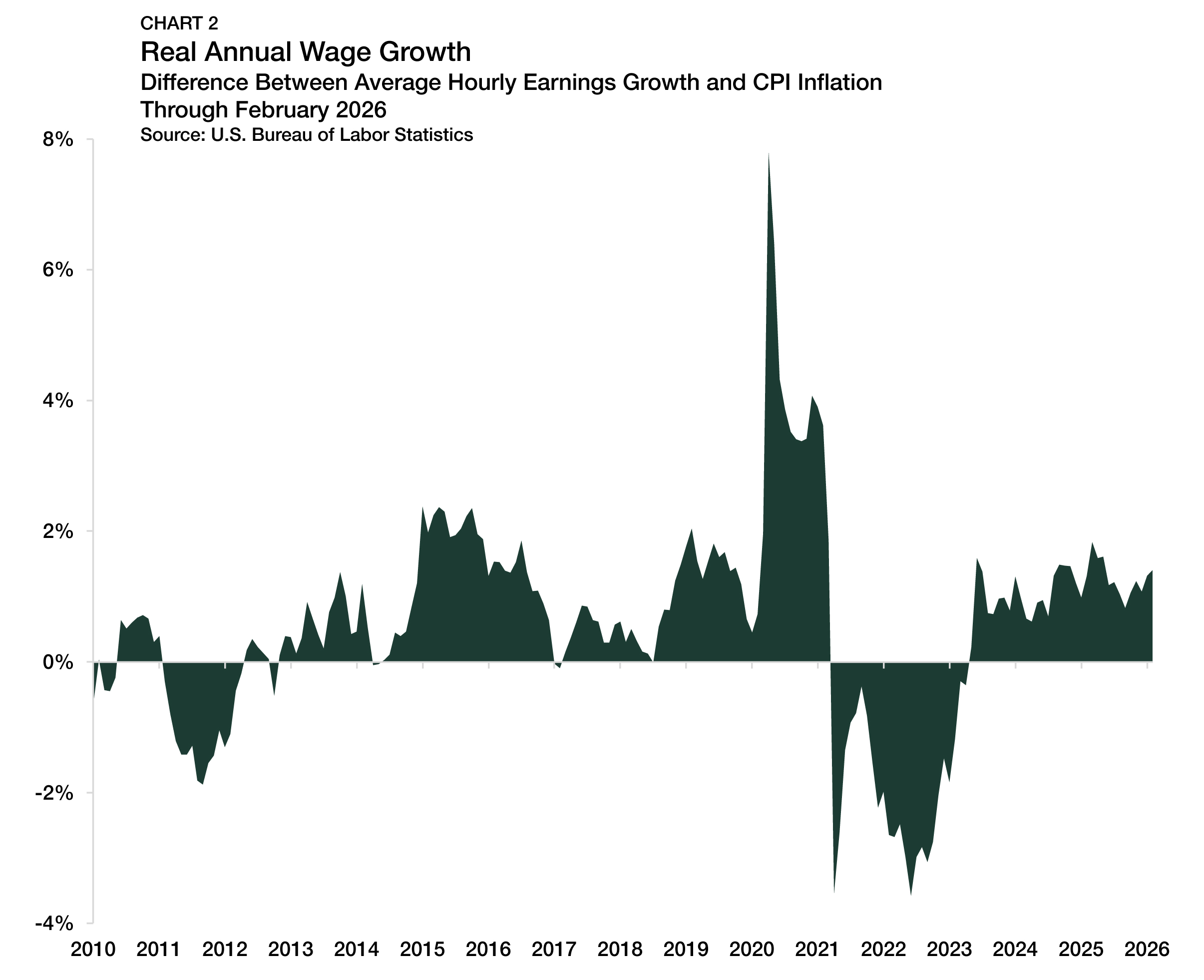
The softness of the labor market is only one part of the equation. Wage growth has remained constructive. Since mid-2023, nominal wage gains consistently outpaced inflation, restoring purchasing power after the sharp real income compression of 2021–2022. Through February 2026, average hourly earnings rose 3.8% year-over-year, while CPI inflation of 2.4%, resulted in real wage growth of roughly 1.4% (Chart 2).

Wage earners have seen nearly three consecutive years of sustained real income expansion, a durable stretch by historical standards. While the labor market has added fewer jobs, households have, on balance, experienced modest real income gains.

Wage earners’ income resilience helps to explain why economic output has remained comparatively steady. Real GDP expanded 2.2% in 2025, while real final sales to domestic purchasers (a measure closely tied to underlying consumer demand) grew 2.7%. However, a notable gap persists between perceived consumer sentiment and actual spending behavior. While surveys reflect caution, household consumption still anchors economic growth.

Trade policy is another important variable within this late-cycle environment. A recent Supreme Court ruling limiting the administration’s use of emergency tariff authority — albeit while leaving other statutory tariffs intact — reduced the effective tariff rate from an estimated 12.7% to roughly 8.3% according to an analysis by Trepp.

In commercial real estate, tariffs have added an estimated 4.6% to construction costs, disproportionately impacting steel-intensive projects. With the effective tariff burden now lower, some development pressure should begin to ease at the margin, modestly improving project feasibility and supporting capital formation. Policy uncertainty has not completely receded, but the risk of abrupt tariff escalation has lessened.

Altogether, the data show the macroeconomic backdrop is cooling, not contracting. Job growth has sharply slowed, but real incomes are rising, and output remains positive. The expansion is now evolving and maturing, a substantial plus for housing demand in the quarters ahead.

Multifamily Balance Sheet Dynamics Move to the Forefront

Multifamily enters spring 2026 on firm operational footing, even as balance-sheet dynamics move to the forefront. The supply shock that defined 2023 and early 2024 has slowly faded, rent growth has normalized, and valuations have stabilized. Capital discipline now defines multifamily.

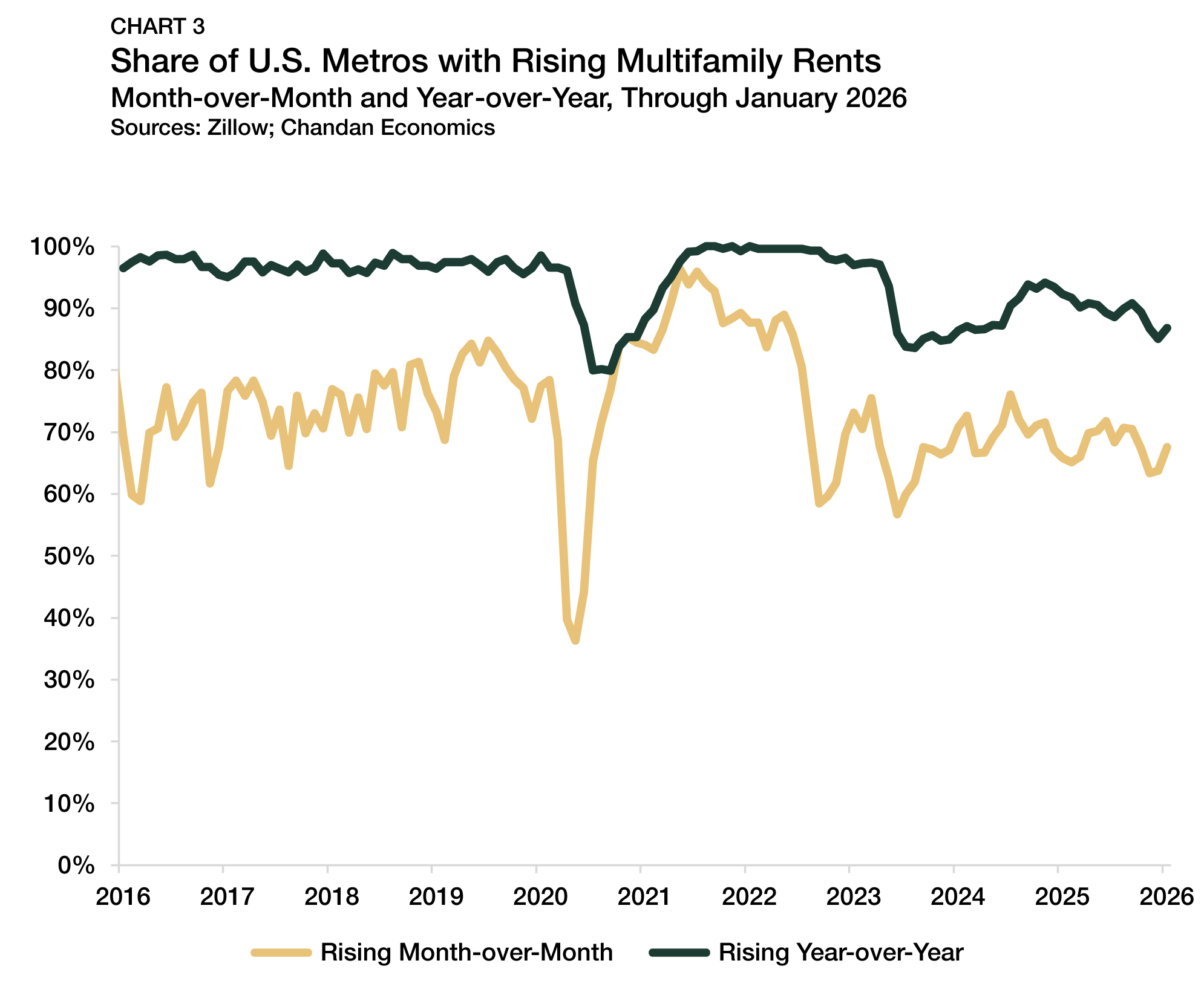
Nationally, multifamily rents rose 1.4% year-over-year through January 2026, remaining firmly positive while moderating from post-pandemic peaks. The breadth of rent growth improved modestly at the start of the year, with roughly two-thirds of major metros posting monthly increases and nearly 87% of them registering positive annual growth (Chart 3). High-supply Sun Belt markets continued to show softness, while select Midwest and coastal metros remained comparatively firm. The national picture is one of normalization, with geographic dispersion narrowing relative to 2024.

Occupancy trends tell a similarly balanced story. National Association of Home Builders economists project there will be modest upward pressure on vacancies in 2026 as elevated completions continue to come online. Yet Census Bureau data show rental occupancy across the 75 largest metros averaged 92.8% at year-end 2025, with nearly 30% of markets operating above 95% occupancy with mostly lower year-over-year vacancy rates.

While incremental vacancy expansion is likely at the national level, stabilization is already evident across many metros, with risk concentrated primarily in recent high-delivery markets. At the same time, the sharp deceleration in net international migration since its 2024 peak suggests that population-driven rental demand growth may become more measured than during the post-pandemic surge, reinforcing a return to steadier, more sustainable absorption patterns.

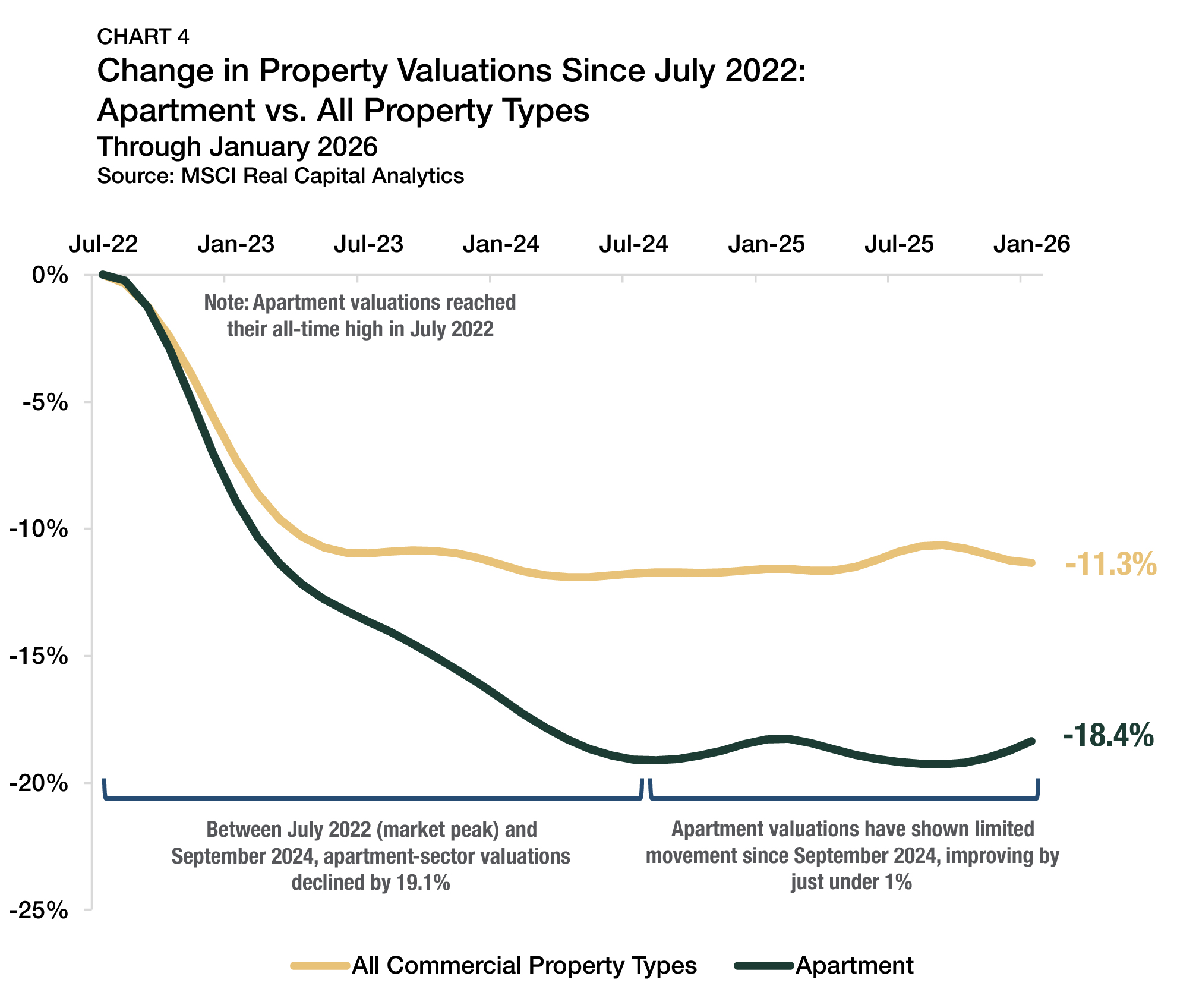
Apartment valuations have also stabilized but have yet to meaningfully reaccelerate. According to MSCI Real Capital Analytics, apartment prices rose for four consecutive months through January 2026. However, values remain 18.4% below their July 2022 peak — a steeper correction than the 11.3% decline recorded across the broader all-property index (Chart 4). Valuations at a nearly 20% discount, combined with stabilizing fundamentals, have created an attractive entry point for long-term capital.

Capital availability reinforces that view. Private real estate funds have accumulated roughly $250 billion in capital waiting to target North American properties, a level comparable to prior cyclical troughs when adjusted for market size. After two years of subdued transaction activity, inflows rebounded in 2025, and investor sentiment has become more constructive. Deployment, however, remains tempered by lingering bid-ask spreads and uncertainty surrounding refinancing outcomes.

As localized oversupply pressures fade, refinancing activity has been increasingly shaping market dynamics. While the volume of upcoming multifamily loan maturities is substantial, the key issue is market capacity. Assets with durable cash flow and moderate leverage continue to gain access to capital markets, and the evolving rate environment has opened opportunities for borrowers to refinance, restructure, or extend existing loans. As liquidity gradually returns and underwriting visibility improves, refinancing activity is expected to remain an important driver of multifamily capital markets in the year ahead.

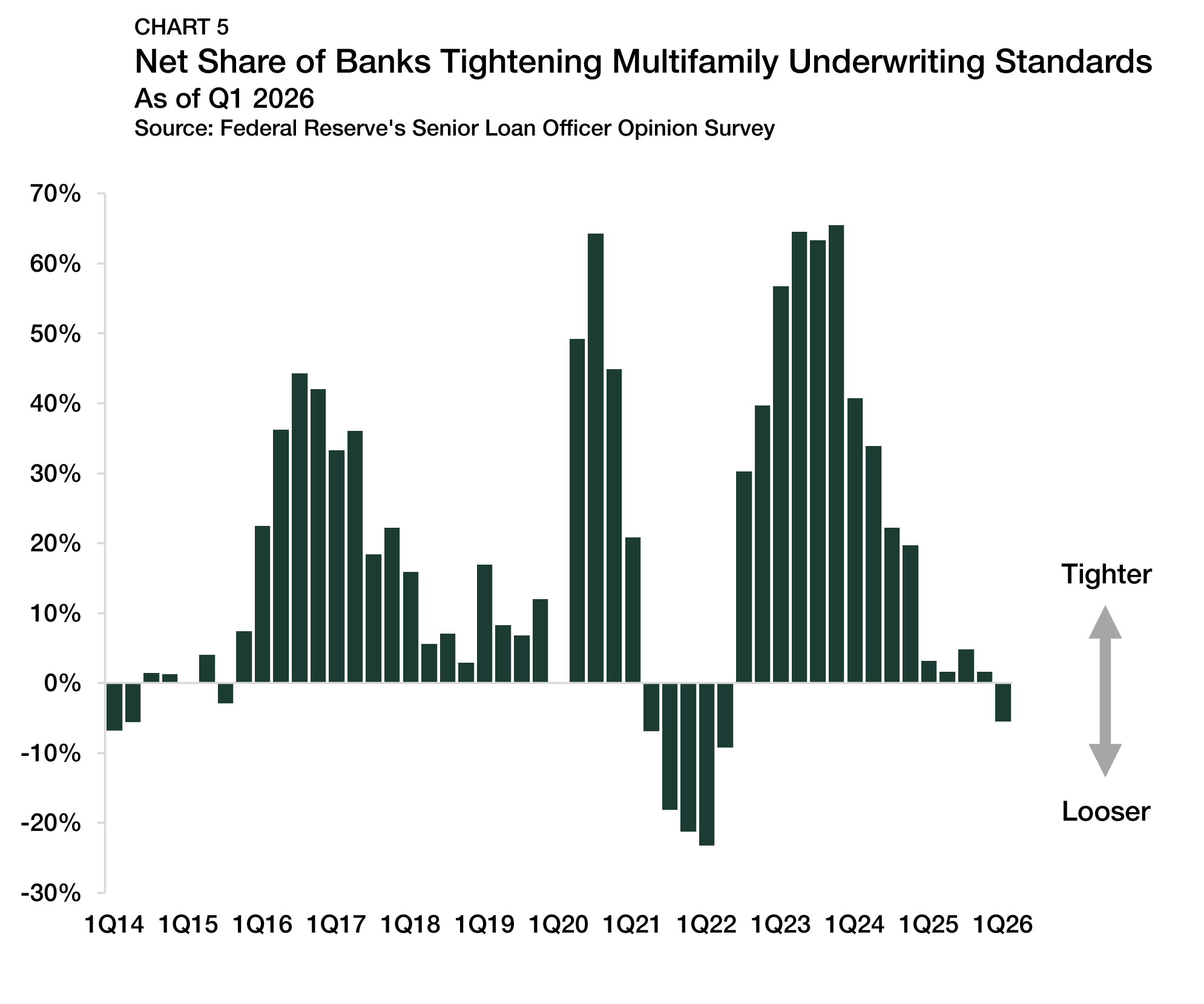
Additionally, credit conditions are beginning to ease at the margin. For the first time since mid-2022, a net share of lenders report loosening multifamily underwriting standards (Chart 5). While credit remains tight by historical norms, the directional shift is notable and reflects improving visibility into fundamentals.

Policy developments could provide incremental support over time. The House’s passage of the 21st Century ROAD to Housing Act signals renewed bipartisan momentum toward housing supply reform, including modifications to federal housing programs and expanded flexibility for affordable housing development. While final enactment remains uncertain, the direction of travel suggests a more constructive federal backdrop for multifamily production and investment.

The Road Ahead

Multifamily is positioned for incremental improvement in 2026. The macro backdrop has become more stable, with year-ahead recession probabilities subsiding, signaling that downside risks have moderated even as growth cools. While the labor market remains tempered, the probability of a broad contraction has diminished relative to earlier expectations.

Refinancing will be the defining variable in the rental housing market this year. As liquidity conditions improve, the opportunity window for borrowers to refinance into more favorable terms has widened, even as elevated maturity volumes move through the system and place pressure on some capital structures. Preliminary estimates from the Mortgage Bankers Association indicate that multifamily originations rose 36% year-over-year in 2025. With capital re-engaging and fundamentals stabilizing, the current environment increasingly reflects a reset rather than a retrenchment, building a more supportive setup for disciplined long-term investors.

For more research and insights, visit arbor.com/research

About Arbor
Arbor Realty Trust, Inc. (NYSE: ABR) is a nationwide real estate investment trust and direct lender, providing loan origination and servicing for multifamily, single-family rental (SFR) portfolios, and other diverse commercial real estate assets. Headquartered in Uniondale, New York, Arbor manages a multibillion-dollar servicing portfolio, specializing in government-sponsored enterprise products. Arbor is a leading Fannie Mae DUS® lender, Freddie Mac Optigo® Seller/Servicer, and an approved FHA Multifamily Accelerated Processing (MAP) lender. Arbor’s product platform also includes bridge, CMBS, mezzanine, and preferred equity loans. Arbor is rated by Standard and Poor’s and Fitch. In June 2023, Arbor was added to the S&P SmallCap 600® index. Arbor is committed to building on its reputation for service, quality, and customized solutions with an unparalleled dedication to providing our clients excellence over the entire life of a loan.

Disclaimer
This report is intended for general guidance and information purposes only. This report is under no circumstances intended to be used or considered as financial or investment advice, a recommendation or an offer to sell, or a solicitation of any offer to buy any securities or other form of financial asset. Please note that this is not an offer document. The report is not to be considered as investment research or an objective or independent explanation of the matters contained herein and is not prepared in accordance with the regulation regarding investment analysis. The material in the report is obtained from various sources per dating of the report. We have taken reasonable care to ensure that, and to the best of our knowledge, material information contained herein is in accordance with the facts and contains no omission likely to affect its understanding. That said, all content is provided herein “as is” and neither Arbor Realty Trust, Inc. or Chandan Economics, LLC (“the Companies”) nor their affiliated or related entities, nor any person involved in the creation, production and distribution of the content make any warranties, express or implied. The Companies do not make any representations or warranties, express or implied, as to the reliability, usefulness, completeness, accuracy, currency nor represent that use of any information provided herein would not infringe on other third-party rights. The Companies shall not be liable for any direct, indirect or consequential damages to the reader or a third party arising from the use of the information contained herein. There may have been changes in matters which affect the content contained herein and/or the Companies subsequent to the date of this report. Neither the issue nor delivery of this report shall under any circumstance create any implication that the information contained herein is correct as of any time subsequent to the date hereof or that the affairs of the Companies have not since changed. The Companies do not intend, and do not assume any obligation to update or correct the information included in this report. The contents of this report are not to be construed as legal, business, investment or tax advice. Each recipient should consult with its legal, business, investment and tax advisors as to legal, business, investment and tax advice. The information contained herein may be subject to changes without prior notice. This report is only intended for the recipients, and should not be copied or otherwise distributed, in whole or in part, to any other person.