Articles

Build-to-Rent Activity Stabilizes Above Historical Highs

As the single-family rental (SFR) sector has matured, build-to-rent (BTR) has become a key source of new supply. Purpose-built rental communities are absorbing demand from households seeking the space and privacy of single-family living without the financial or lifestyle commitments of homeownership. Newly released U.S. Census Bureau data show that while SFR/BTR construction continued to decline from its 2024 peak through year-end 2025, development activity remains elevated compared to historical norms.

Articles

Why Leading with Authenticity in CRE is a Competitive Advantage

In commercial real estate, long-term financial partnerships drive deals. At the recent Real Estate Pride Roundtable in New York City, CRE leaders shared how living openly with their LGBTQ+ identities has allowed them to lead with authenticity in the boardroom and in life. This Pride Month, Arbor celebrates authenticity in the workplace.

Articles

Dr. Sam Chandan’s State of Rental Housing Spring 2026

In a new video, Dr. Sam Chandan, a leading commercial real estate scholar, expands on the findings of Arbor Realty Trust’s latest Special Report, developed in partnership with Chandan Economics. He shares his expert insight into the state of rental housing in spring 2026. Chandan notes that multifamily is moving toward a state of balance as supply pressures ease and growth trends turn positive. The result, he said, is that selective opportunities are emerging for well-positioned investors in a climate “defined less by dislocation” and “more by normalization.”

Articles

Renters Reassess Homeownership as Affordability Challenges Persist

Homeownership has been an aspiration of generations of Americans, but elevated prices, mortgage rates, and financing hurdles are complicating the typical path to owning a home. According to the Federal Reserve Bank of New York’s 2026 Survey of Consumer Expectations Housing Survey, renters are continuing to experience difficulty with mortgage financing and have more measured views about homeownership’s current investment potential. As households reassess the housing market, rental housing demand is the beneficiary.

Current Reports

Small Multifamily Investment Trends Report Q2 2026

Arbor Realty Trust’s latest Small Multifamily Investment Trends Report, developed in partnership with Chandan Economics, evaluates what’s driving this sector’s ongoing stability as macroeconomic conditions remain mixed. Loan originations rose last quarter, and valuations are rebounding, signaling that normalization is taking hold.

Articles

Where Labor Market Momentum Outpaces the National Average

Labor market conditions are a foundational driver of rental housing demand, influencing tenant stability and household growth. While the national pace of hiring has moderated, the economies of many metropolitan areas continue to outperform. Expanding on Arbor’s latest Top Markets for Multifamily Investment Report, our research teams highlight the local dynamics supporting growth in several of the country’s strongest-performing multifamily markets.

Analysis

U.S. Multifamily Market Snapshot — May 2026

The U.S. multifamily sector continued to build momentum at the start of 2026. Rent growth moved into positive territory, and a moderating construction pipeline showed that vacancy may have reached its cycle peak.

General: 800.ARBOR.10

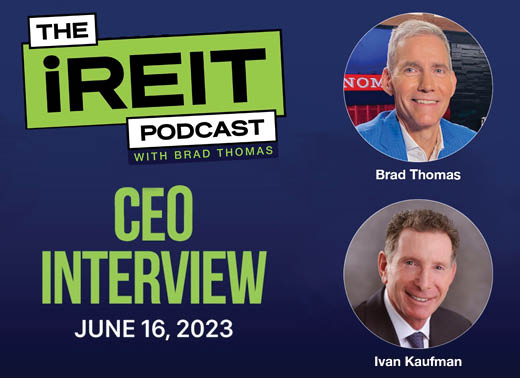
Ivan Kaufman Discusses Arbor’s Strength and Diversification on The iREIT Podcast with Brad Thomas

The iREIT Podcast

Arbor Realty Trust’s CEO discusses diversified income streams, stock buybacks, and the state of regional bank CRE lending in this wide-ranging interview.

Arbor’s diverse business model differentiates it from other multifamily lenders, Founder, Chairman, and CEO, Ivan Kaufman told Brad Thomas, founder of Wide Moat Research, in an interview on the iREIT Podcast on June 16, 2023.

“We are actually more than a mortgage REIT,” said Kaufman, noting that Arbor has multiple income streams. “Not only are we a leading originator of loans that we hold in our portfolio like most mortgage REITs and create that spread, but we also have a variety of other businesses that work together that create multiple income streams and feed off of one another.”

Thomas pointed out that Kaufman’s belief in the strength of his company prompted him to initiate a stock buyback program this year.

“As everybody’s aware, there was this short report that was written on us … we knew fundamentally it was wrong, and we also knew fundamentally how solid we were as evidenced by the ability to increase our dividend by two cents and still have the lowest payout ratio in the industry.”

Kaufman saw an opportunity in Arbor’s undervalued stock price and had the liquidity and access to capital to purchase more shares.

“Our stock typically trades at an eight dividend,” he added. “An eight dividend is a $20, $21 stock price. So, we’re sitting at $10 and a quarter, and we’re like, ‘Okay, this is a no-brainer for a 50% return.’ When the market normalizes, that’s just incredible.”

Kaufman told Thomas that Arbor is well-positioned to increase its stature in the multifamily lending market following the failures of Silicon Valley Bank and Signature Bank in March.

“We used to have 10 regionals who would compete with us in that sector, [but today] we don’t have that competition. We’re a leader in that space, and we’re growing that book of business, and it’s a great book of business.”

Looking forward, Kaufman sees Arbor leading from a position of strength.

“I’m excited, and I’m excited because we lost the regional banks,” he said. “I lost a lot of competitors. We have a lot of liquidity, and the market’s going to be ours.”
Listen to the complete podcast.