

Three Rental Housing Takeaways from ULI-PwC’s 2027 Emerging Trends Report
- Multifamily remains a preferred investment sector, with strong investor interest in lower-income apartments, reflecting ongoing need for affordable rental housing.
- A tapering of new construction should enable multifamily markets to better absorb recent supply additions, while repricing across the sector may create selective buying opportunities for investors.
- A shift in migration patterns has drawn attention to a broader range of rental housing markets, although local construction levels will determine where population growth most strengthens rent performance.
The Urban Land Institute (ULI) and PwC’s Emerging Trends in Real Estate 2027 attests to continued investor interest in rental housing amid ongoing economic disturbance. In its findings, the influential annual report sheds light on three key trends — investor preferences across housing segments, the adjustment to slowing construction, and the changing geography of rental demand — that will shape the apartment outlook in the new year.
1) Lower-Income Apartments Among Investors’ Preferred Housing Segments
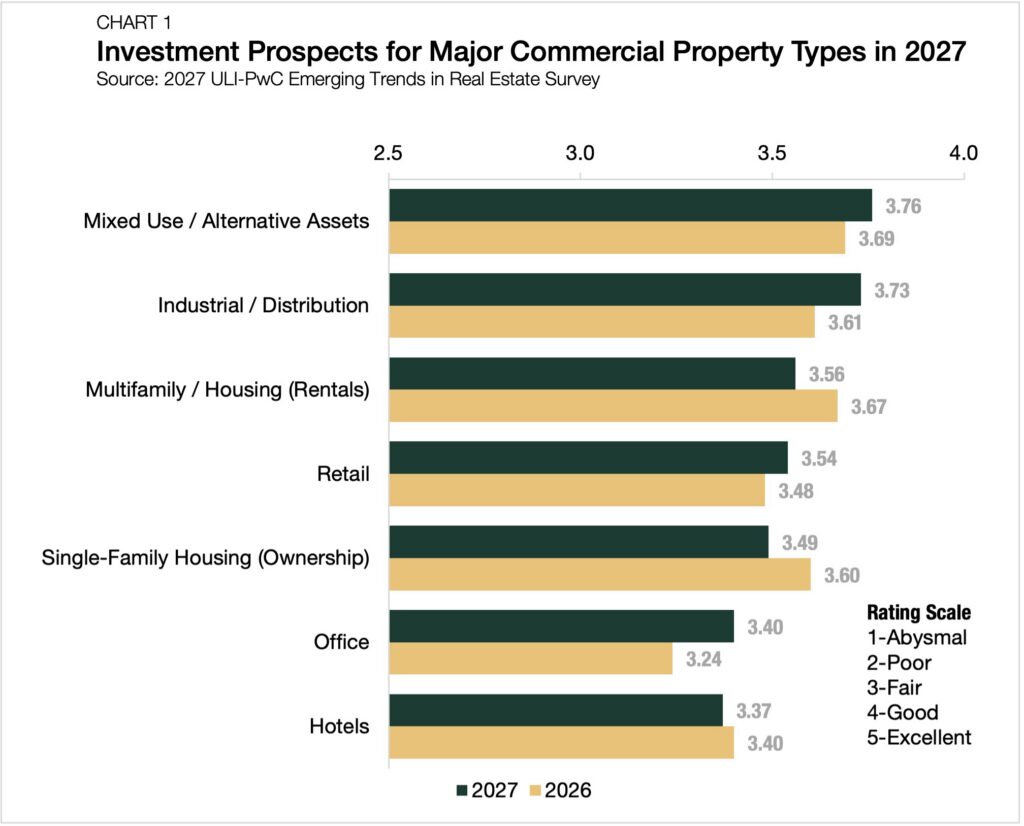
Multifamily continues to be a highly valued commercial real estate asset class. Compared with all other major property types, the multifamily sector ranked third for investment prospects, behind only mixed-use/alternative assets and industrial/distribution, in the ULI-PwC survey. Its score of 3.56 sits between “good” and “fair” on the survey’s five-point scale (Chart 1). Although it sits slightly below where it was last year, the rating remains broadly consistent as 2026 draws to a close.
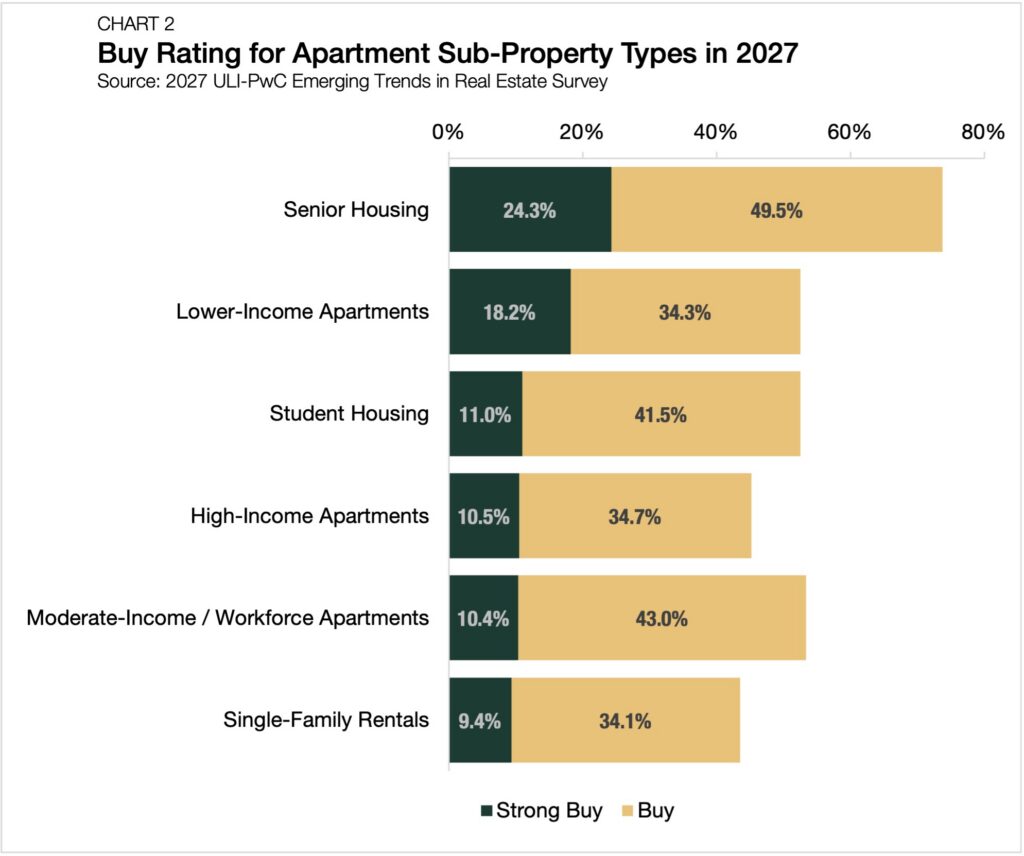
Senior housing led rental housing’s buy recommendations, supported in part by the aging of the Baby Boomer generation. Lower-income apartments received the second-highest share of “strong buy” recommendations at 18.2%, while moderate-income and workforce apartments ranked second at 53.4%, when “buy” and “strong buy” responses were combined (Chart 2). Together, these preferences point to investor interest in multifamily housing with rents that fit the local earning potential.
The report also challenged the common assumption that increasingly high homeownership prices automatically translate into stronger apartment demand. Renters have limits, too. When neither buying nor renting is affordable, households could also double up or remain with family, delaying the formation of new rental households.
A shortage of affordable options creates a need for housing, but local incomes determine what tenants can sustainably pay for an apartment. Properties with rents in line with prevailing income levels can serve households priced out of homeownership and more expensive apartments.
2) Slowing Construction Opens a Path to Recovery
After several years of high apartment delivery levels, the construction pipeline has settled into a calmer pattern. Fewer new units should give existing properties greater opportunity to fill vacancies and regain pricing power. However, ULI-PwC’s report made clear that reaching a more stable balance will not come overnight. According to Yardi Matrix, 1.2 million apartments remained in lease-up nationally as of August 2026.
Ultimately, the pace of recovery will depend on both how quickly deliveries fall and whether rental demand holds up. The report presents differing forecasts for new supply, with a few of the cited researchers expecting a faster return to typical rent growth and others anticipating a longer adjustment. In markets where renters still have plenty of options, concessions will take time to recede.
For investors, a gradual recovery may create opportunities to buy before stronger property performance is fully reflected in prices. Lower valuations can offer more attractive entry points even while financing costs remain elevated. The report’s data also identifies recapitalizations of properties nearing the end of loan extensions as one source driving current deal activity.
3) Investors Take a Wider View of Rental Housing Markets
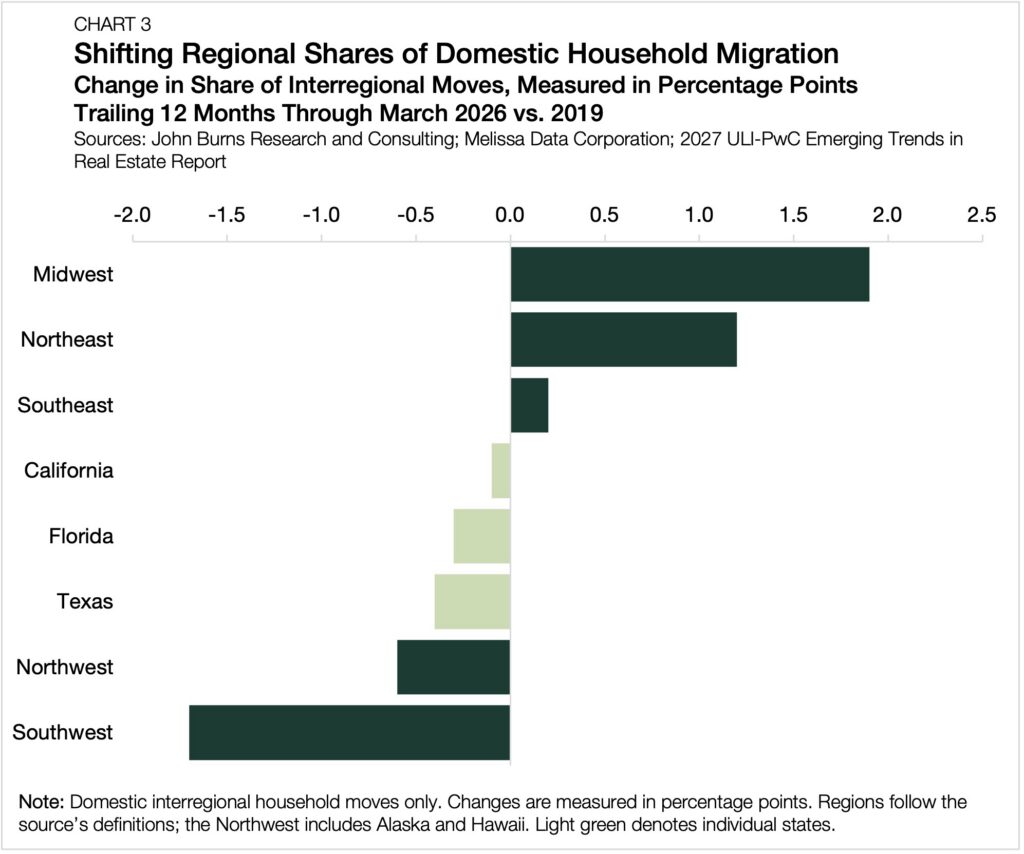
As the market evolves, the geography of rental demand is shifting. Compared with 2019, the Midwest and the Northeast increased their shares of interregional household moves, while the Southwest and the Northwest lost ground. After several years of attention concentrated on pandemic growth markets, investors may have good reason to widen their search to emerging locations (Chart 3).
The Sun Belt continues to attract young households and families, particularly in the Southeast, Texas, and Florida. But its population growth alone does not explain how its rental housing market has performed. Where construction outpaced demand, even local markets that attracted substantial inflows have struggled with soft rents and elevated concessions.
Some Midwest and Northeast markets offer a different picture. The report points to Minneapolis, MN, Columbus, OH, and Chicago, IL, as locations attracting investor interest because these cities have steadier rents and more limited supply. The broadening of opportunity is also featured in Arbor Realty Trust’s latest Top Markets for Multifamily Investment Report, with Kansas City, MO, and Columbus, OH, joining Raleigh, NC, and Charlotte, NC, among the leading markets.
Market selection is not just about finding the right metropolitan area. It also requires a closer look within metro boundaries. A property facing several nearby lease-ups may compete for tenants very differently from one in an established neighborhood with little new construction. Migration can help investors project where demand is heading, while local incomes, rents, and competing supply can better indicate which properties may benefit.
The Bottom Line
The ULI-PwC report confirms the strength of rental housing’s long-term appeal, but how the sector navigates recovery will vary by segment and location. For multifamily investors, opportunities in 2027 will be more focused. By weighing demographic and migration trends alongside local rent prices, competing supply, and financing costs, investors can pinpoint emerging markets with high-value opportunities.
Interested in the multifamily real estate investment market? Contact Arbor today to learn about our array of multifamily, single-family rental, and affordable housing financing options or view our multifamily articles and research reports.