

Affordable Housing Trends Snapshot 2026
Arbor’s latest Affordable Housing Trends Report, developed in partnership with Chandan Economics, explores recent federal and state initiatives poised to reshape tomorrow’s pipeline. Our annual report details last year’s consequential shifts designed to alleviate housing pressures while further incentivizing the creation and preservation of affordable housing.
Low Affordable Inventory Strains Market
The rent burden in the U.S. presents a daily challenge for many. Renters earning below $30,000 annually spend about 57% of their income on rent, a reality that has prompted action from lawmakers.
State and Local Initiatives Create Change
Alongside federal policy, state and local governments play an important role in financing affordable housing and providing targeted assistance to local needs.
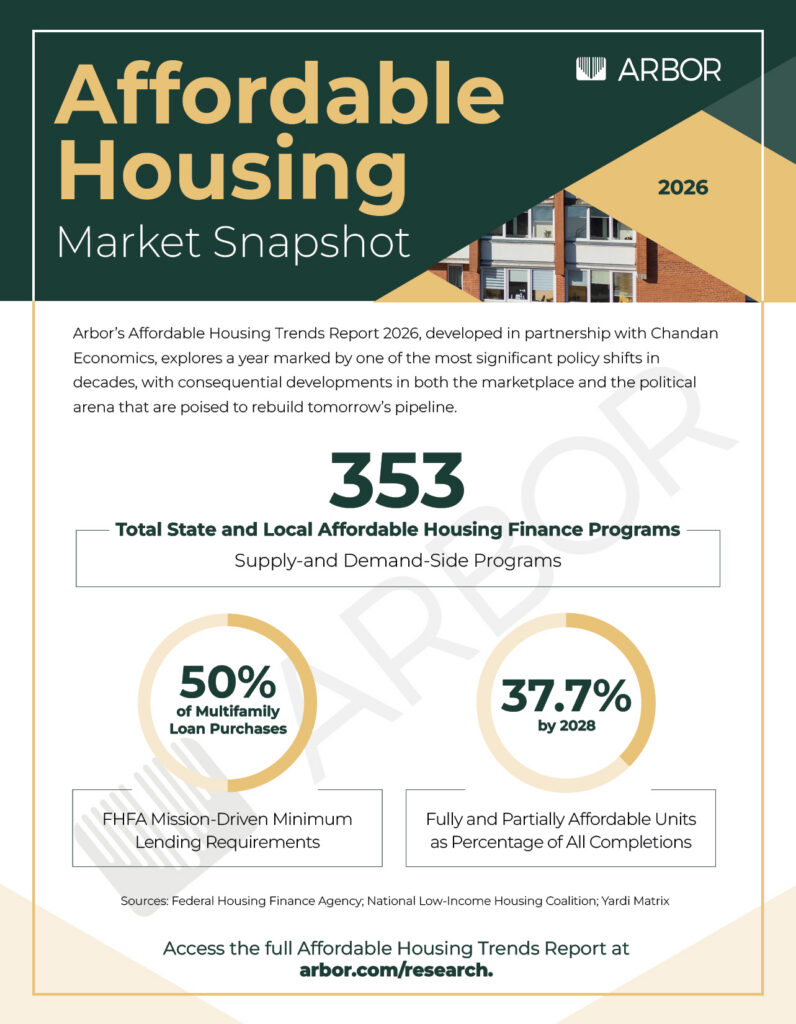
Across the country, 353 non-federal rental housing programs were in action through 2023, including 281 state programs and 72 locally sponsored programs, according to the National Low Income Housing Coalition’s database. These initiatives span both supply-side programs that provide capital for affordable housing construction, rehabilitation, or acquisition and demand-side programs such as rental assistance and renter tax relief.
Mission-Driven Lending Expands
Tax incentives, Federal Housing Finance Agency’s (FHFA) mission-driven lending requirements, and other targeted capital structures provide financing channels not available to market-rate development to the same degree.
In 2025, FHFA doubled the annual amount that each enterprise can invest in Low-Income Housing Tax Credit (LIHTC) properties from $1 billion to $2 billion. Fannie Mae and Freddie Mac can now deploy as much as $4 billion annually through LIHTC equity investments, with a portion reserved for difficult-to-serve and rural markets. Federal affordable housing initiatives like this have widened the pool of capital available to investors in the sector.
Number of New Affordable Units to Rise
While low inventory has continued to bolster rental demand in many markets, affordable creation and preservation may offer greater opportunity over the next several years. After recent state and local policy shifts, fully and partially affordable units are projected to rise from 29.4% of apartment completions in 2025 to 37.7% by 2028, a jump set to also impact the investment landscape.
To discover more facts and figures about key affordable housing trends, read our latest research report.
Interested in the multifamily real estate investment market? Contact Arbor today to learn about our array of multifamily, single-family rental, and affordable housing financing options or view our multifamily articles and research reports.