

Examining Multifamily Market-Level Conditions and Trends

- Multifamily market-level performance is back in line with long-run historical averages, underlining the national normalization narrative.
- Among the 50 largest U.S. metro areas, Nashville and Salt Lake City have the most multifamily sector momentum.
- Regionally, the Midwest and Rust Belt continue to outperform.
Normalization was the thread that tied together multifamily real estate narratives in 2025. Asset valuations stabilized, cap rates held steady, and rent growth was balanced. Entering the new year, normalization is still driving the conversation, as shown by newly released data from the Federal Reserve Bank of Atlanta on real estate conditions and associated trends.
Momentum at the Market-Level Held Steady
Through the third quarter of 2025, the median multifamily market in the U.S. registered roughly zero, indicating momentum broadly in line with long-run historical averages (Chart 1). The Atlanta Fed’s Commercial Real Estate Market Index (CREMI) reading, which measures how a market’s performance compares to its own historical average, showed a cross-market stabilization. Even after a pandemic-era surge and subsequent retreat, the median metro-level multifamily market has settled at or near its long-term average.
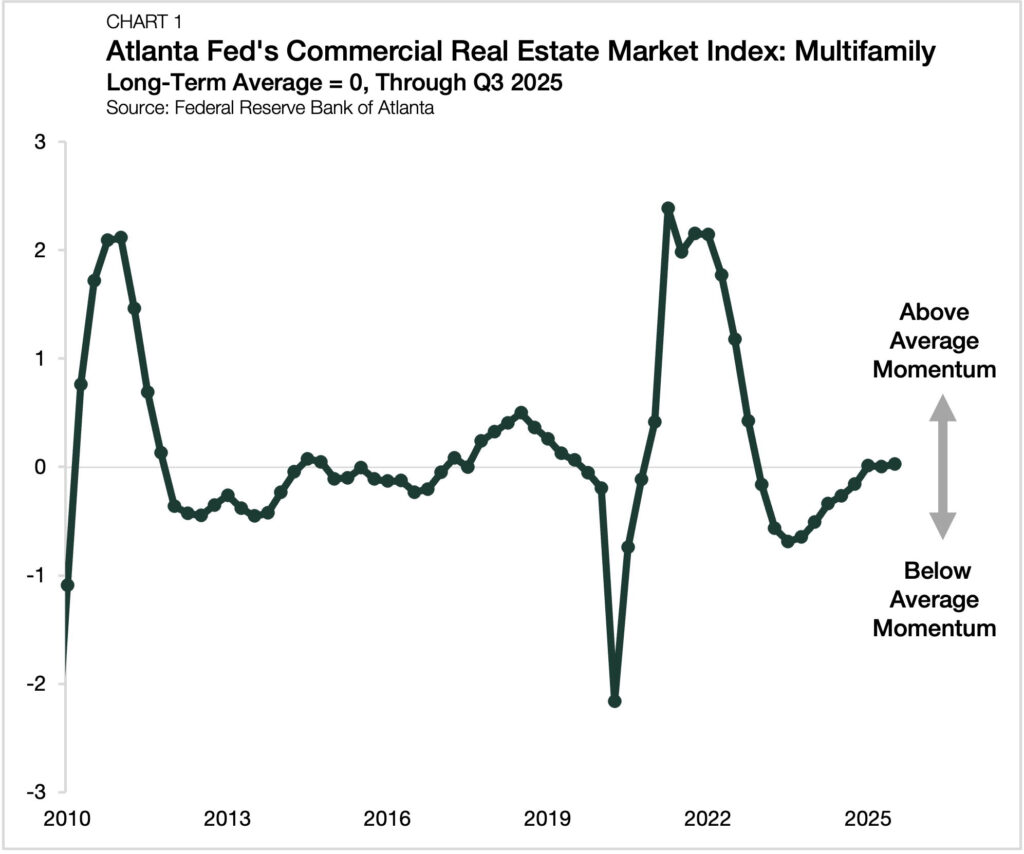
Commercial Real Estate Market Index’s (CREMI) readings measure market momentum relative to each metro’s own long-run average, with positive and negative values indicating above-trend and below-trend performance in standard-deviation terms.
Markets with High and Low Levels of Momentum
While overall market momentum moderated nationally, several individual markets remained clear leaders. Nashville (+2.67) and Salt Lake City (+2.59) topped the list, each more than two standard deviations above their historical norms (Chart 2). Notably, both metros ranked in the top four in the latest Top Markets for Multifamily Investment Report from Arbor Realty Trust. In both cases, strong population inflows, diversified employment bases, and comparatively disciplined new supply pipelines have supported sustained above-trend performance.
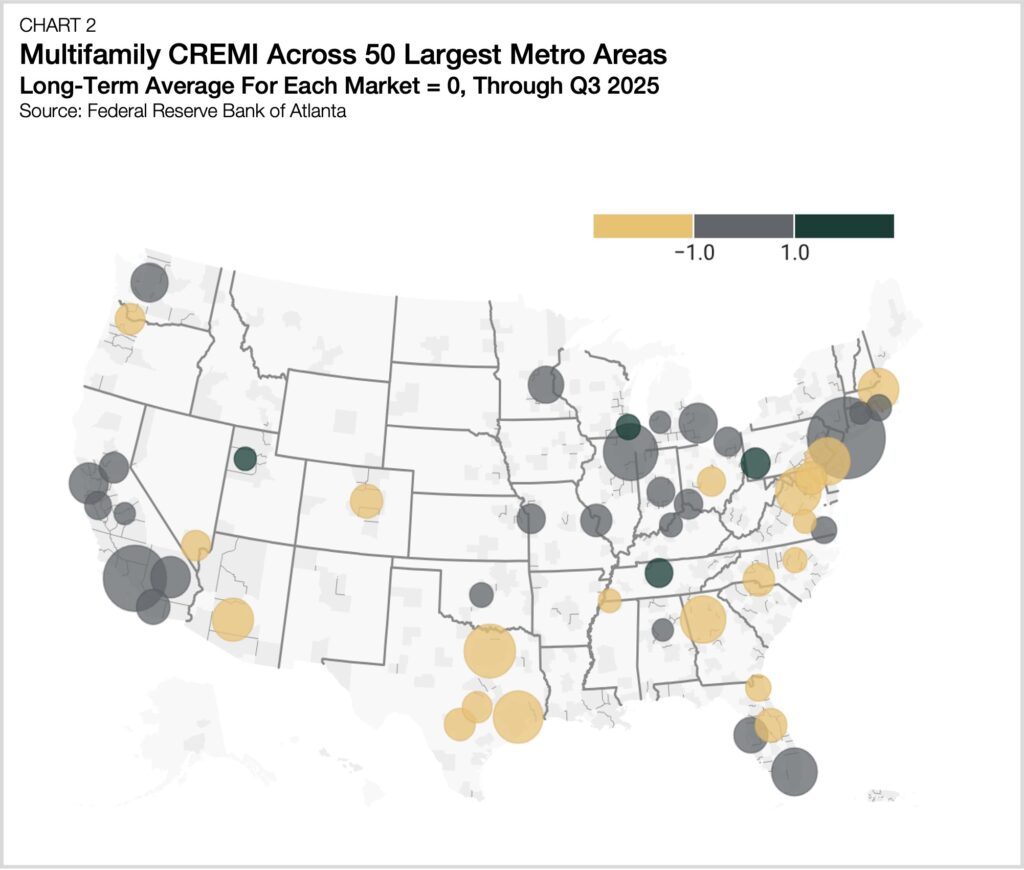
Milwaukee (+2.04) and Pittsburgh (+1.33) were also above trend, underscoring that recent outperformance was mostly concentrated in Midwest markets. The region’s relative affordability, stable job bases, and strong development activity have combined to create favorable supply-demand dynamics.
Denver (-2.19), San Antonio (-2.08), and Portland (-2.00) sat at the bottom of the Q3 2025 rankings, each roughly two standard deviations below their long-run averages. In all three cities, elevated development pipelines collided with higher financing costs and softer demand growth, slowing market momentum and reflecting the ongoing presence of cyclical and structural headwinds.
The Bottom Line
Multifamily investment opportunities are often localized. With national momentum holding steady, market-level fundamentals, including demographics, supply discipline, and employment composition, will continue to influence real estate investment outcomes and capital deployment decisions. In the year ahead, metros with favorable supply-demand fundamentals and population growth trends will be the most attractive markets for investment.
Interested in the multifamily real estate investment market? Contact Arbor today to learn about our array of multifamily, single-family rental, and affordable housing financing options or view our multifamily articles and research reports.