

Renters Now Represent 80% of Household Growth
- Renters accounted for nearly 80% of total household growth in 2025, supported by active new development pipelines and continued constraints in the homebuying market.
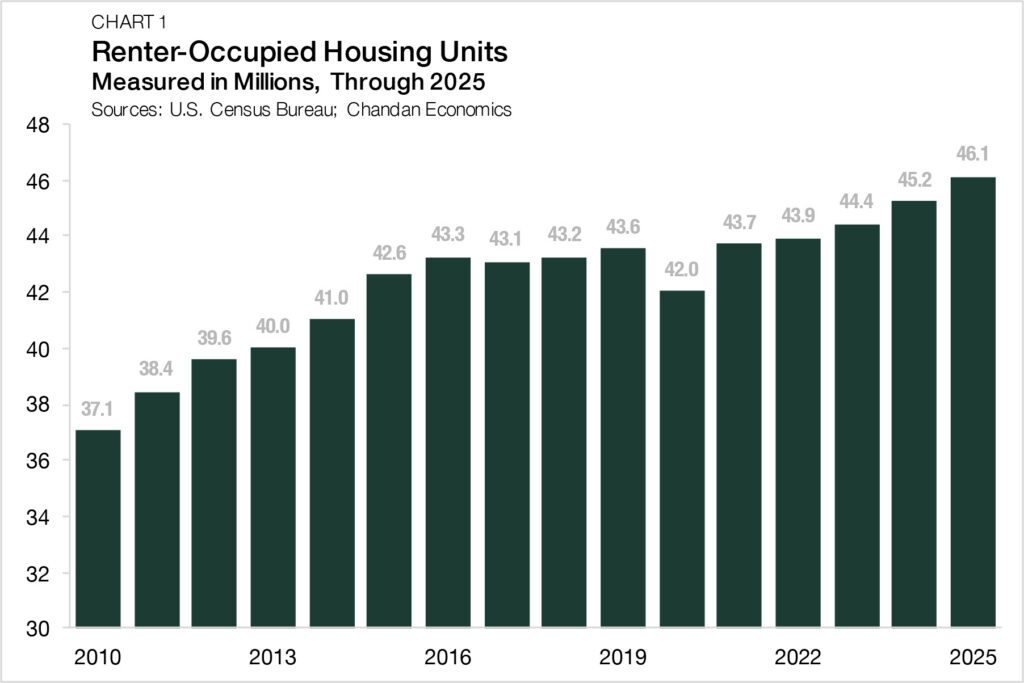
- The number of rental households increased by 898,000 in 2025, a 2.0% increase that raises the total to 46.1 million.
- Rental household expansion significantly outpaced owner-occupied housing growth, which rose 0.3% (or 234,000 households).
Renters accounted for roughly four-in-five new households last year, demonstrating how much rental demand has climbed while the for-sale housing market remains soft.
Based on an analysis of U.S. Census Bureau data, Arbor Realty Trust and Chandan Economics examine how rental and homeowner growth in 2025 compare and outline the economic factors supporting the rise in demand across multifamily and single-family rental (SFR) housing.
Rental Households Accelerate
The number of rental households in the U.S., across all property types, increased by 898,000 in 2025, rising from 45.2 million to a new record high of 46.1 million (Chart 1). In contrast, the number of owner-occupied households rose by just 234,000 over the same period, reaching 86.6 million.
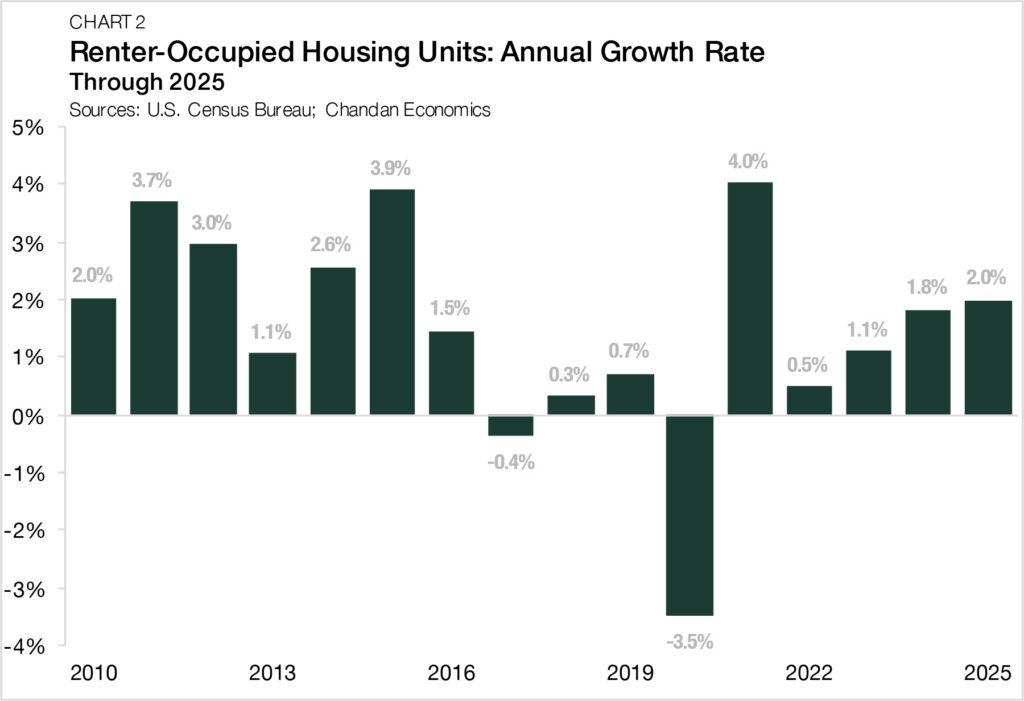
The relative annual increase for the rental housing sector was 2.0% last year — accelerating from 1.8% in 2024 and far outpacing the 0.3% growth rate of owner-occupied households (Chart 2).
Measured together, renter and owner household growth contributed to a total increase of roughly 1.13 million occupied housing units in 2025, with renters accounting for 79.3% of that expansion.
Excluding a pandemic-era rebound in 2021, last year marked one of the strongest annual increases in rental household growth since the mid-2010s. Despite some variability in recent years, total rental demand has been increasing nearly every year since the Great Recession, with only brief declines in 2017 and 2020.
Supporting Factors
This surge in rental household growth hasn’t occurred in isolation. It has been driven by several structural and cyclical factors. A strong new development pipeline, persistent affordability challenges in the for-sale market, and evolving renter preferences were integral in supporting rental household growth in 2025.
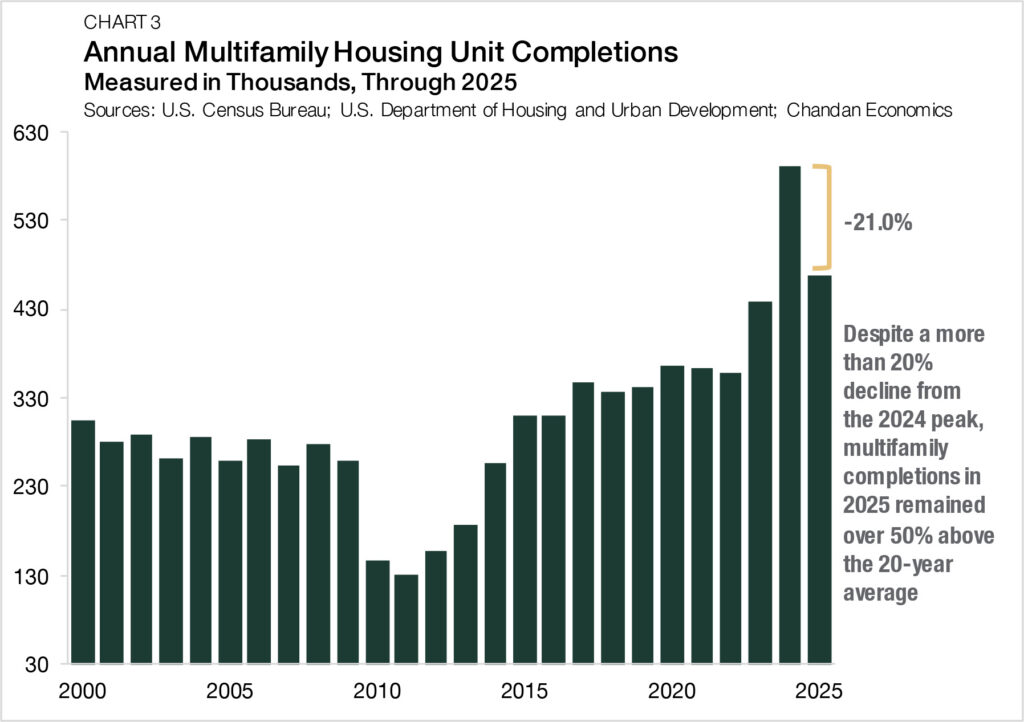
Builders completed roughly 467,000 multifamily units nationally last year (Chart 3). While it is a sizable decline, down 21% from its 2024 peak, completions remained more than 50% above the 20-year average, which indicates that the pace of new development continues to be historically elevated even as deliveries normalize.
Within the single-family construction sector, the growing adoption of build-to-rent (BTR) development has also significantly elevated rentable inventory. Even as the volume of BTR starts has recently retreated from all-time highs, the current pace of production remains higher than at any point before 2022.
Renter demand also continues to be supported by household preferences and mobility considerations. Among renters planning to move within the next year, a majority (59%) reported plans to continue renting, while a smaller share (37%) indicated plans to purchase a home, reflecting a modest pullback in homebuying intent.
Constraints on homeownership continue to shape tenure outcomes. Mortgage rates remained elevated throughout 2025, holding above 6%, limiting affordability and making the transition into homeownership more challenging for renters with an intent to buy.
The Bottom Line
Rental households account for roughly 35% of all occupied households but drove 4 of 5 household formations in 2025, reinforcing their central and growing role in housing demand. While multifamily and BTR construction have begun to moderate, the new development pipeline remains active as demand for premium rental housing expands.
Due to market conditions, for-sale housing activity has been soft. Mortgage rates moved higher in March 2026, jumping by 40 bps in less than a month as geopolitical tensions, including the war in Iran, drove volatility in energy and financial markets.
Even though the number of potential home sellers has grown, entrenched high home prices and renewed increases in mortgage rates continue to constrain would-be homebuyers, underscoring the ongoing need for more quality rental housing that can meet the demand of a growing population of renters.
Interested in the multifamily real estate investment market? Contact Arbor today to learn about our array of multifamily, single-family rental, and affordable housing financing options or view our multifamily articles and research reports.