

Senior Renters Prefer Multifamily Housing and City Living

- A majority of senior renters live in multifamily housing, with a relatively even split between those residing in small and large multifamily buildings.
- Compared with all renters, senior renters more often choose multifamily and urbanized living, reflecting downsizing trends and a growing preference for amenity-rich communities.
- Las Vegas, NV, and North Port-Sarasota, FL, remained top destinations for senior renters, while Boise, ID, Greenville, SC, and Knoxville, TN, are quickly attracting more relocating retirees.
Senior renters are increasingly choosing multifamily housing, with more than half now living in these rental properties, according to new data from the U.S. Census Bureau’s American Community Survey. Where they live — both by property type and by metropolitan area — provides insight into how housing preferences, local market conditions, and migration patterns shape rental housing demand.
Senior Renters Increasingly Choose Multifamily
Seniors, those 65 years of age and older, accounted for 18.0% of the U.S. population, 28.4% of all households, and 17.4% of renter households through 2024. Senior-renter households are spread across the rental stock, but the majority live in multifamily housing. In 2024, 54.4% of senior renter households lived in multifamily properties, including 28.1% in small multifamily buildings and 26.3% in large multifamily properties (Chart 1).
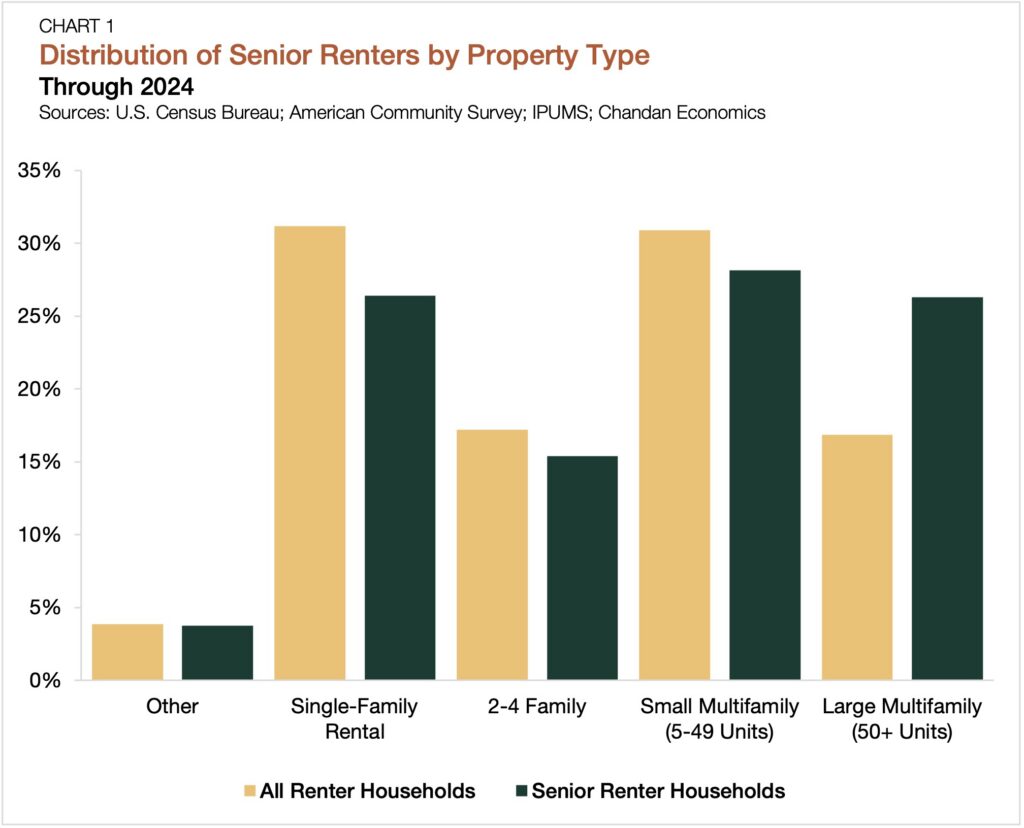
Compared with all renter households, senior renters are notably more concentrated in large multifamily housing (50+ units). While 26.3% of senior-renter households live in large multifamily properties, the percentage for all renter households in large buildings is just 17.0%, clearly distinguishing seniors from the broader renter population.
By contrast, senior-renter households are a little less concentrated in single-family rentals and smaller-scale rental properties. Roughly 26% of senior renters lived in single-family rentals through 2024, five percentage points below the share for all renters.
The growing presence of seniors in multifamily, and especially large multifamily, may reflect a combination of life-stage dynamics and location preferences. These types of households generally need less space than younger families, particularly after children leave home, making downsizing more natural. At the same time, the elevated large multifamily share in more urbanized settings suggests that proximity to amenities, services, healthcare, and transit may be attracting senior renters to denser rental environments.
Senior-Renter Hubs and Destination Markets
Beyond property type, location patterns reveal where senior-renter demand is trending. To identify the markets with the strongest senior-renter demand, we evaluated metropolitan areas across two dimensions:
- Senior renter households as a share of all households, which captures the current footprint of senior-renter demand.
- In-migrating senior renter households as a share of all senior-renter households, which captures recent momentum.
Together, these measures distinguish between markets with a large existing senior-renter base and those actively attracting new senior renter demand.
Markets with a high senior renter share of all households but low in-migration stand out as legacy senior-renter hubs. These are areas, such as New York, NY, New Haven, CT, Boston, MA, and Providence, RI, where senior renters already make up a sizable part of the housing landscape, but where new inflows are more limited (Chart 2).
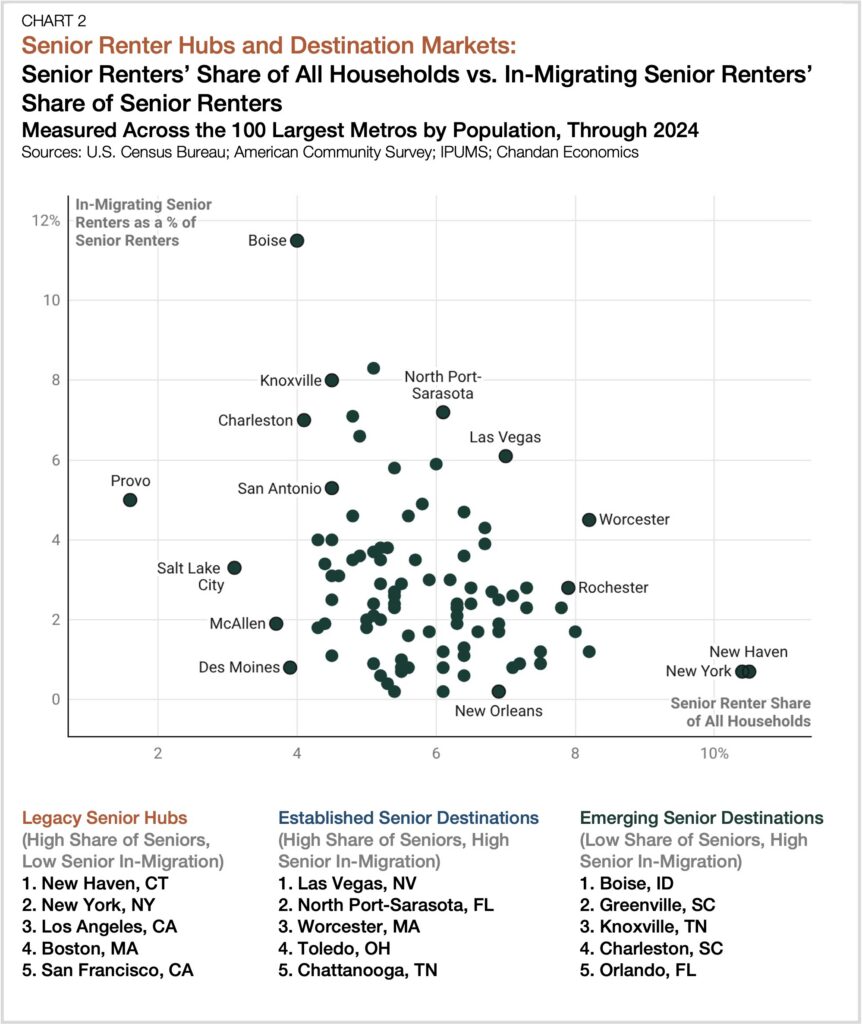
Multifamily markets that scored highly combine a sizable senior-renter footprint with continued inbound demand, suggesting that seniors there are not just aging in place, but the areas are attracting more senior renter households. Las Vegas, NV, and North Port-Sarasota, FL, are notable examples of established senior-renter destinations.
The second set of markets is more emerging in nature, with smaller existing senior-renter footprints but stronger recent in-migration patterns. Markets including Boise, ID; Greenville, SC; Knoxville, TN; and Charleston, SC, have recently seen strong senior renter demand.
Taken together, many established senior-renter destinations and emerging destination markets share similarities. They are smaller or secondary metropolitan areas with lower taxes that feature a blend of amenities, accessibility, and relative affordability. For senior renters, areas with this mix can be especially attractive as they combine the conveniences of metropolitan living with lower housing and living costs than major gateway markets.
The Bottom Line
Senior renters are not heavily concentrated in just one segment of the housing market, but this demographic is clearly tilting toward multifamily housing, particularly larger properties. The new pattern may result from the appeal of lower-maintenance living, downsizing, and access to services and amenities as households age.
As seniors continue to relocate, the list of leading destinations is reshuffling. For multifamily real estate investors, the most compelling senior-renter markets are not just those with a large existing base, but those continuing to attract new senior renters.
Interested in the multifamily real estate investment market? Contact Arbor today to learn about our array of multifamily, single-family rental, and affordable housing financing options or view our multifamily articles and research reports.