

Where Multifamily Permitting is Intensifying and Accelerating
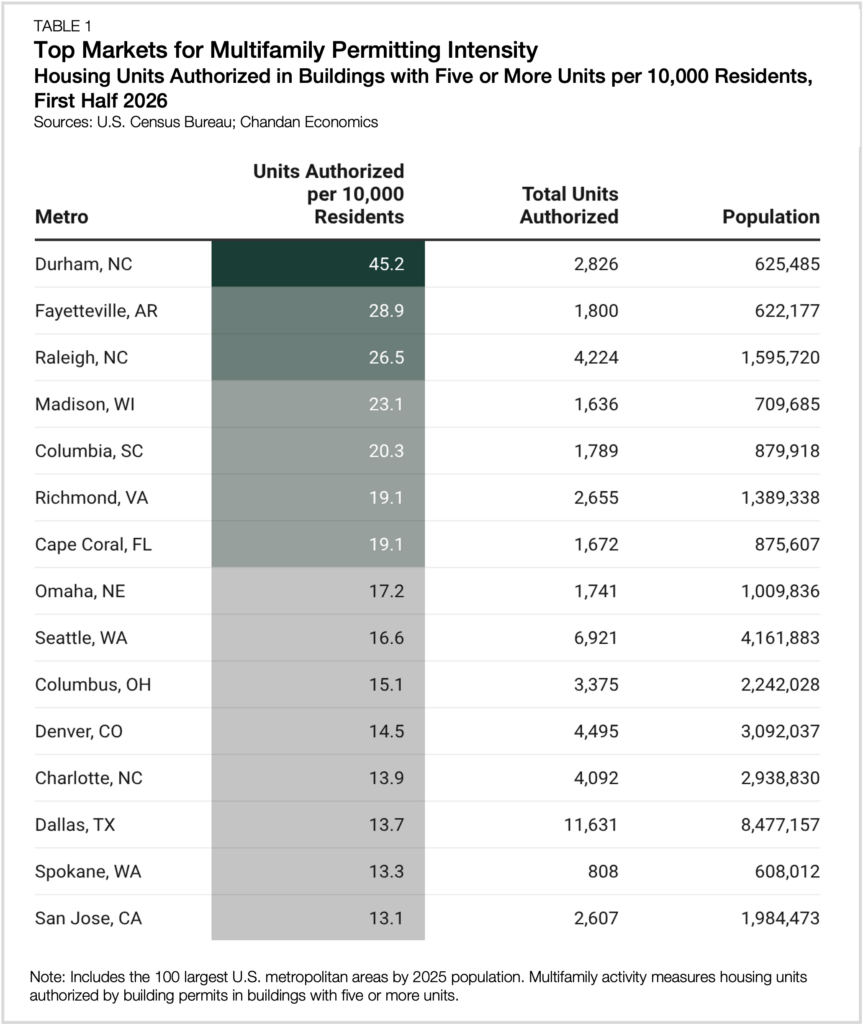
- Durham, NC, led the country in multifamily permitting intensity, with 45.2 units authorized per 10,000 residents during the first half of 2026.
- Columbia, SC, and San Jose, CA, ranked first and second, respectively, in year-over-year growth of authorized multifamily units.
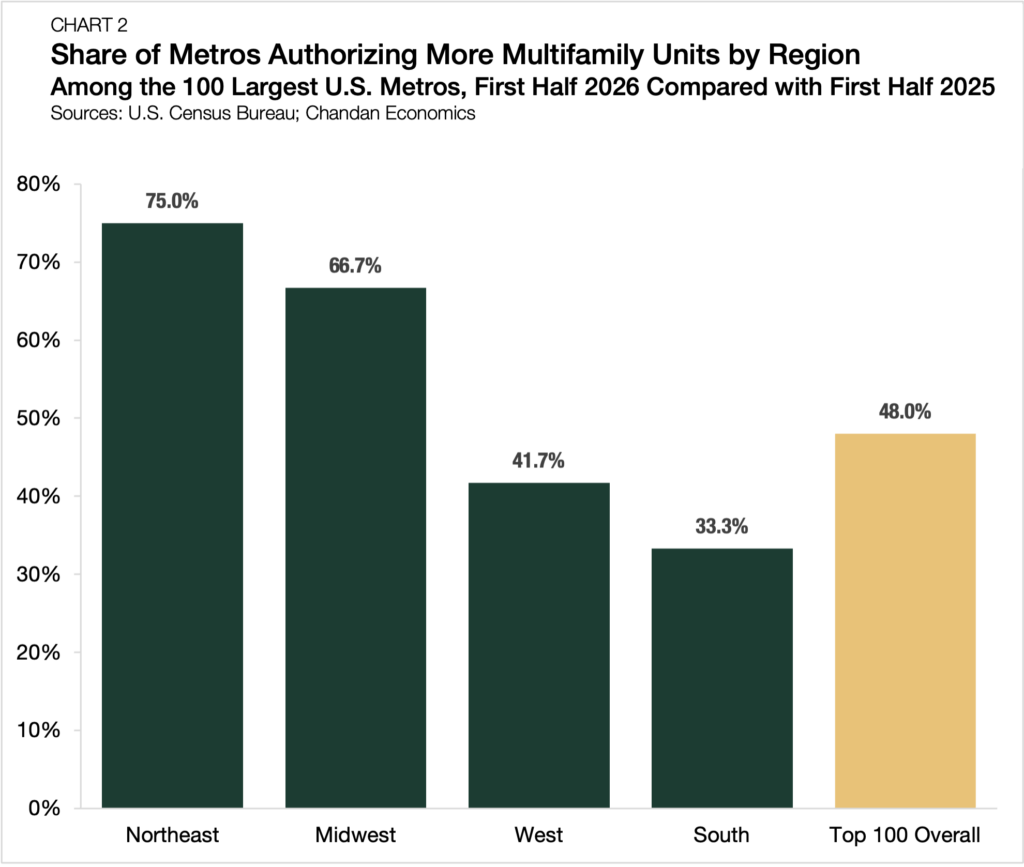
- Multifamily permitting increased across most Northeast and Midwest metros but declined across most Southern markets.
While national multifamily permitting stabilizes, the authorization of new apartment buildings with five or more units has become more heavily concentrated in smaller, rapidly growing metropolitan areas. From Durham, NC, to Fayetteville, AR, and Raleigh, NC, new U.S. Census Bureau data reveal where multifamily permitting was most concentrated and where it was accelerating fastest in the first half of 2026.
Market Leaders in Permitting Intensity
Durham led the 100 largest U.S. metros in multifamily permitting intensity in the first six months of the year (Table 1). The vibrant North Carolina market authorized 2,826 units in buildings with five or more units, equaling 45.2 units per 10,000 residents. Durham’s permitting was 56% higher on a per-capita basis than Fayetteville, the next highest ranking market.
Durham’s elevated permitting activity coincides with strong demographic and economic fundamentals. Located less than 10 miles from Research Triangle Park — a leading center for engineering, scientific research, biomedical science, and other STEM-related industries — Durham’s job market benefits from a deep local talent base supported by Duke University, the University of North Carolina at Chapel Hill, and NC State University. Population, employment, and wage growth remain above the national average in the area. Durham, ranked second nationally in the Geography of Prosperity Index, also received high marks for strengths like automation readiness and climate resilience.
Fayetteville ranked second for permitting with 1,800 multifamily units authorized, or 28.9 per 10,000 residents. Its permitting rate nearly doubled from 14.9 units per 10,000 residents a year earlier. Population growth in this northwest Arkansas market reached 2.4% in 2025 and has not fallen below 1.9% annually since 2011. At the same time, the University of Arkansas reported a record-breaking enrollment of more than 34,000, adding depth and strength to the local labor market.
Raleigh rounded out the top three with 26.5 units authorized per 10,000 residents. Together with Durham, Columbia, SC, and Charlotte, NC, the Carolinas had four metros ranked in the top 12, a high concentration of building activity that was driven by population growth. In 2025, South Carolina led the nation in population growth at 1.5%, while North Carolina ranked third at 1.3%, according to the U.S. Census Bureau.
Across the 100 largest U.S. metros, permitting intensity was concentrated in smaller markets.
Seven of the top eight have fewer than 1.5 million residents, with Raleigh being the only exception. Durham and Fayetteville, two markets where the development pipeline has expanded sharply, each have approximately 625,000 residents and rank 93rd and 94th, respectively, by population.
Where Permitting Is Accelerating
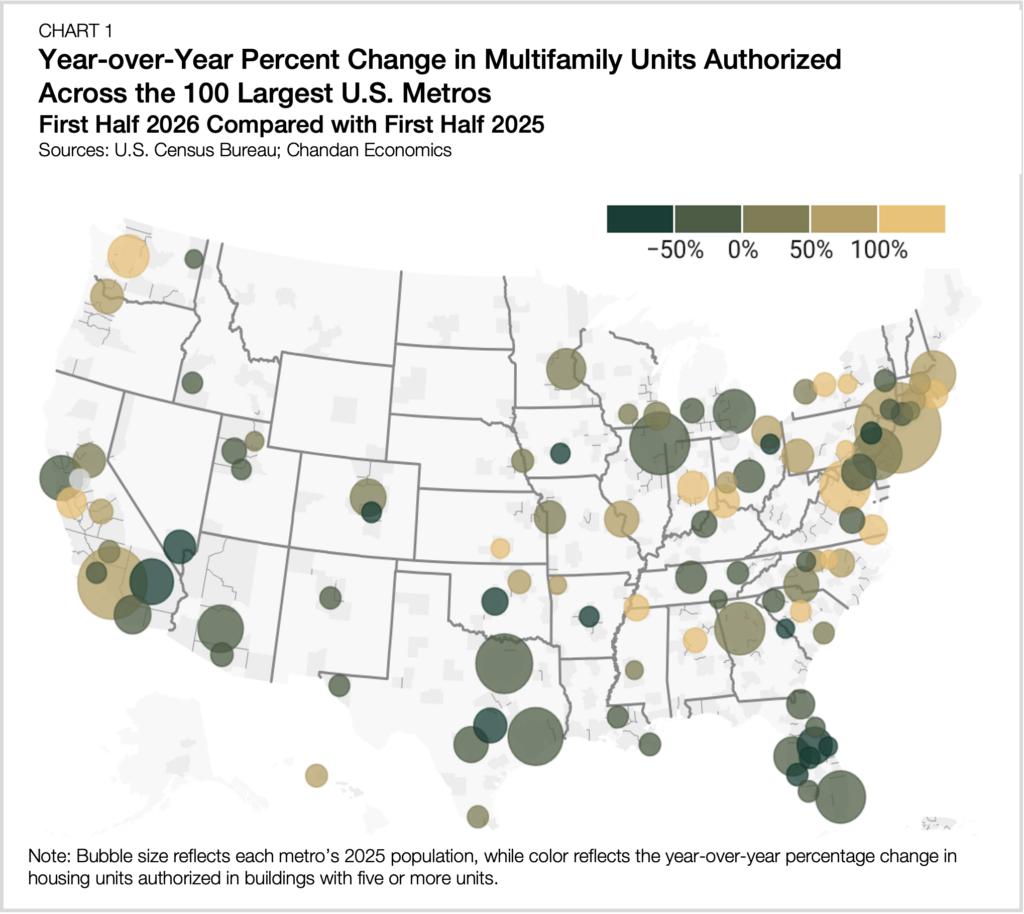
Columbia stands out as a leading market in both permitting intensity and momentum rankings. After placing fifth in permitting intensity, Columbia recorded the largest year-over-year increase, with its number of multifamily units authorized climbing 468% (Chart 1).
Columbia’s performance also reinforces a broader pattern found within the Carolinas, a notable exception to the soft performance of many Southern markets. While the South had the lowest share of any region of metros that authorized more multifamily units than a year earlier (Chart 2), six of the 14 Southern markets with positive year-over-year growth were in the Carolinas.
San Jose, CA, ranked second in permitting acceleration with a 366% increase. The California metro has been taking concrete steps to unlock housing development through fee reductions and tax incentives. Demand conditions also remain favorable, with multifamily rents rising 6.2% year-over-year in June — the fourth-fastest pace among the 100 largest U.S. metros, according to a Chandan Economics analysis of Zillow data.
Virginia Beach, VA, followed in third with a 342% increase. It has recently expanded municipal support for multifamily development, including a new workforce-housing grant program designed to encourage the construction of affordable rental housing.
Syracuse, NY, and Providence, RI, complete the top five with increases of 287% and 243%, respectively. The Northeast’s strength extended well beyond those two metros: 12 of its 16 top 100 markets authorized more multifamily units than a year earlier, the highest share of any region.
The Bottom Line
Multifamily permitting has settled into a steady range nationally, but regional and local patterns continue to shift. Smaller, fast-growing metros, including several in the Carolinas, led on a per-capita basis, while year-over-year improvement was much more widespread in the Northeast and Midwest than in the South. At the same time, the markets posting the sharpest increases hail from all regions of the country. Taken together, the findings indicate that multifamily permitting is shaped more by local demand, demographic growth, and conditions conducive to development than by a single regional cycle.
Interested in the multifamily real estate investment market? Contact Arbor today to learn about our array of multifamily, single-family rental, and affordable housing financing options or view our multifamily articles and research reports.