
Arbor Realty Trust’s research articles and reports, developed in partnership with Chandan Economics, refer to and cite credible third-party sources, including: American Real Estate Society CoStar Fannie Mae Federal Deposit Insurance Corporation (FDIC) Federal Housing Finance Agency (FHFA) Federal Reserve Bank of Atlanta Federal Reserve Bank of New York Federal Reserve Board FINSIGHT Freddie Mac Moody’s CRE Morningstar DBRS MSCI Real Capital Analytics Nareit National Apartment Association National Association of Home Builders National Low Income Housing Coalition National Multifamily Home Council Novogradac Trepp U.S. Bureau of Economic Analysis U.S. Bureau of Labor Statistics U.S. Census Bureau U.S. Department of Housing and Urban Development (HUD) Zillow

Affordable Housing
Fall 2025
About This Report
The Arbor Realty Trust Affordable Housing Trends Report Fall 2025, developed in partnership with Chandan Economics, explores the most critical recent developments in the affordable and workforce housing sectors.
Key Takeaways
-
11 million renter households face affordability challenges as severe underbuilding in many West Coast, Northeast, and Great Lakes metros restricts supply.
-
The One Big Beautiful Bill Act expands Low-Income Housing Tax Credits (LIHTC) and Opportunity Zones, aiming to accelerate affordable housing construction.
-
State-level reforms employ supply-side housing policies to spur development.

State of the Market
As public attention focuses on cost of living, the affordable housing sector contains both new opportunities and lingering challenges. According to the National Low Income Housing Coalition, the U.S. now has a 7.1-million-unit rental home shortage. While the 2025 total is down roughly 200,000 units from last year, the overall shortfall impacts nearly 11 million households.
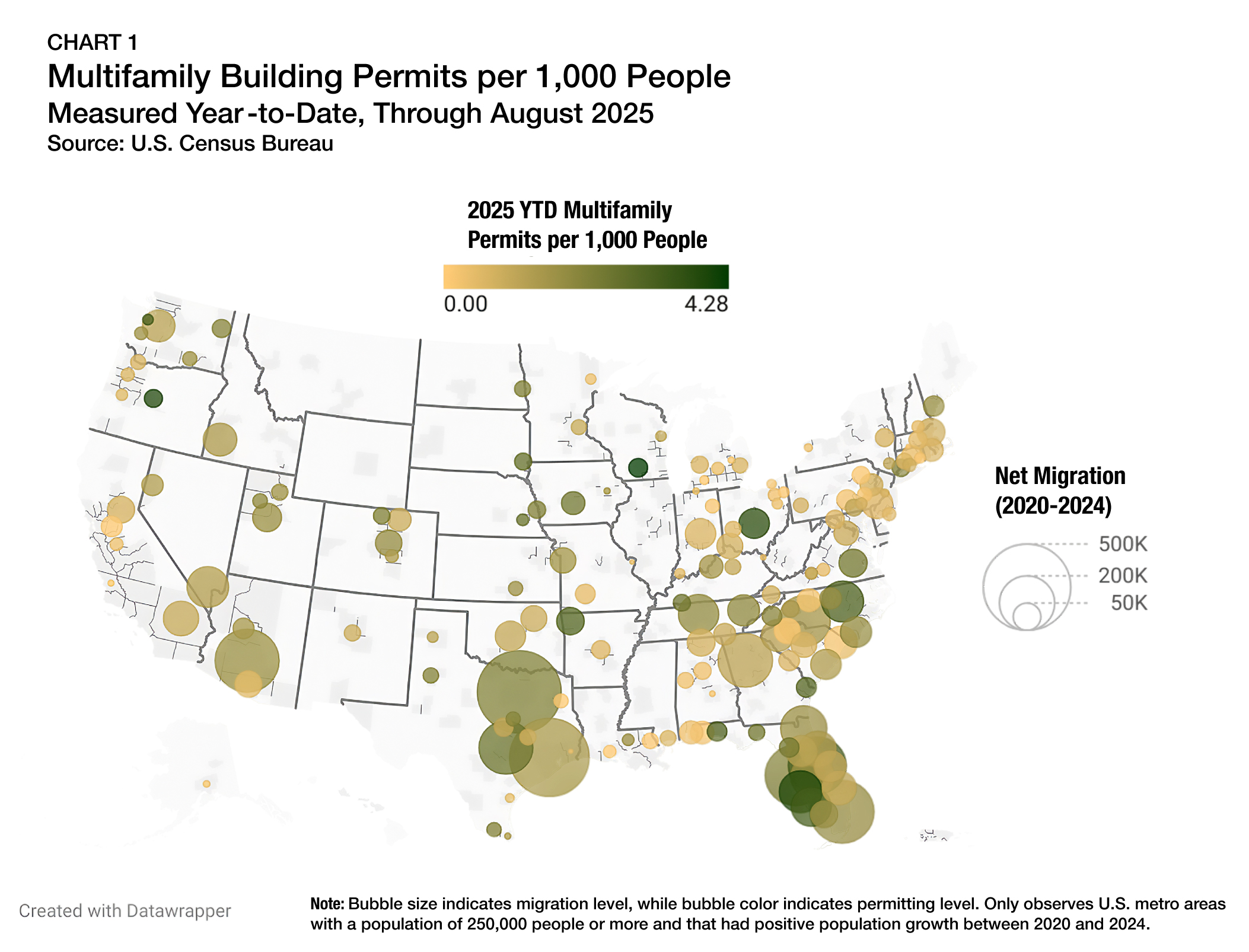
New construction alone has been unable to alleviate the shortage. Although housing starts picked up this year, multifamily building permits retreated to pre-pandemic levels. In metropolitan areas with positive net migration between 2020 and 2024, over half (54%) of these markets averaged less than one multifamily building authorization per 1,000 residents in 2025.
Across the country, the creation of affordable housing has been uneven. West Coast, Northeast, and Great Lakes metro areas have seen the most severe underbuilding. Pockets in the Appalachian region and the Midwest have also seen low construction activity, limiting housing options amid growing demand for rentals (Chart 1).
Following years of underbuilding, early signs of a policy pivot have emerged. Recently enacted federal and state laws, including the One Big Beautiful Bill Act (OBBBA), are expected to increase affordable housing construction.
Permanent expansions of Low-Income Housing Tax Credits (LIHTC) and opportunity zones are projected to bring needed capital to underserved areas. At the same time, a dovish interest-rate outlook could prompt a rebound in development activity.
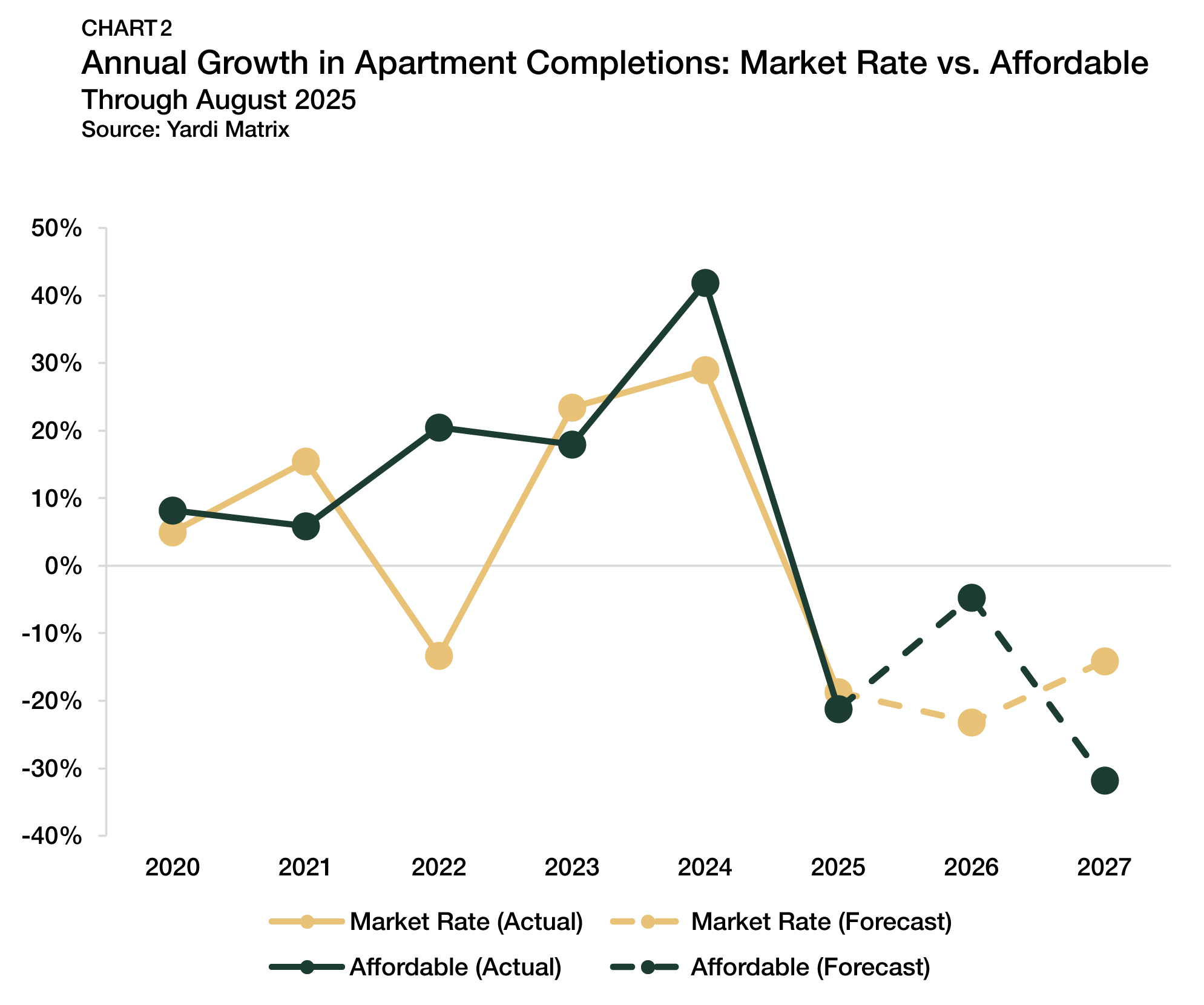
In August, Yardi Matrix forecasted that market-rate apartment deliveries were on pace to decline by 37.5% in 2026 compared to 2024, while affordable housing deliveries were projected to drop only 25%, perhaps signaling the start of a new trend (Chart 2).
At the state level, Texas, Colorado, and California, which have among the highest numbers of severely cost-burdened low-income households, passed legislation last year designed to tackle affordability challenges. To comprehensively address the affordable housing crisis, both housing shortages and risk barriers in today’s financial environment need to be considered. Heading into 2026, both fiscal and monetary winds will carry some of the seeds for this alignment.
OBBBA Expands LIHTC Program
At a time when cost-of-living pressures are high, OBBBA could be the most consequential federal law for housing affordability in the last decade. Passed in July 2025, the legislation included several notable pro-housing-supply provisions. One of its key features is a permanent funding increase of LIHTC, which allows states to subsidize the construction of new affordable rental housing.
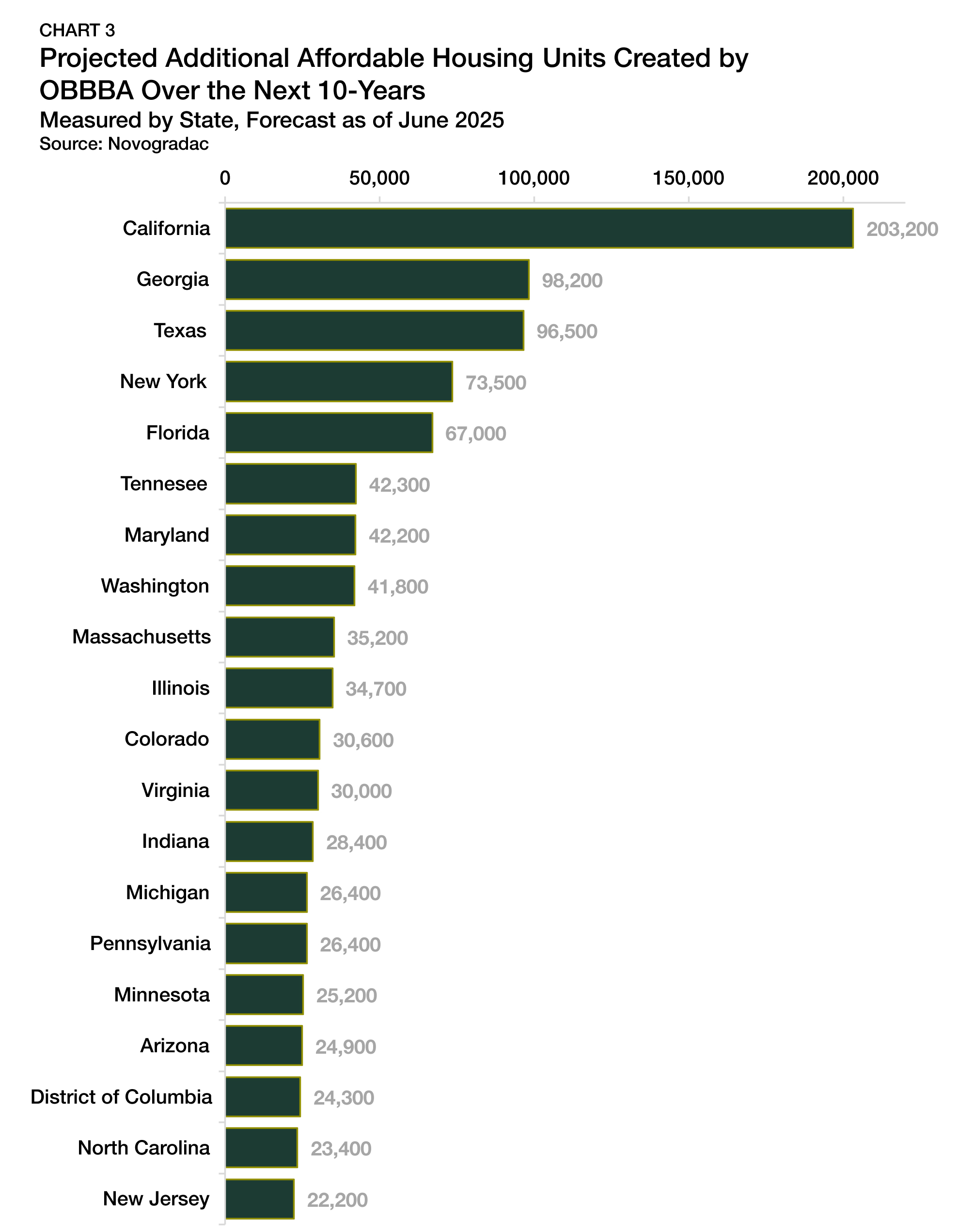
OBBBA permanently extended a 12.5% funding increase for each state’s 9% LIHTC allocations, which can at times cover up to 70% of an eligible project’s development costs, making more projects feasible. As a result, total LIHTC allocations are estimated to grow by 50% over the next two years and support the construction of an additional 1.22 million affordable rental homes between 2026 and 2035 (Chart 3).
The OBBBA also amended the financing requirements for projects that use the 4% rehabilitation LIHTC. Previously, projects using this rehabilitation credit were required to finance 50% of their capital stack using municipal private activity bonds (PABs). Now, the threshold for PABs has been lowered to 25% of the capital stack, allowing for a wider range of potential rehab projects to benefit from LIHTC.
The OBBBA LIHTC extension also provides more of an incentive for Fannie Mae and Freddie Mac to support affordable housing development. After it was signed into law, the Federal Housing Finance Agency (FHFA) announced it was doubling the yearly amount Fannie Mae and Freddie Mac can each invest in “safe and sound LIHTC properties,” from $1 billion to $2 billion. Half of these allocations are reserved for markets where LIHTC has faced challenges serving local needs, with at least 20% of that half designated for rural communities.
Key industry groups like the National Multifamily Home Council (NMHC) and National Association of Homebuilders (NAHB) have hailed the FHFA‘s response as essential, with NAHB chairman Buddy Hughes stating that he expects the newly deployed capital “will allow builders to construct and rehabilitate badly needed rental housing.”
OBBBA Expands Opportunity Zones
OBBBA Expands Opportunity Zones In addition to LIHTC expansions, the OBBBA also made Opportunity Zones a permanent part of the tax code. First created under the 2017 Tax Cut and Jobs Act (TCJA), opportunity zones were designed to encourage long-term private investment into underserved communities with reduced and deferred capital gains taxes.
Roughly 8,700 of these types of zones exist nationally. State governors nominate census tracts for designation in each state which are then certified by the U.S. Treasury Department. Investors can use what is known as a Qualified Opportunity Fund (QOF) to channel private capital gains into eligible projects.
Detractors of Opportunity Zones often point to research showing that designated census tracts with greater pre-existing investment and growth conditions tend to attract more investment than others. However, research has shown that multifamily housing is a key exception. A 2024 paper published in Journal of Economic Perspectives found that the opportunity zones policy increased the likelihood of new residential development projects in a collection of large U.S. cities. New development increased by 20.5% in census tracts that received the credit and nearby tracts also had positive spillover effects.
To help address concerns of Opportunity Zones funds flowing into less-distressed areas, the OBBBA narrowed their scope to focus on investing in genuinely low-income areas. Census tracts must now meet a stricter requirement of 70% of the median income to be considered eligible, compared to the previous 80%. The law also removes contiguous tract allowances and establishes a poverty rate criterion for an Opportunity Zone, which was previously up to a state’s discretion.
Additionally, provisions in the law launched new rural-focused funds and enhanced incentives aimed at redirecting capital towards underserved markets. According to an analysis of the law by CohnReznick, the new Qualified Rural Opportunity Funds (QROF) must be used to develop or rehab buildings in areas with a population below 50,000. QROFs follow the same rules as a typical QOF but receive enhanced tax benefits in the form of a 30% step-up in basis when their deferred capital gain becomes taxable after five years, compared to 10% for typical QOFs.
State-Level Regulatory Reforms
In addition to federal initiatives, individual states play a critical role in steering supply-side reform. In California, which has a shortfall of about 3.5 million housing units, Governor Gavin Newsom signed two bills into law in June that aim to boost the production of affordable housing. The new legislation, which had rare bipartisan support in the state legislature, is designed to streamline the review process to allow more units to be built at a faster pace.
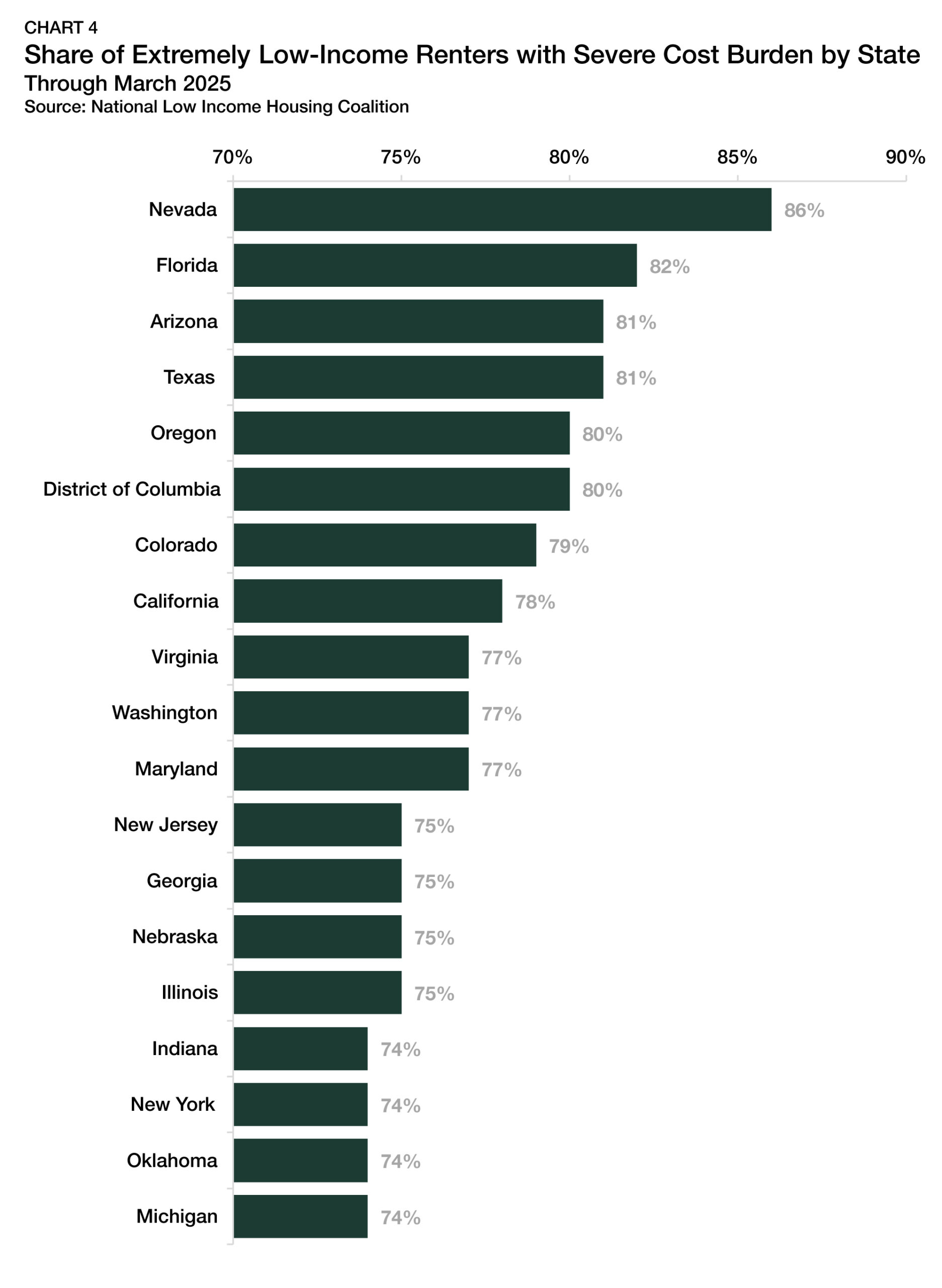
Affordable housing legislation has also advanced in Texas, where Governor Greg Abott signed three bills in August to help alleviate a statewide affordable housing crisis. The new legislation will curb minimum lot sizes and repeal rules regulating the design and parking requirements for specific properties, allowing for smaller and denser development. In addition, options for construction within the state will increase as commercial zones have been opened to mixed-use and multifamily development. According to the National Low-Income Housing Coalition, Texas ranks third nationally (887,927) in extremely low-income rental households that are severely cost-burdened and fourth in share of state population (81%) (Chart 4).
Meanwhile, the state of Washington opted for a mix of expansive and restrictive changes to housing policy. A new law caps annual rent hikes for existing tenants at 7% + inflation or 10% (whichever is lower), with a 5% cap for manufactured homes. The legislature simultaneously enacted measures that limit parking mandates, speed permit timelines, and enable commercial-to-residential conversions — all aimed at improving supply and increasing renter stability.
Looking Ahead
A weakening job market and sluggish wage growth present near-term obstacles to renters’ upward mobility, likely maintaining elevated demand for affordable housing.
Simultaneously, the federal housing agenda remains unsettled amid ongoing gridlock in Washington, D.C. Notably, the 2026 funding levels for key housing programs administered by the Department of Housing and Urban Development (HUD) remain to be determined.
However, there are still separate, ongoing efforts in both the House of Representatives and the U.S. Senate to advance affordable housing and community development legislation. The bipartisan ROAD to Housing Act, which, according to the National Multifamily Home Council (NMHC), would treat housing supply as critical infrastructure and tie zoning reforms to modernization incentives, could be a transformational development in affordable housing.
Although multifamily construction activity is expected to decline from recent cyclical highs next year, several financial barriers that have limited affordable housing investment are beginning to erode, which could lead to measurable progress. While significant challenges persist, the recent emergence of new tailwinds may result in meaningful progress in affordable housing development that will dovetail with investment opportunity.
For more affordable housing research and insights, visit arbor.com/research
Disclaimer
This report is intended for general guidance and information purposes only. This report is under no circumstances intended to be used or considered as financial or investment advice, a recommendation or an offer to sell, or a solicitation of any offer to buy any securities or other form of financial asset. Please note that this is not an offer document. The report is not to be considered as investment research or an objective or independent explanation of the matters contained herein and is not prepared in accordance with the regulation regarding investment analysis. The material in the report is obtained from various sources per dating of the report. We have taken reasonable care to ensure that, and to the best of our knowledge, material information contained herein is in accordance with the facts and contains no omission likely to affect its understanding. That said, all content is provided herein “as is” and neither Arbor Realty Trust, Inc. or Chandan Economics, LLC (“the Companies”) nor their affiliated or related entities, nor any person involved in the creation, production and distribution of the content make any warranties, express or implied. The Companies do not make any representations or warranties, express or implied, as to the reliability, usefulness, completeness, accuracy, currency nor represent that use of any information provided herein would not infringe on other third-party rights. The Companies shall not be liable for any direct, indirect or consequential damages to the reader or a third party arising from the use of the information contained herein. There may have been changes in matters which affect the content contained herein and/or the Companies subsequent to the date of this report. Neither the issue nor delivery of this report shall under any circumstance create any implication that the information contained herein is correct as of any time subsequent to the date hereof or that the affairs of the Companies have not since changed. The Companies do not intend, and do not assume any obligation to update or correct the information included in this report. The contents of this report are not to be construed as legal, business, investment or tax advice. Each recipient should consult with its legal, business, investment and tax advisors as to legal, business, investment and tax advice. The information contained herein may be subject to changes without prior notice. This report is only intended for the recipients, and should not be copied or otherwise distributed, in whole or in part, to any other person.