Articles

Single-Family Homes for Rent Reach 7-Year High

The number of households renting single-family homes rose 1.7% in 2025, reaching a seven-year high, according to a new Arbor Realty Trust and Chandan Economics forecast, based on an analysis of newly released U.S. Census Bureau data. Since the pandemic, the single-family rental (SFR) sector has stabilized, reversing recent household losses and regaining momentum.

Articles

New Affordable Housing Policies Expected to Expand Capital Access

The latest report in Arbor Realty Trust’s Affordable Housing Trends series, developed in partnership with Chandan Economics, explores lingering challenges and new opportunities in this critically important multifamily real estate sector. In a new video, Dr. Sam Chandan, one of the commercial real estate industry’s leading scholars, shares his take on the new research report and what its findings could mean for the future of affordable housing finance.

Uncategorized

Why Tenant Retention Drives Value for Multifamily Investors

With homebuying out of reach for many, more tenants are staying in the rental market longer than in previous cycles. This dynamic offers multifamily investors a strategic opportunity to focus on tenant retention, according to Dr. Sam Chandan, one of the commercial real estate industry’s leading scholars, who recently shared his expert insights on the 2026 Housing Outlook webinar with RentRedi.

Articles

Examining Multifamily Market-Level Conditions and Trends

Normalization was the thread that tied together multifamily real estate narratives in 2025. Asset valuations stabilized, cap rates held steady, and rent growth was balanced. Entering the new year, normalization is still driving the conversation, as shown by newly released data from the Federal Reserve Bank of Atlanta on real estate conditions and associated trends.

Articles

Arbor’s Holiday Drive Supporting LI Youth Exceeds Goal

Arbor Realty Trust recently wrapped up its 18th Annual Holiday Drive, which raised nearly $22,000 for Long Island-based Family & Children’s Association (FCA). As in past years, Arbor extended the impact of the drive by matching all employee contributions dollar-for-dollar.

Articles

Multifamily Households Estimate Hits Record High

The multifamily rental households estimate reached an all-time high of 22.4 million in 2025, following meaningful post-pandemic shifts in affordable housing and rental demand. The commercial real estate pillar maintained its growth, as new inventory and persistent homeownership constraints supported a rising number of multifamily household formations.

Articles

Dr. Chandan’s Guide to Arbor’s Top Multifamily Markets Report

In any multifamily project, site selection is a critical step requiring careful consideration. From New York to Los Angeles and all the major metropolitan areas in between, U.S. metros are ripe for new investment, but narrowing down the optimal location is never easy. In a new video, Dr. Sam Chandan, one of the commercial real estate industry’s leading scholars, shares his expert insight into Arbor Realty Trust’s latest Top Markets for Multifamily Investment Report.

General: 800.ARBOR.10


Turning a Corner

Multifamily Market Recalibration Moves to the Rearview

Key Findings

  • The multifamily real estate sector demonstrates clear signs of stabilization as housing supply imbalances ease and valuations rise.

  • As the Federal Reserve begins lowering interest rates, optimism is building in commercial real estate despite a cooling labor market and cautious consumer spending.

  • Recent shifts in federal policy have improved multifamily’s after-tax return profile and added new incentives to encourage deal flow.

The Outlook

The U.S. multifamily market enters the final stretch of 2025 on firm ground while the macroeconomic environment remains mixed. A cooling labor market, tariff-related risks, and cautious consumer spending have contributed to ongoing uncertainty. Despite these headwinds, the economy has demonstrated resilience and strength.

Within the sector, the case for bullishness is solidifying. Asset pricing has stabilized and returned to growth nationally, a majority of metro markets continued to see rent growth, and financing conditions have been normalizing.

Following the Federal Reserve’s quarter-point interest rate cut at its September 2025 meeting, markets anticipate it will lower the Federal Funds Rate by another 50 basis points (bps) this year and an additional 75 bps in 2026. As monetary policy loosens, lower interest rates are expected to encourage transaction activity and release pent-up demand, previously constrained by higher capital costs. Simultaneously, localized housing supply imbalances have improved, and new federal policies introduced tax benefits designed to encourage deal flow.

The multifamily market outlook — already trending upward — looks even brighter after the arrival of long-awaited interest rate relief. Suddenly, a new sense of urgency has brought investors back to the table, further reinforcing the sector’s short-term and long-term growth prospects.

Labor Market, Tariffs, and Consumer Spending

Ambiguity defines today’s economy. On the one hand, unemployment has remained in check, annualized GDP growth came in above 3% in the second quarter, and the S&P 500 continues to hit record highs. Looking only at these performance metrics would suggest the U.S. is enjoying a golden period of economic success. On the other hand, sources of uncertainty tell a different tale.

The White House’s tariff policy, first announced in April, has contributed to a sense of uncertainty felt from Wall Street to Main Street. In the roughly six months since then, full clarity has yet to emerge on which levies will stay in place or what their eventual net effect will be.

A common rule of thumb, supported by Moody’s chief economist Mark Zandi, is that a 1-percentage-point increase in tariffs adds roughly 10 basis points to inflation the following year. In a baseline scenario where all current tariffs remain in place, Yale’s Budget Lab estimated that consumers will face an overall average effective tariff rate of 17.4%, its highest level since 1935, after starting the year at 2.0%.

However, the IEEPA tariffs, which account for more than two-thirds of the total increase, continue to face legal tests and could moderate in the months ahead.1 Regardless of the outcome of legal challenges, tariffs will be a key consideration in the commercial real estate conversation going forward.

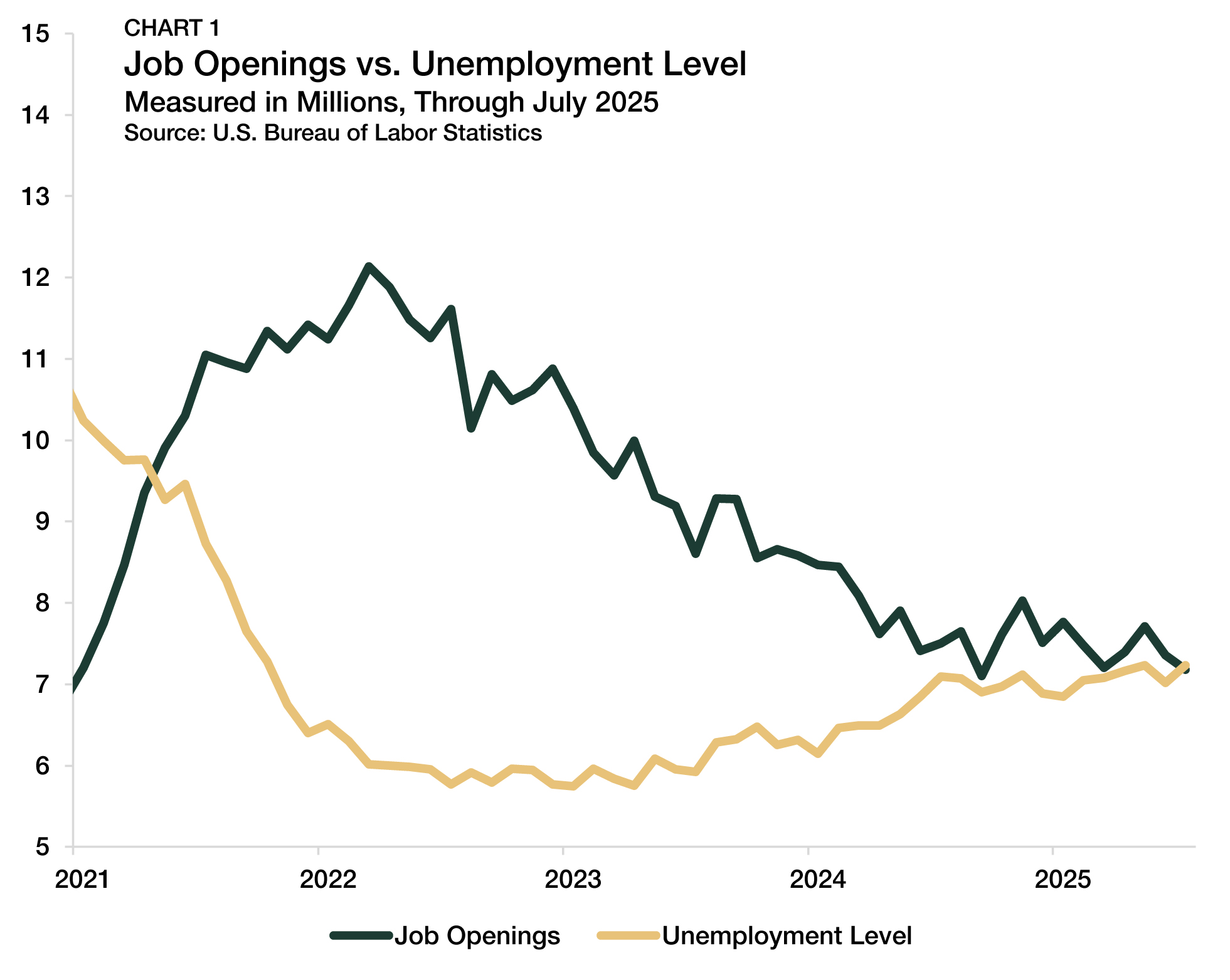
Meanwhile, momentum in the labor market has cooled. Recent readings show a downshift in hiring demand as the number of unemployed individuals outnumbers job openings for the first time since the spring of 2021 (Chart 1). The slowdown isn’t purely demand-side: labor supply has also eased at the margin as policy and enforcement changes have affected the pace at which new workers enter the U.S. labor force. Softer hiring and slower labor force growth have combined to create a modest drag on overall economic growth. 

1 International Emergency Economic Powers Act of 1977

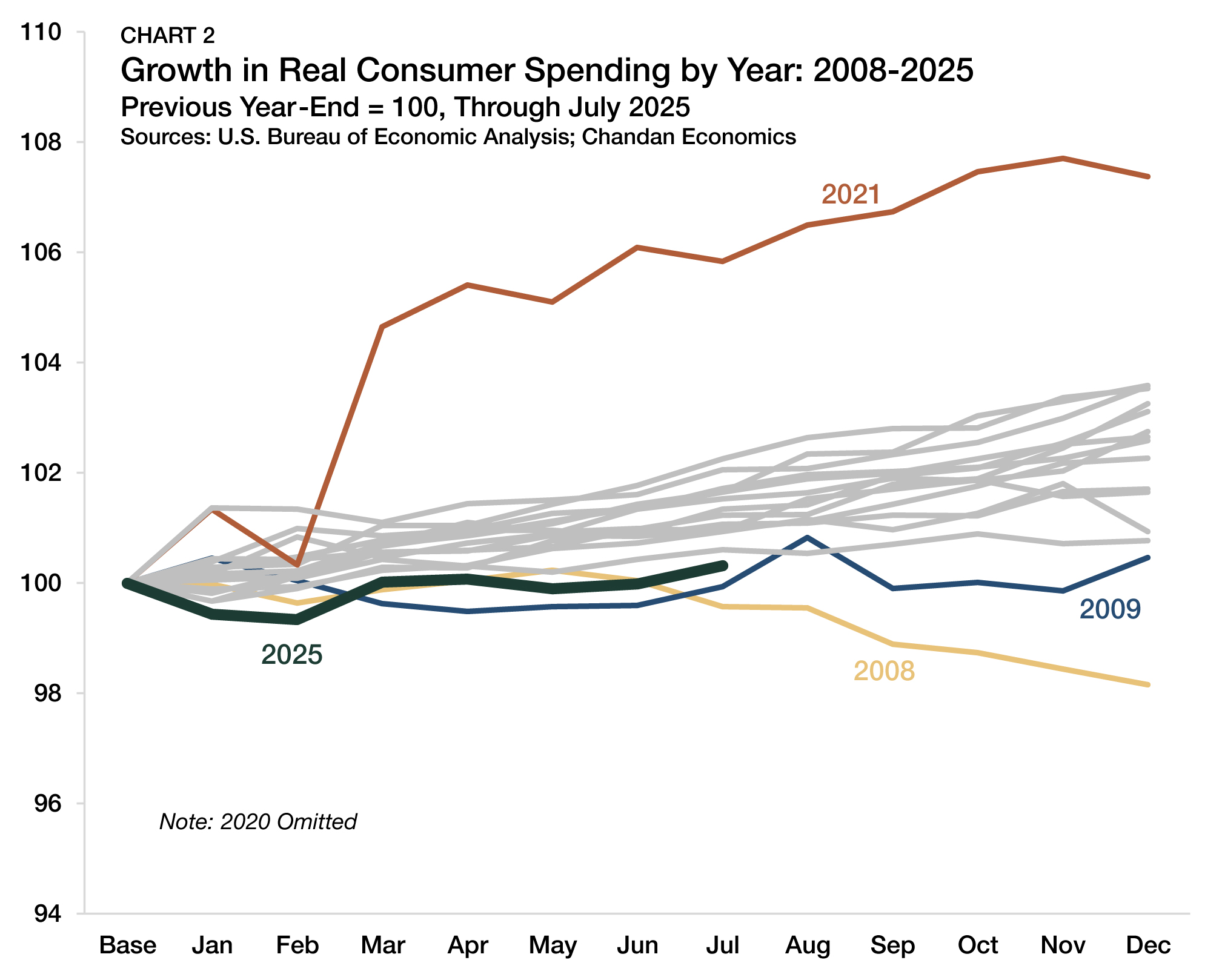
If the labor market softens further, consumer spending, the backbone of the macroeconomy, could feel the impact. Already, consumers have been tapping the brakes. Through July of this year, real consumer spending increased by just 0.3% (Chart 2). Since the Global Financial Crisis, only the years 2008, 2009, and 2020 have started slower. Given these factors, economists anticipate a modest — albeit still positive — trajectory of growth. Fannie Mae forecasts that 2025 GDP growth will land at 1.1%, down from 2.5% last year.

Market Remains Confident in Multifamily

The confidence displayed in the multifamily real estate sector’s recovery stands in stark contrast to the macroeconomy’s uncertainty. Multifamily ended the first half of 2025 with a period of recalibration in the rearview and a set of tailwinds at its back.

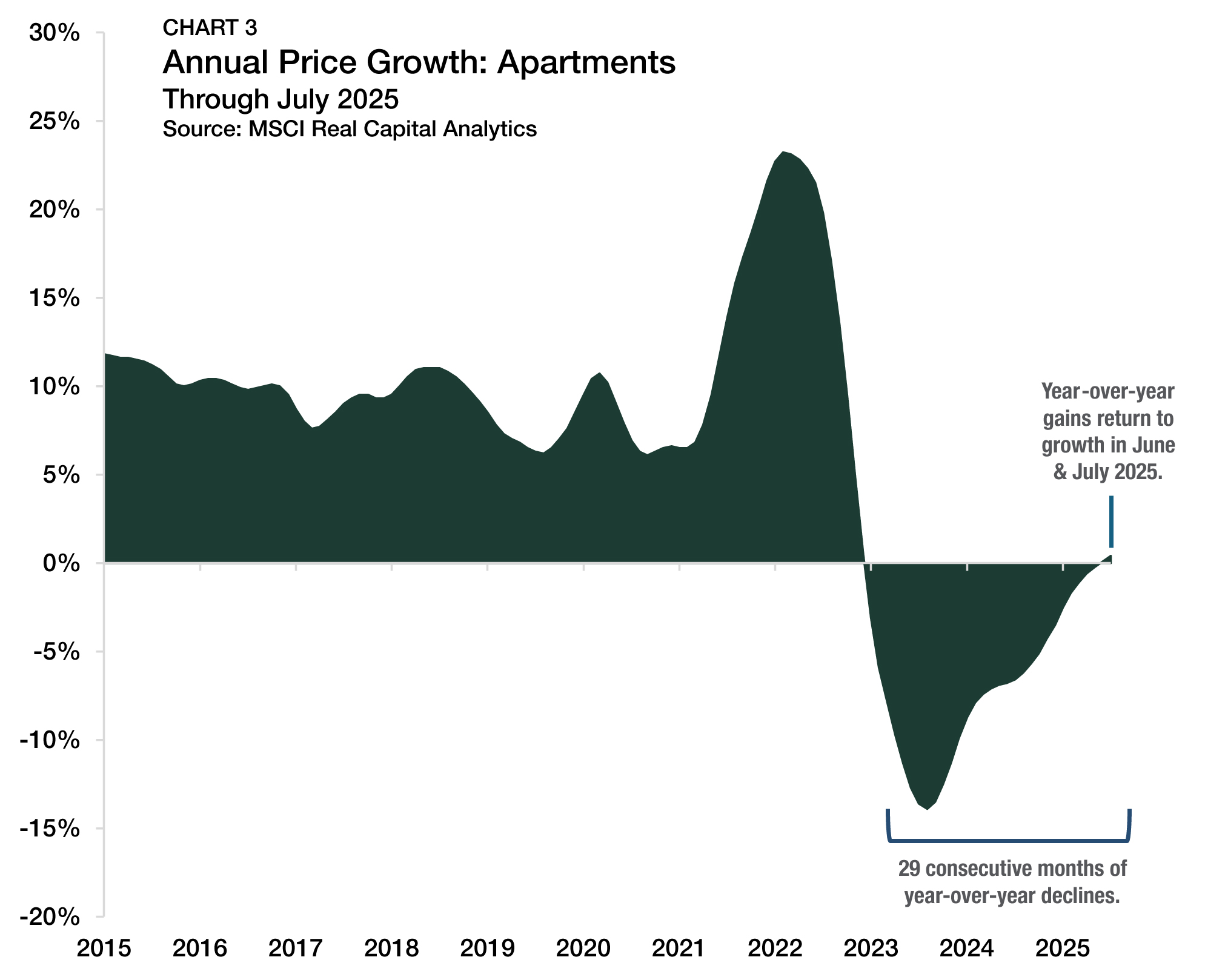
This more optimistic outlook has arrived after a period of setbacks. After prices soared in 2021 and 2022, prior to the Federal Reserve’s monetary tightening cycle, a correction followed with declines in multifamily valuations in 2023 and 2024. According to MSCI Real Capital Analytics, apartment valuations fell by about 19% between 2022 and spring 2025. Accounting for the impact of inflation, the valuation drop-off was even more severe, exceeding 26%.2 However, prices have swung back this year. In June 2025, annual price gains moved into positive territory for the first time in 29 months (Chart 3).

2 Based on a Chandan Economics analysis of MSCI Real Capital Analytics Commercial Property Price Index for Apartments. Inflation adjustments are calculated using the Consumer Price Index for All Urban Consumers.

One of the most significant factors contributing to the pricing turnaround is that oversupply, a primary headwind for multifamily, has become less acute. Looking back a year ago, the pace of multifamily completions was nearly twice what it is today. In August 2024, the annual pace hit a peak of 2.0 multifamily completions for every 1,000 U.S. residents. As of July 2025, that was down to just 1.1 — almost directly in line with the 2015–2019 average (Chart 4).

As noted in Yardi Matrix’s latest multifamily report, a moderating construction pipeline has allowed absorption to keep pace with new inventory. As the supply overhang recedes, that stabilization should continue to pass through into rents. According to a Chandan Economics analysis of the Zillow Observed Rent Index, 70% of the multifamily markets in the U.S. experienced monthly rent increases in August.

The firming of capital markets and financing conditions has also proved supportive of the multifamily sector’s rebound. The Federal Reserve’s Senior Loan Officer Opinion Survey showed the net share of banks tightening multifamily standards eased toward zero in 2025, signaling an underwriting normalization. Moreover, investor sentiment echoed a positive shift. The Real Estate Roundtable’s Q3 2025 Sentiment Survey reported firmer expectations for the year ahead. A positive net share of respondents expect that general market conditions will improve, commercial property prices will rise, and debt and equity capital will become more available over the next year, pointing to healthier, more stable fundamentals (Chart 5).

Recent Federal policy shifts should also provide tailwinds for multifamily. The One Big Beautiful Bill Act created several new incentives that encourage multifamily investments. Among the most impactful is the restoration of 100% bonus depreciation, which supercharges the tax benefits of purchasing investment property. Additionally, the law made permanent the Opportunity Zone Program and meaningfully expanded the 9% Low-Income Housing Tax Credit. Altogether, these changes provide a modest lift to after-tax returns and create a wider set of deals that pencil, which is a boon for new deal activity.

The Road Ahead

Barring unforeseen developments, the base case is for a steadier, broader multifamily recovery through the end of 2025 and into 2026. As tariff policy, the strength of the labor market, and consumer spending remain open questions, ambiguity will persist. As the national inventory pipeline continues to rebalance, absorption has been keeping pace, resulting in widespread monthly rent gains.

On the capital side, conditions have shifted to neutral. Underwriting standards have reset and interest rate spreads have cooled, making the cost of capital more predictable and price discovery easier. Simultaneously, investor confidence is building, as higher shares of executives expect improved capital availability and positive pricing pressures in the year ahead. Together, these dynamics should support a continued thaw in transaction activity as buyers and sellers meet on narrower bid–ask spreads.

On net, deal flow should see momentum over the medium-term. With pricing and financing fundamentals stabilizing and policy tailwinds modestly improving after-tax returns, the multifamily sector is once again ripe with opportunity.

For more research and insights, visit arbor.com/articles

About Arbor
Arbor Realty Trust, Inc. (NYSE: ABR) is a nationwide real estate investment trust and direct lender, providing loan origination and servicing for multifamily, single-family rental (SFR) portfolios, and other diverse commercial real estate assets. Headquartered in Uniondale, New York, Arbor manages a multibillion-dollar servicing portfolio, specializing in government-sponsored enterprise products. Arbor is a leading Fannie Mae DUS® lender, Freddie Mac Optigo® Seller/Servicer, and an approved FHA Multifamily Accelerated Processing (MAP) lender. Arbor’s product platform also includes bridge, CMBS, mezzanine, and preferred equity loans. Arbor is rated by Standard and Poor’s and Fitch. In June 2023, Arbor was added to the S&P SmallCap 600® index. Arbor is committed to building on its reputation for service, quality, and customized solutions with an unparalleled dedication to providing our clients excellence over the entire life of a loan.

Disclaimer
This report is intended for general guidance and information purposes only. This report is under no circumstances intended to be used or considered as financial or investment advice, a recommendation or an offer to sell, or a solicitation of any offer to buy any securities or other form of financial asset. Please note that this is not an offer document. The report is not to be considered as investment research or an objective or independent explanation of the matters contained herein and is not prepared in accordance with the regulation regarding investment analysis. The material in the report is obtained from various sources per dating of the report. We have taken reasonable care to ensure that, and to the best of our knowledge, material information contained herein is in accordance with the facts and contains no omission likely to affect its understanding. That said, all content is provided herein “as is” and neither Arbor Realty Trust, Inc. or Chandan Economics, LLC (“the Companies”) nor their affiliated or related entities, nor any person involved in the creation, production and distribution of the content make any warranties, express or implied. The Companies do not make any representations or warranties, express or implied, as to the reliability, usefulness, completeness, accuracy, currency nor represent that use of any information provided herein would not infringe on other third-party rights. The Companies shall not be liable for any direct, indirect or consequential damages to the reader or a third party arising from the use of the information contained herein. There may have been changes in matters which affect the content contained herein and/or the Companies subsequent to the date of this report. Neither the issue nor delivery of this report shall under any circumstance create any implication that the information contained herein is correct as of any time subsequent to the date hereof or that the affairs of the Companies have not since changed. The Companies do not intend, and do not assume any obligation to update or correct the information included in this report. The contents of this report are not to be construed as legal, business, investment or tax advice. Each recipient should consult with its legal, business, investment and tax advisors as to legal, business, investment and tax advice. The information contained herein may be subject to changes without prior notice. This report is only intended for the recipients, and should not be copied or otherwise distributed, in whole or in part, to any other person.