Articles

Why Top Multifamily Lenders Practice Disciplined Underwriting

Every multifamily lender says it underwrites conservatively, but few follow a truly disciplined approach. Arbor Realty Trust’s own record is a case in point, with 19 consecutive years in the Top 10 Fannie Mae Multifamily DUS Lenders, a top-three ranking in Freddie Mac’s Conventional Small program, and an upgraded Commercial Special Servicer rating from Fitch Ratings in January 2026.

Investment

Special Report Fall 2026

Arbor Realty Trust’s Special Report Fall 2026, developed in partnership with Chandan Economics, leverages data-driven research to detail the state of the rental housing market. Amid headwinds, multifamily remained resilient in a selective investment environment favoring disciplined underwriting and market selection. Attractive entry points for well-positioned investors continue to populate the road ahead.

Analysis

U.S. Multifamily Market Snapshot — September 2026

The U.S. multifamily market remains on stable footing in a mixed macroeconomic climate. Rent growth continued to trend upward through the second quarter, while apartment fundamentals remained resilient amid slowing employment growth and elevated vacancies.

Current Reports

Single-Family Rental Investment Trends Report Q3 2026

Arbor’s latest Single-Family Rental Investment Trends Report highlights how this commercial real estate sector performed resiliently in the face of adversity last quarter. Even as policy uncertainty created new headwinds, firm operating fundamentals drove SFR forward.

Articles

Build-to-Rent Activity Remained Elevated Amid Policy Uncertainty

Build-to-rent (BTR) development remained resilient in a complicated operating environment last quarter as production continued to normalize, according to newly released U.S. Census Bureau data. Despite political uncertainty, higher capital costs, and other headwinds, BTR maintained a historically high share of new single-family construction.

Articles

Where Multifamily Permitting is Intensifying and Accelerating

While national multifamily permitting stabilizes, the authorization of new apartment buildings with five or more units has become more heavily concentrated in smaller, rapidly growing metropolitan areas. From Durham, NC, to Fayetteville, AR, and Raleigh, NC, new U.S. Census Bureau data reveal where multifamily permitting was most concentrated and where it was accelerating fastest in the first half of 2026.

Articles

Small Multifamily Lending Volume Moves Steadily Higher

Small multifamily lending activity rose during the first half of 2026. According to the latest Small Multifamily Investment Trends Report from Arbor Realty Trust and Chandan Economics, originations on loans with original balances between $1 million and $9 million reached an annualized pace of $71.6 billion through the second quarter. At this pace, originations are running 2.8% above the $69.6 billion total for 2025, placing small multifamily on pace for a third consecutive annual increase.


General: 800.ARBOR.10


The State of Rental Housing

Multifamily Advances Against Rate Pressures

Key Findings

  • Multifamily fundamentals have strengthened as supply pressures receded, rent growth broadened, and occupancy improved.

  • Credit availability continued to normalize, but elevated Treasury yields and historically narrow cap-rate spreads remained constraints on apartment valuations.

  • A valuation reset has improved entry pricing for long-term investors, while elevated capital costs continue to reward selective market and asset underwriting.

The Outlook

After several years of adjustment, the rental housing market entered the final stretch of 2026 with a clearer divide between improving property fundamentals and capital markets still adjusting to an elevated interest rate environment.

Improvements in absorption have begun to alleviate pressures from a recent multifamily supply wave; rent and occupancy conditions have been firming across a broader set of markets; and lending conditions have normalized considerably. At the same time, apartment valuations have come under renewed pressure as long-term rates remain elevated.

The broader economic backdrop remained resilient but has shifted to a slower growth trajectory. Hiring has cooled, labor force growth has moderated, and household spending continues to support economic activity. Taken together, the economy has lost some momentum, but there aren’t clear signs of a broad contraction.

Interest rate headwinds have become more persistent. The Federal Reserve’s September quarter-point rate hike reinforced expectations that short-term rates will remain elevated, while long-term Treasury yields have also remained high amid persistent inflation and concerns about the national fiscal outlook. For multifamily, elevated benchmark rates continue to weigh on financing economics and asset valuations, even as lenders have become more inclined to extend credit.

These crosscurrents have created a more selective investment environment. Right now, historically narrow yield spreads and elevated capital costs continue to favor disciplined underwriting and market selection. At the same time, improvements in the supply/demand balance continue to support operating fundamentals as valuations reset from recent peaks, creating new sets of attractive entry points for well-positioned investors.

Labor Market Dynamics Shift with Demographics and Technology

The U.S. labor market picture remains consistent with a maturing cycle with a slower pace of growth than during its post-pandemic expansion.

Hiring has moderated, and wage gains have cooled, as average hourly earnings growth has not kept pace with inflation. Labor force participation has also trended lower, cutting into the nation’s available labor supply. The economy has been generating fewer jobs than earlier in the cycle, but the distinction between weaker labor demand and more limited labor supply has become increasingly important.

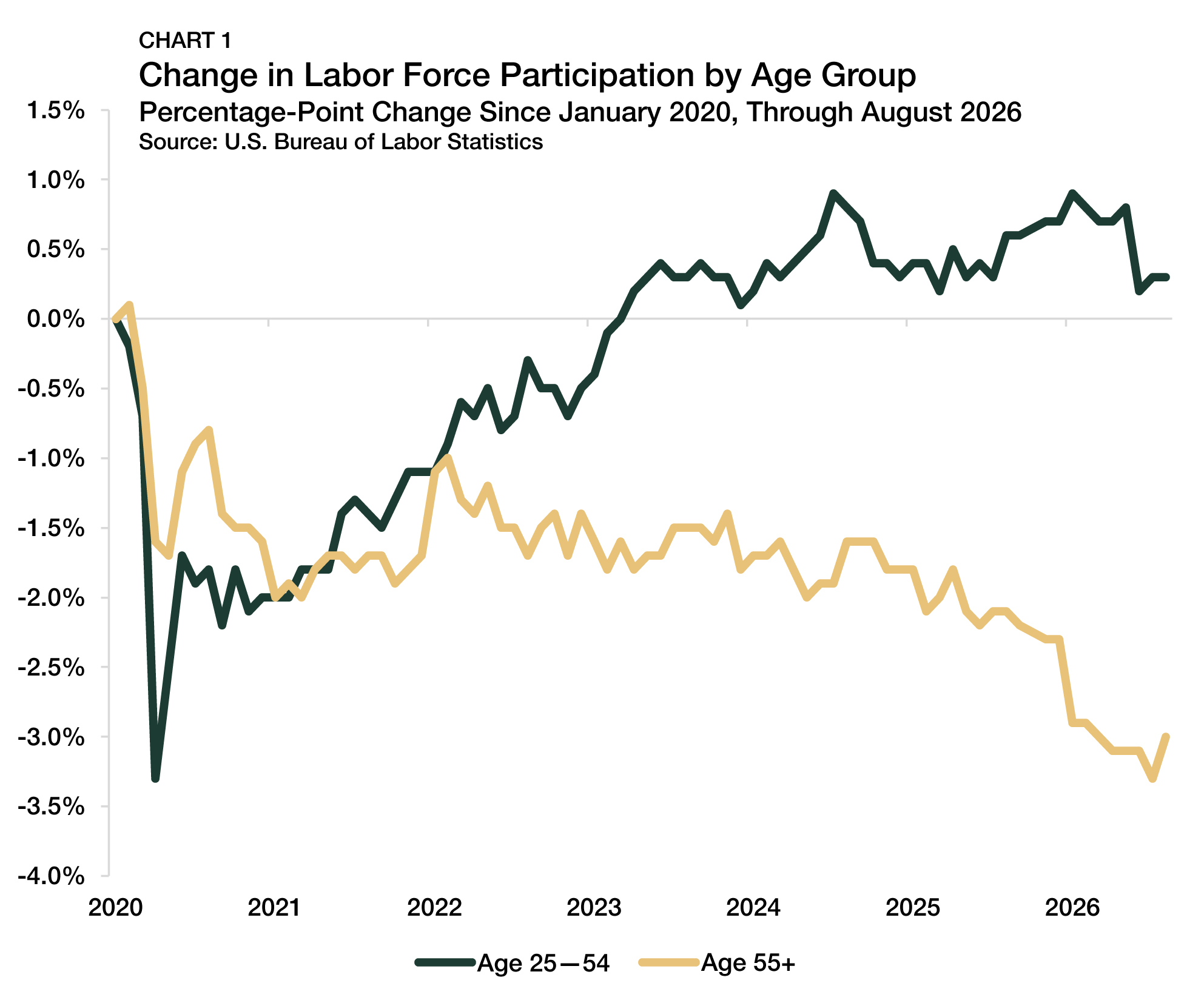
Demographics are a growing part of that distinction. Prime working-age (25-54) labor force participation has fully recovered from the pandemic shock and remains slightly above its pre-pandemic level, while Americans age 55 and older have been participating at a rate about three percentage points lower (Chart 1).

Recent employment reports tell a similar story. Native-born employment was roughly flat to slightly negative year over year, while the number of seniors outside the labor force continued to rise. At the same time, foreign-born employment, an important source of labor force growth earlier in the expansion, slowed sharply alongside the pullback in net international migration. Together, aging and reduced immigration have been increasingly limiting the economy’s capacity to add workers.

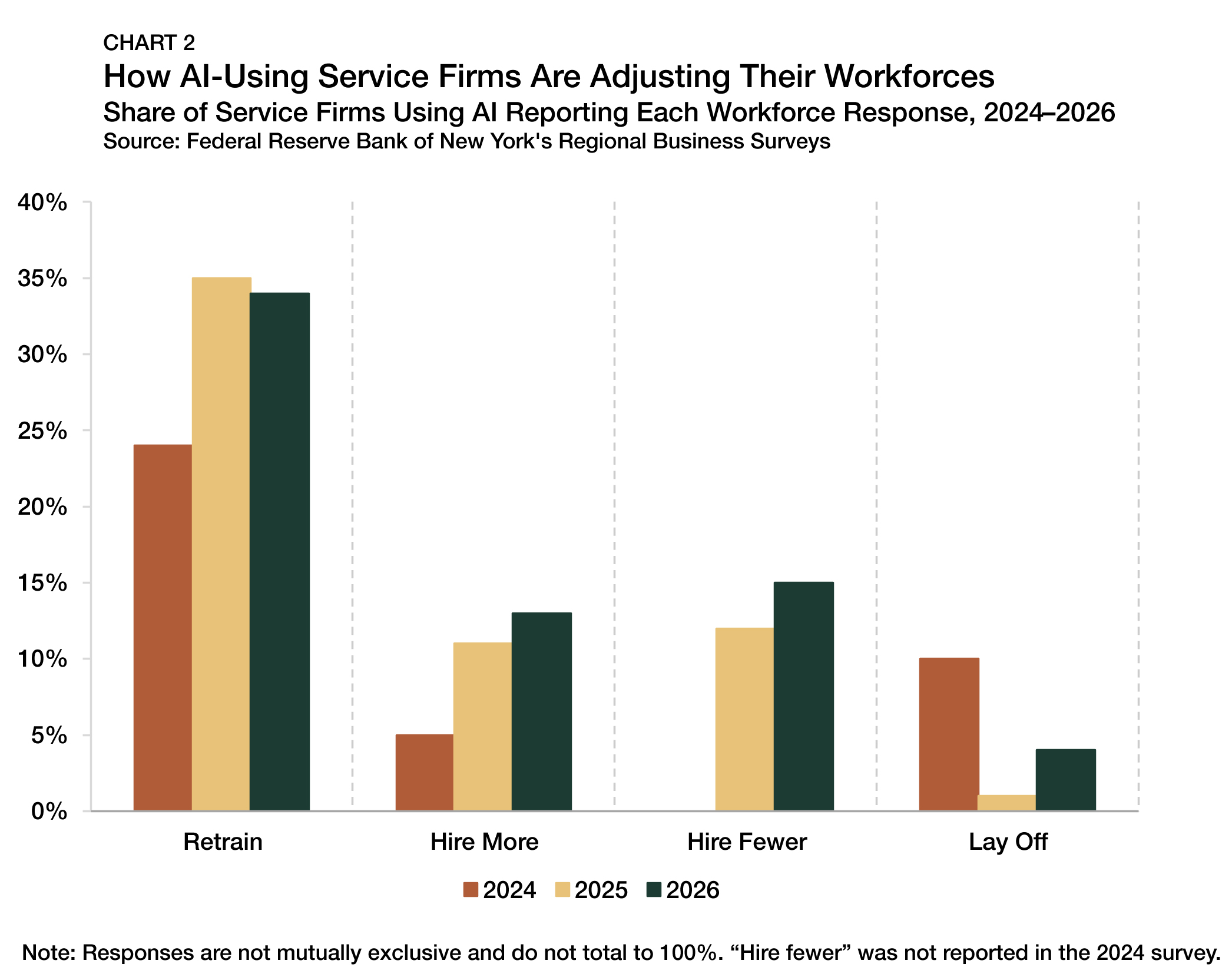
Artificial intelligence introduces another source of uncertainty, although its near-term labor market effects have so far been more modest than some displacement concerns imply. In the Federal Reserve Bank of New York’s latest Regional Business Surveys, 34% of service firms using AI reported retraining workers, compared with 15% hiring fewer workers, 13% hiring more, and just 4% reporting AI-related layoffs (Chart 2). The findings do not resolve longer-term displacement concerns, but they suggest that workforce adaptation remains substantially more common than outright job elimination.

Meanwhile, consumer spending has remained an important source of economic resilience. Inflation-adjusted consumption continues to grow, but the personal saving rate has fallen to roughly half the level typical of the 2010s. Households have therefore sustained spending while retaining a smaller share of disposable income, leaving less room in their budgets to maintain consumption by reducing saving further if income or employment conditions weaken.

Altogether, the macroeconomic picture has remained one of slow growth rather than broad retrenchment. Labor force expansion has been increasingly constrained by aging and reduced immigration, while available evidence has yet to show widespread AI-driven displacement and consumers are still spending. For the rental housing market, the backdrop remains broadly supportive of demand, even as elevated interest rates continue to weigh on the capital markets side of the multifamily recovery.

Multifamily Fundamentals Strengthen as Capital Markets Normalize

Multifamily fundamentals continued to improve as the sector moved beyond the recent supply surge. The market has absorbed new supply more effectively, while delivery volume has begun moderating.

Data from the Federal Reserve Bank of Atlanta’s Commercial Real Estate Market Index showed that 50.1% of multifamily markets had improved absorption in the second quarter, the highest share since late 2024 and the second consecutive quarterly increase. National Multifamily Housing Council’s Market Tightness Index also moved above neutral, reinforcing the view that the national market is moving toward balance.

Rent trends provided some of the clearest evidence that conditions are firming. Annual multifamily rent growth reached 1.8% in July, extending a four-month acceleration. More importantly, roughly three-quarters of metros recorded monthly rent gains and nearly 90% posted year-over-year increases.

Occupancy conditions have also begun to improve at the margin, with Apartment List’s national vacancy measure easing from its recent peak earlier in the year. The recovery, however, remains uneven, with supply-constrained markets generally outperforming metros still absorbing high amounts of recent deliveries.

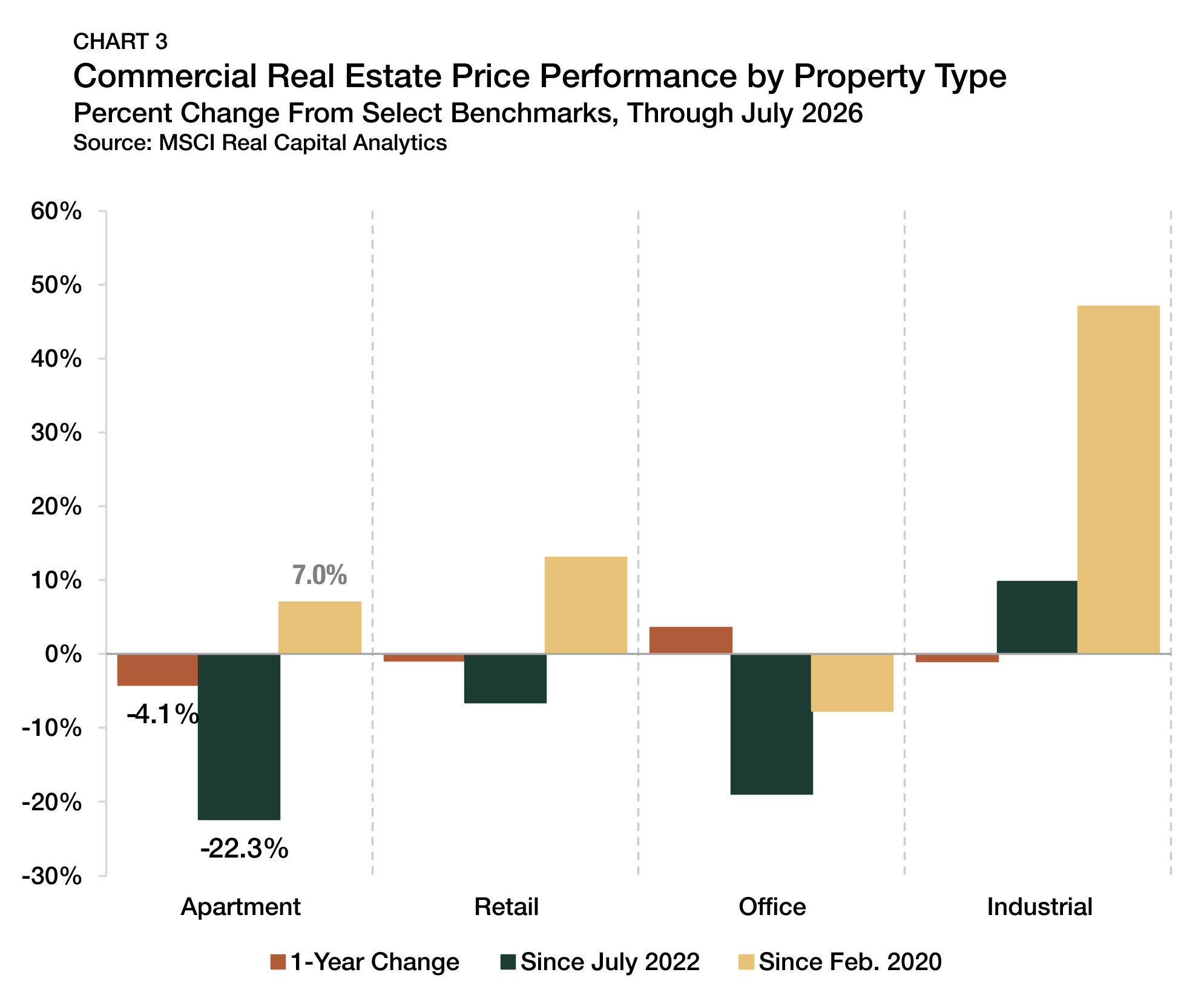
Asset pricing, however, continued to lag the improvement seen in operating fundamentals. Apartment values were 22.3% below their July 2022 level, a larger correction than office, retail, or industrial over the same period, while still standing 7.0% above February 2020 levels (Chart 3).

This contrast points to a substantial cyclical repricing, rather than the structural impairment felt in parts of the office sector. Recent softness has kept apartment valuations from fully participating in the operating recovery. However, the depth of the reset has given apartments a more attractive entry point for long-term capital.

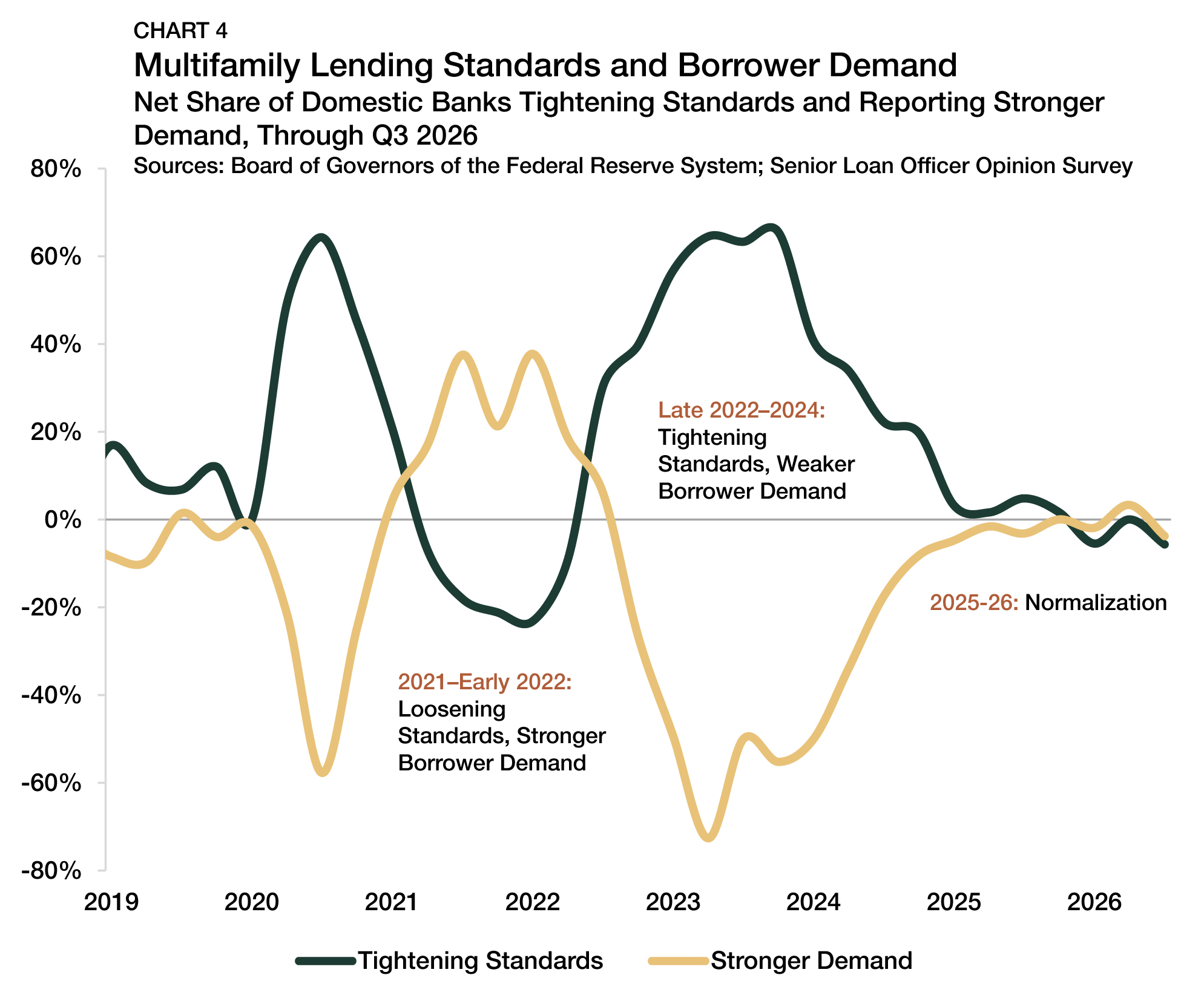
Credit conditions also moved closer to balance. The Federal Reserve’s Senior Loan Officer Opinion Survey shows that multifamily lending standards and borrower demand converged toward neutral after several years of unusually large swings (Chart 4). The latest readings indicate a modest net easing in standards and slightly weaker demand, but the broader signal is of deepening normalization, consistent with a market where lender competition is intensifying as borrowers remain selective.

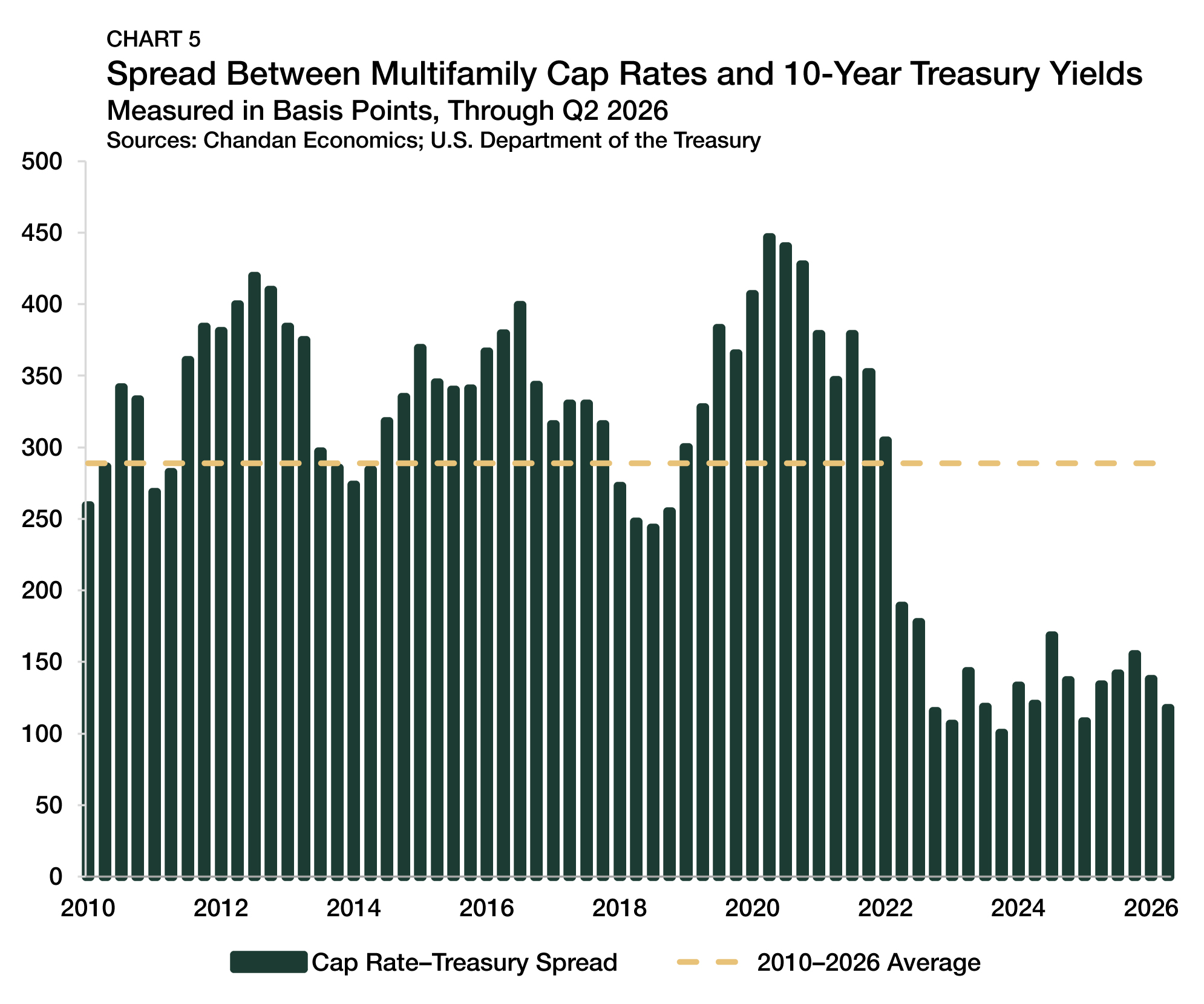
Today’s interest rate environment helps explain why improving credit availability has not translated into a stronger valuation recovery. The spread between multifamily cap rates and the 10-year Treasury yield measured about 118 basis points in the second quarter, compared with an average of roughly 290 basis points since 2010 (Chart 5).

Multifamily cap rates have adjusted higher since the tightening cycle began, but Treasury yields have remained elevated enough to keep the relative investment premium historically narrow. As a result, limited room is left for meaningful cap rate compression without more favorable long-term interest rates.

Property cash flow remains another important consideration. Operating expense growth has moderated, but costs continue to limit how quickly improving rents and occupancy translate into stronger net operating income (NOI).

At the same time, technology is creating additional avenues for efficiency. Recent industry research from NAA, NMHC, and RETTC points to growing AI use across customer service, maintenance, document processing, forecasting, and administrative functions. Buildium’s 2026 research found that AI adoption among surveyed property management companies rose from 20% to 58%. These tools will not eliminate broader expense pressures, but they can help operators streamline workflows, contain costs, and support margins over time.

Taken together, multifamily has moved further into recovery at the property level while capital markets have become more stable. The combination has broadened the opportunity set, though transaction economics remain selective.

The Road Ahead

Looking ahead, normalizing deliveries should provide a more supportive backdrop for multifamily operations. As the development pipeline moderates, broader rent growth and easing vacancy pressures suggest the market is moving toward a healthier balance. While slower population and labor force growth may temper the pace of demand expansion, current conditions increasingly favor continued normalization of sector fundamentals.

On the capital markets side, the pace of improvement will remain sensitive to the interest rate environment. Lending conditions have normalized and competition among capital providers has increased, but historically narrow cap rate spreads continue to limit the potential for rapid valuation appreciation. Apartment pricing has also remained substantially below its 2022 peak even as property fundamentals improved, creating a more compelling basis for targeted investment.

The next phase of the cycle need not depend on a return to unusually low financing costs or outsized rent growth. Instead, improving operations, greater credit availability, and reset valuations will favor disciplined investors who can identify multifamily markets and assets where fundamentals are strengthening fastest.

For more research and insights, visit arbor.com/research

About Arbor
Arbor Realty Trust, Inc. (NYSE: ABR) is a nationwide real estate investment trust and direct lender, providing loan origination and servicing for multifamily, single-family rental (SFR) portfolios, and other diverse commercial real estate assets. Headquartered in Uniondale, New York, Arbor manages a multibillion-dollar servicing portfolio, specializing in government-sponsored enterprise products. Arbor is a leading Fannie Mae DUS® lender, Freddie Mac Optigo® Seller/Servicer, and an approved FHA Multifamily Accelerated Processing (MAP) lender. Arbor’s product platform also includes bridge, CMBS, mezzanine, and preferred equity loans. Arbor is rated by Standard and Poor’s and Fitch. In June 2023, Arbor was added to the S&P SmallCap 600® index. Arbor is committed to building on its reputation for service, quality, and customized solutions with an unparalleled dedication to providing our clients excellence over the entire life of a loan.

Disclaimer
This report is intended for general guidance and information purposes only. This report is under no circumstances intended to be used or considered as financial or investment advice, a recommendation or an offer to sell, or a solicitation of any offer to buy any securities or other form of financial asset. Please note that this is not an offer document. The report is not to be considered as investment research or an objective or independent explanation of the matters contained herein and is not prepared in accordance with the regulation regarding investment analysis. The material in the report is obtained from various sources per dating of the report. We have taken reasonable care to ensure that, and to the best of our knowledge, material information contained herein is in accordance with the facts and contains no omission likely to affect its understanding. That said, all content is provided herein “as is” and neither Arbor Realty Trust, Inc. or Chandan Economics, LLC (“the Companies”) nor their affiliated or related entities, nor any person involved in the creation, production and distribution of the content make any warranties, express or implied. The Companies do not make any representations or warranties, express or implied, as to the reliability, usefulness, completeness, accuracy, currency nor represent that use of any information provided herein would not infringe on other third-party rights. The Companies shall not be liable for any direct, indirect or consequential damages to the reader or a third party arising from the use of the information contained herein. There may have been changes in matters which affect the content contained herein and/or the Companies subsequent to the date of this report. Neither the issue nor delivery of this report shall under any circumstance create any implication that the information contained herein is correct as of any time subsequent to the date hereof or that the affairs of the Companies have not since changed. The Companies do not intend, and do not assume any obligation to update or correct the information included in this report. The contents of this report are not to be construed as legal, business, investment or tax advice. Each recipient should consult with its legal, business, investment and tax advisors as to legal, business, investment and tax advice. The information contained herein may be subject to changes without prior notice. This report is only intended for the recipients, and should not be copied or otherwise distributed, in whole or in part, to any other person.