

Top Markets for Gen Z Household Formation Potential

- As domestic migration normalizes, young adults who live at home could become an important source of rental demand.
- Gen Z’s household formation potential could have an outsized impact on rental demand as post-pandemic migration trends normalize and new supply continues to pressure some formerly high-growth markets.
- Markets in California and Texas were heavily represented at the top of the rankings, with Stockton, CA; Fresno, CA; El Paso, TX; and Bakersfield, CA, all in the top five.
Generation Z’s potential for household formation could soon reshape many U.S. metropolitan areas. From McAllen, TX, to Hartford, CT, explore the top multifamily markets where rental demand is set to rise as Gen Z leaves the nest.
Where Gen Z Household Formation Potential Is Highest
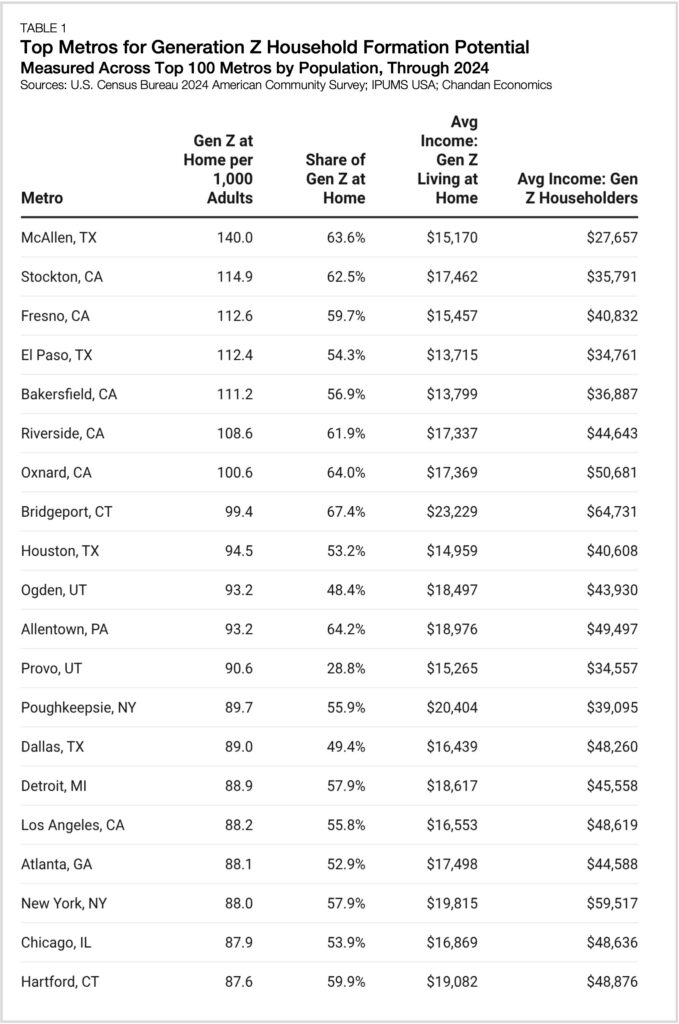
Using data from the U.S. Census Bureau’s 2024 American Community Survey (ACS), this analysis ranks the 100 largest ACS-identifiable U.S. metropolitan areas by the number of adults ages 18 to 27 living at home per 1,000 adults. McAllen, TX, leads all large U.S. metros in the concentration of Generation Z adults living at home. For every 1,000 adults in the metro, roughly 140 Gen Z adults live in a parent’s home. For investors, markets like McAllen help illustrate where a large pool of delayed household formations could support future rental demand.
While the average Gen Z adult living at home in McAllen earned $15,170 in 2024, the transition into independent household formation in the area remained relatively accessible compared to other large metros. In McAllen, the most affordable of the nation’s top 100 largest metros by population, the average Gen Z householder earned $27,657.
Stockton, CA; Fresno, CA; El Paso, TX; and Bakersfield, CA, followed close behind, each with more than 110 adults in the cohort living at home per 1,000 adults. Stockton ranks second at 114.9, followed by Fresno at 112.6, El Paso at 112.4, and Bakersfield at 111.2.
While several smaller California and Texas metros ranked near the very top, large gateway and legacy markets such as New York, Los Angeles, Chicago, Atlanta, and Detroit also appeared in the top 20. The strong performance of small markets suggests that the elevated rates of Gen Z adults living at home are shaped by multiple forces, including housing affordability, local age structures, family-based living arrangements, and the ability of young adults to remain rooted locally while delaying independent household formation.
A Local Demand Pipeline for Rental Housing
Not all Gen Z adults living at home are immediate renters. However, as they age, more of them become potential renters, which could support demand for a long time to come.
Among markets with the highest concentration of adults in Gen Z who live at home, rent growth remains consistently positive (Chart 1). By contrast, markets with lower concentrations show a much wider range of outcomes, from strong growth in Urban Honolulu, HI (+6.4%), to outright decline in North Port, FL (-5.7%).
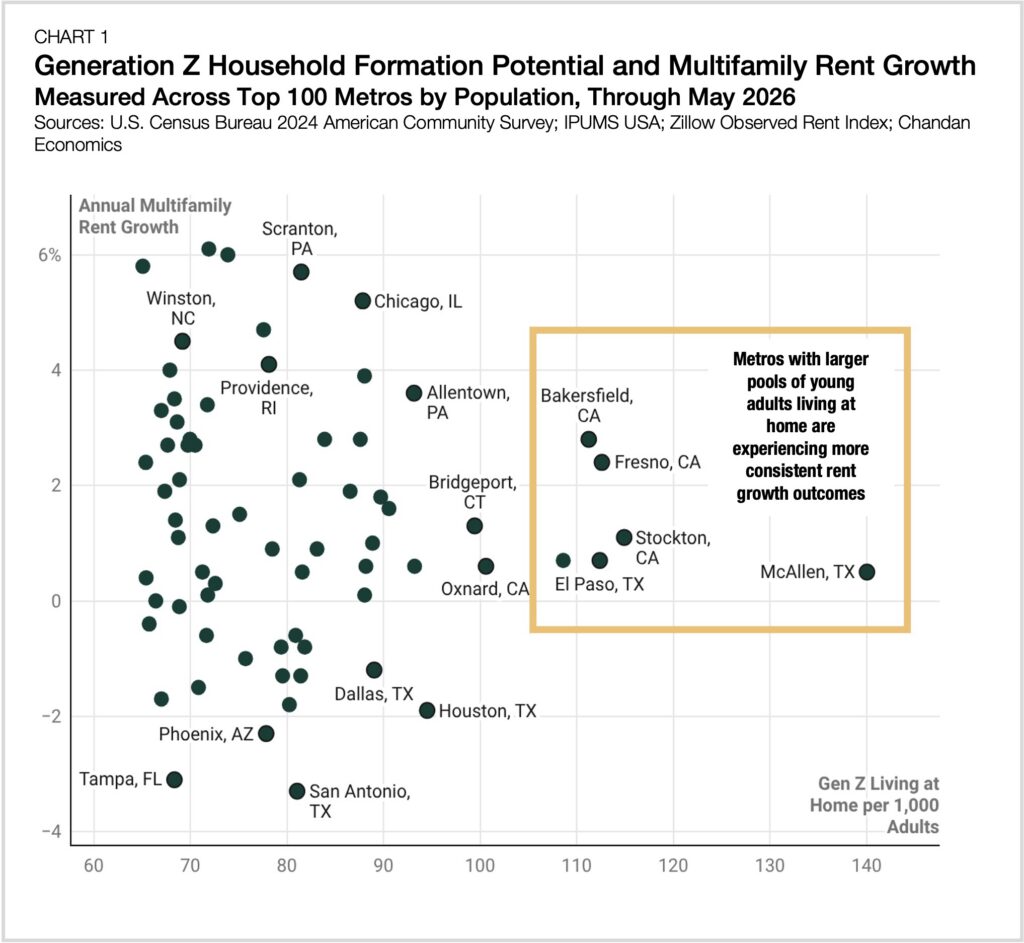
The disparity in multifamily rent growth suggests that rental markets can achieve demand growth through different channels, but locally generated demand can serve as a powerful, and often underappreciated, stabilizer. Gen Z’s household formation potential may become more important as post-pandemic migration trends normalize and new supply continues to pressure some formerly high-growth markets.
McAllen and El Paso illustrate this dynamic. Annual rent growth sat below 1% in both metros, making them modest underperformers compared with the national market. However, the two are outliers within Texas. McAllen and El Paso are the only top 100 metros in the state to post positive rent growth over the past year. A larger pool of local young adults still living at home may be ready to support rental demand as migration-driven momentum cools elsewhere.
The Bottom Line
Gen Z household formation potential provides another lens for evaluating future rental demand. The markets with the deepest pools of young adults living at home may not always have the fastest rent growth today, but they may have a stronger local demand base supporting future renter household growth. For rental housing investors, understanding a market’s ability to generate new households locally can help assess both future demand upside and downside protection.
Interested in the multifamily real estate investment market? Contact Arbor today to learn about our array of multifamily, single-family rental, and affordable housing financing options or view our multifamily articles and research reports.