

SFR Rent Growth Accelerated and Expanded in First Half of 2026
- Single-family rental (SFR) rent growth accelerated in the Northeast and Midwest, home to eight of 10 leading markets in the first half of 2026.
- Buffalo, NY, outpaced all 50 largest U.S. metropolitan areas, posting 3.6% rent growth.
- In June, 456 of the 602 tracked markets had monthly rent increases, the highest level of 2026.
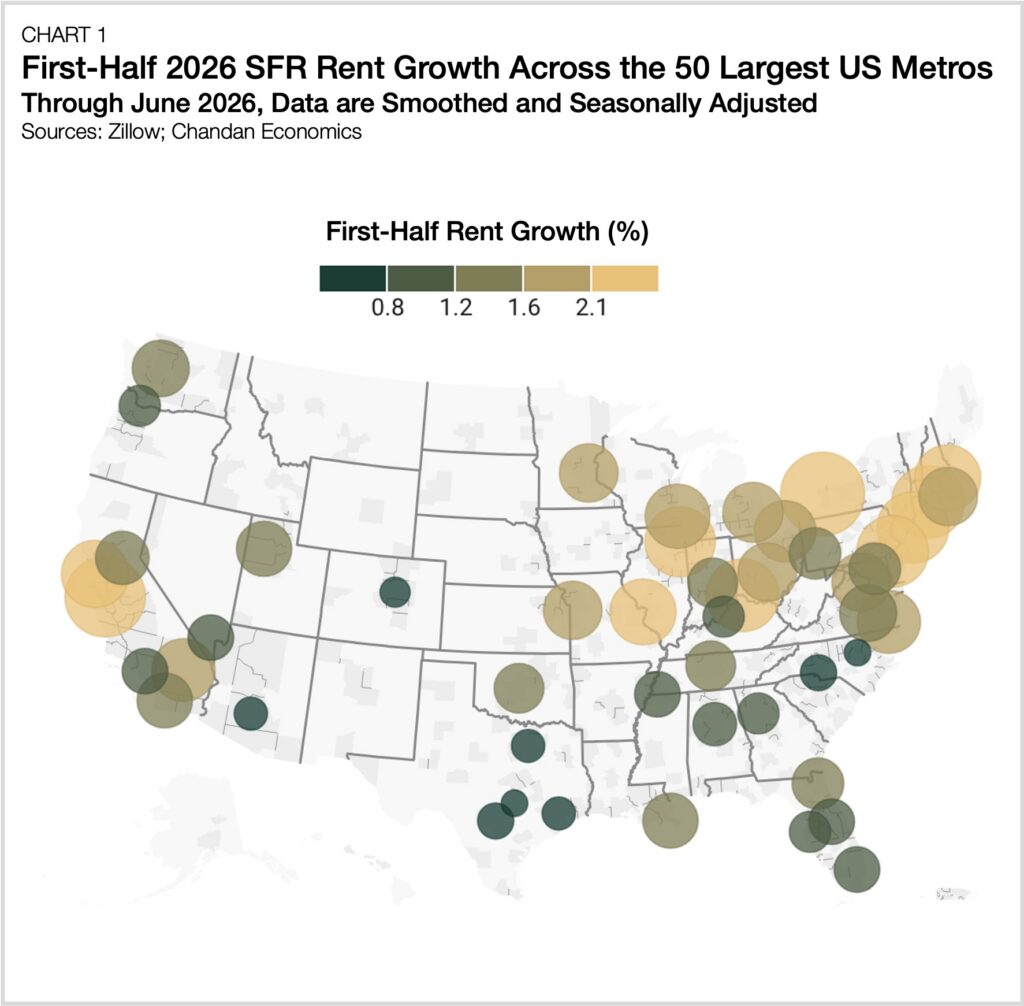
Single-family rental (SFR) conditions strengthened during the first half of 2026, with rents rising across all 50 of the nation’s largest metros between December 2025 and June 2026. Growth was broad-based but uneven, with many Northeast and Midwest markets outperforming major Sun Belt metros (Chart 1).
Top Markets for SFR Rent Growth
For this analysis, the research teams at Chandan Economics and Arbor Realty Trust used Zillow’s Observed Rent Index for single-family properties to determine SFR rent growth during the first half of 2026.
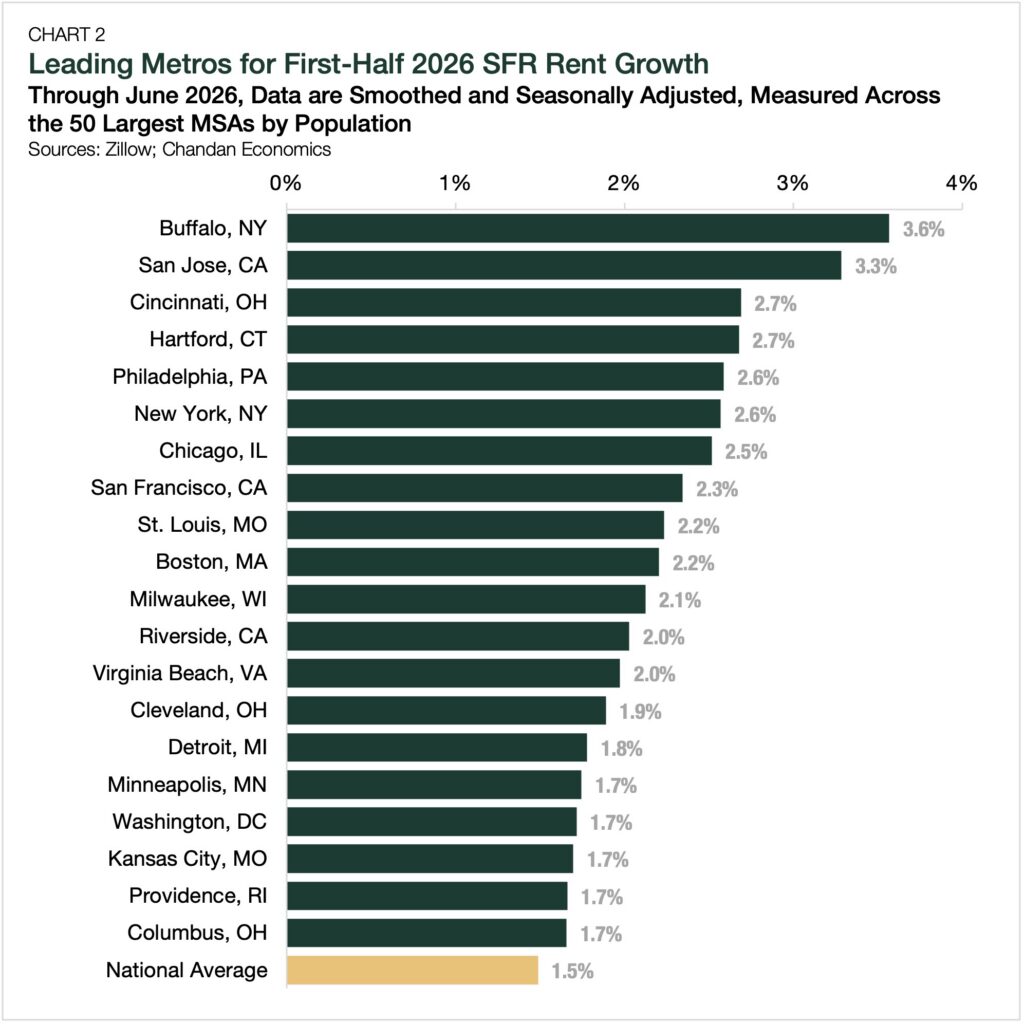
Buffalo, NY, had the fastest SFR rent growth during this period, with rents increasing 3.6%. San Jose, CA, ranked second, recording 3.3% (Chart 2).
However, these two markets reached the top of the rankings from very different starting points.
Buffalo’s performance was consistent with the broader strength observed across many relatively affordable markets in the Northeast and Midwest.
San Jose, by contrast, is the most expensive SFR market among the 50 largest metros, with the average single-family home renting for $4,794 per month. Regardless of local economic conditions, it had the second-highest level of rent growth in the first half of 2026.
Cincinnati, OH, and Hartford, CT, tied for third, with rents increasing 2.7%. New York, NY, and Philadelphia, PA, followed at 2.6%, while Chicago, IL, recorded a 2.5% increase. In total, eight of the 10 fastest-growing large metros are in the Northeast or Midwest.
San Francisco, CA, also ranked among the leading markets, with rents rising 2.3%. With San Jose and San Francisco in the top 10, Northern California has become a notable exception to broader regional patterns.
By contrast, in several major Sun Belt markets rent gains were substantially weaker. Austin, TX, and Raleigh, NC, had the lowest growth rates, at 0.3%, followed by Denver, CO, at 0.4%. Dallas, TX, Houston, TX, and Phoenix, AZ, each saw 0.5% rent growth.
While metro-level rent gains remained uneven, SFR rent growth remained positive during the first half of 2026.
Rent Growth Spreads Across More SFR Markets
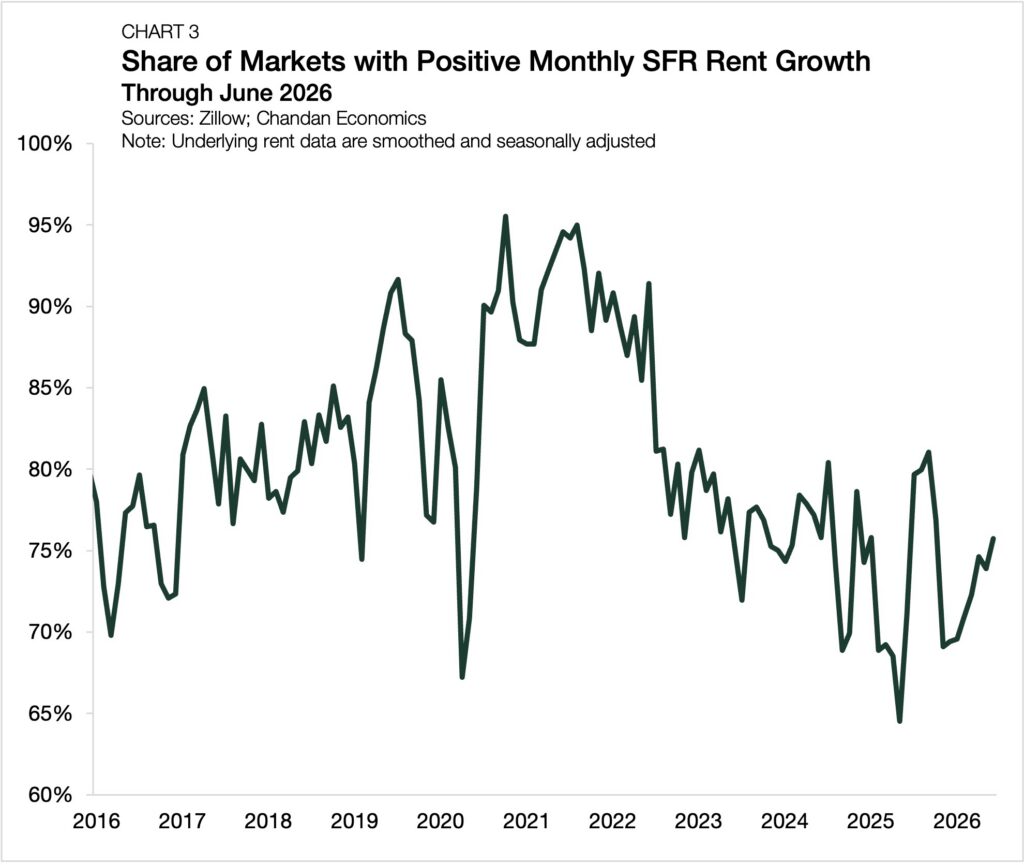
The national trend in SFR rents extended well beyond the leading large metros. In June, 456 of the 602 tracked markets had monthly rent increases, lifting the share with rising rents to 75.7%, the highest level of 2026 (Chart 3).
In the past year, SFR rent growth has strengthened and become considerably more widespread.
June’s reading of tracked markets with monthly rent increases was 11.2 percentage points above a recent low of 64.5% in May 2025. It was also up from 69.4% in December, indicating that positive momentum became more widely distributed during the first half of 2026.
SFR rent growth patterns have continued to differ from pre-pandemic norms. The share of markets with rising rents averaged 80.3% from 2016 through 2019, roughly 4.6 percentage points above the June 2026 reading, as the market normalized toward its pre-pandemic baseline.
The Bottom Line
The SFR market gained momentum during the first half of 2026, with growth extending from the high-cost markets of Silicon Valley to more affordable metros across the Midwest and Northeast. As momentum improves, the SFR sector is also becoming increasingly differentiated, making local rent trends, supply conditions, and property economics more important to investment decisions.
Interested in the multifamily real estate investment market? Contact Arbor today to learn about our array of multifamily, single-family rental, and affordable housing financing options or view our multifamily articles and research reports.